军贸出口

Search documents
英大证券晨会纪要-20260325
British Securities· 2026-03-25 02:52
Market Overview - The current macro liquidity in the domestic market remains positive, providing strong support for the market [4][8] - Geopolitical conflicts are significant factors causing market adjustments, but historically, such impacts do not alter the long-term market direction [4][8] - The A-share market experienced a rebound, with major indices rising over 1%, and over 5100 stocks closing in the green [4][5][10] Trading Volume and Market Sentiment - The trading volume in the two markets decreased significantly compared to the previous day, indicating a potential weakness in the recovery process [4][9] - The performance of the indices in the short term will continue to be influenced by external events, particularly geopolitical developments [9][10] - Investors are advised to focus on changes in trading volume, rotation of market hotspots, and the adjustment structure of quality stocks rather than short-term index fluctuations [2][9] Sector Performance - The power sector showed strong performance, driven by the government's emphasis on "collaborative computing and electricity" as part of national strategic deployment, which is expected to boost infrastructure investment and demand in the power industry [6] - The military industry, particularly ground equipment stocks, also performed well due to geopolitical tensions and the increasing importance of self-sufficiency in defense technology [7] - Key sectors that saw significant gains include electric power, environmental protection, medical services, and industrial metals, among others [4][5] Future Market Outlook - The report suggests that the current market rebound provides a respite after continuous adjustments, with short-term risks largely alleviated [9][10] - However, the potential for repeated fluctuations remains due to declining trading volume and ongoing external disturbances [9][10] - Investors are encouraged to identify fundamentally supported directions that may emerge from market differentiation as sentiment gradually improves [2][9]
可回收火箭突破、商飞出海提速、船企订单爆发……多重催化剂注入,军工ETF华宝(512810)放量上行!
Xin Lang Ji Jin· 2026-02-12 11:43
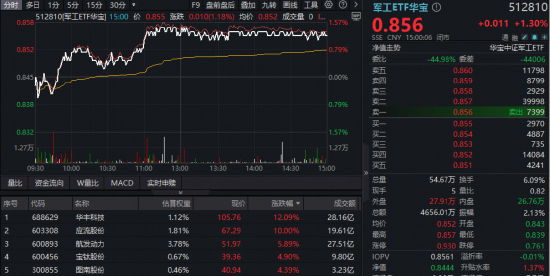
Core Viewpoint - The military industry sector shows strong performance with significant gains in key stocks and ETFs, indicating a bullish trend in the market [1][3]. Group 1: Military Industry Performance - The military sector opened lower but rebounded, with the popular military ETF, Huabao (512810), increasing by 1.3%, outperforming the market [1]. - Among the constituent stocks, 58 increased while 22 declined, with Huafeng Technology leading the gains at 12.09%, and Yingliu Co. hitting the daily limit with a new high [1]. - Major stocks such as Aero Engine Corporation of China and China Shipbuilding Industry Corporation rose by 5.89% and 3.06%, respectively [1]. Group 2: Commercial Aerospace Developments - On February 11, the Long March 10 rocket successfully completed its return flight segment, marking a breakthrough in China's reusable rocket technology, which is expected to enhance space transportation capacity [3]. - China Commercial Aircraft Corporation showcased the C909 and C919 at the Singapore Airshow, securing an order for six C909 firefighting aircraft, accelerating the global expansion of domestic large aircraft [3]. Group 3: Shipbuilding Sector Outlook - By 2025, China's shipbuilding industry is projected to see growth in three core indicators: completion volume, new orders, and backlog orders, maintaining its position as the global leader for 16 consecutive years [3]. - The strong momentum is expected to continue into 2026, with several shipbuilding companies already securing significant contracts at the start of the year [3]. Group 4: Defense Budget Insights - Recent years have seen China's defense budget growth maintained at around 7%, with defense spending accounting for less than 1.5% of GDP, indicating substantial room for growth compared to other major military powers [3]. - The structure of defense spending is anticipated to shift towards new domains and qualities, with military trade exports expected to open up larger market opportunities [3]. - The year 2026 marks the beginning of the 14th Five-Year Plan, suggesting that the military industry may enter a phase of rapid development driven by both domestic demand and foreign trade [3]. Group 5: Investment Opportunities - The military ETF Huabao (512810) covers various hot themes such as commercial aerospace, low-altitude economy, large aircraft, satellite navigation, military informationization, and controllable nuclear fusion, serving as an efficient tool for investing in core military assets [3].

军工行业周报(2026.02.02-2026.02.08):我国成功发射一型可重复使用试验航天
Tai Ping Yang Zheng Quan· 2026-02-10 13:35
Investment Rating - The industry is rated positively, with expectations of overall returns exceeding the CSI 300 Index by more than 5% over the next six months [39] Core Insights - China's defense budget has maintained a growth rate of around 7% in recent years, with defense spending accounting for less than 1.5% of GDP, which is below the average of major military powers. There is significant room for growth in defense spending, which is expected to exceed GDP growth by approximately 2 percentage points in the long term. The structure of defense spending is anticipated to shift towards new domains and qualities, with military trade exports likely to open up larger market opportunities. The year 2026 marks the beginning of the "14th Five-Year Plan," suggesting a rapid development phase driven by both domestic demand and foreign trade. It is recommended to focus on high-quality leading companies in areas such as next-generation fighter jets, low-cost munitions, unmanned equipment, low-altitude economy, deep-sea technology, and commercial aerospace, which have favorable competitive landscapes and high technological barriers [4][9] Summary by Sections Industry News - On February 7, China successfully launched a reusable experimental spacecraft using the Long March 2F rocket from the Jiuquan Satellite Launch Center. This spacecraft will conduct technology verification for reusable spacecraft, supporting the peaceful use of space. The Long March 2F is a major rocket used for launching crewed Shenzhou spacecraft and large target vehicles into low Earth orbit. Reusable spacecraft include crewed ships, cargo ships, propulsion vehicles, planetary landers, and space shuttles, capable of rapid atmospheric re-entry and return to Earth, transporting crew and payloads, and performing various tasks in orbit [3][15] Market Performance - In the past week, the CSI 300 Index fell by 2.32%, while the aerospace and defense index decreased by 0.92%. In the monthly performance, the CSI 300 Index dropped by 1.57%, whereas the aerospace and defense index increased by 3.44% [10] Company Tracking - Wan Ze Co., Ltd. announced that a board member plans to reduce their shareholding by up to 93,750 shares within three months starting from March 10, 2026 [21] - Hangyu Technology plans to invest up to €105 million (approximately ¥86.2 million) to establish a forging production base in Slovakia, enhancing its strategic layout and competitiveness [22] - China Shipbuilding Defense signed a contract for the construction of 16 container ships with a total transaction value between $736 million and $896 million, which is expected to positively impact cash flow and operational performance [25]
市场大跌后迎来强劲反弹,量能未能同步放大,后续修复过程或有震荡
British Securities· 2026-02-04 03:10
Market Overview - The A-share market experienced a significant drop on Monday, but rebounded strongly on Tuesday, with all three major indices showing a V-shaped recovery [1][8] - Key sectors that performed well included shipbuilding, aerospace, and various new energy applications, while banking stocks lagged behind [3][4] - Despite the strong rebound, trading volume did not increase correspondingly, indicating potential volatility in the market's recovery process [1][8] Industry Insights Military Industry - The military sector, particularly shipbuilding and aerospace, has shown strong performance, with significant past gains: 25.27% in H2 2020, 16.30% in H1 2023, and 25.46% in H1 2025 [5] - The Chinese defense budget has seen steady growth, with increases projected at 6.6% to 7.2% from 2020 to 2025, suggesting continued support for the military sector [5] - Geopolitical tensions are expected to drive demand in the military sector, with a focus on domestic production and technological self-sufficiency [5] - Key areas for investment include aerospace, missile technology, defense information systems, and shipbuilding, with an emphasis on companies with strong performance fundamentals [5] New Energy Sector - The new energy sector, particularly solar equipment and batteries, has shown significant activity, driven by ongoing global efforts to achieve carbon neutrality [6][7] - The Chinese government is implementing policies to reduce competition in the solar and battery sectors, which may enhance profitability for leading companies [6][7] - The goal for new energy storage capacity is set at 180 GW by 2027, with an expected investment of approximately 250 billion yuan [7] - Investors are encouraged to focus on leading companies with core technological advantages in the new energy sector [6][7] Strategic Recommendations - For investors heavily invested since 2024, a strategy of holding onto positions for potential gains or gradually selling off overvalued stocks is recommended [1][8] - Investors should seek opportunities in high-quality stocks with reasonable valuations and strong earnings prospects during market pullbacks [1][8] - New investors are advised to manage risk carefully and avoid chasing high prices, focusing instead on structural opportunities [1][8]
A股有降温但热情未完全消退,结构性行情特征或将持续
British Securities· 2026-01-23 02:02
Core Views - The A-share market is experiencing a cooling trend, but the enthusiasm for buying has not completely faded, indicating that structural market characteristics will continue to be prominent [2][10] - Focus on structural opportunities, particularly in sectors with strong annual report growth forecasts, while being cautious of external variables such as geopolitical tensions and overseas tariff disputes [2][10] Market Overview - On Thursday, the three major indices of Shanghai and Shenzhen showed a fluctuating upward trend, with military stocks such as aerospace and shipbuilding experiencing significant gains, while insurance stocks adjusted [4][10] - The overall market sentiment remains active with a good profit-making effect, as the total trading volume reached 26,917 billion [5] Sector Analysis Military Industry - Military stocks, including aerospace and shipbuilding, have shown strong performance, with significant gains in previous years, such as a 25.27% increase in the second half of 2020 and a 25.46% increase in the first half of 2025 [6] - The military sector is expected to benefit from stable growth in defense budgets and geopolitical events that may catalyze demand [6] - Key areas for investment include aerospace, flight weapons, defense information technology, and military new materials, with a focus on companies with long-term performance support [6] Commercial Aerospace - The commercial aerospace sector has seen substantial growth, driven by policy support and increasing demand for satellite internet applications [7][8] - The industry is transitioning from technology validation to exploring sustainable business models, with a clear regulatory framework and financing support in place [7][8] - Investment opportunities include short-term focus on satellite internet constellation construction and long-term attention to technological breakthroughs in rocket recovery and satellite applications [8] Market Outlook for 2026 - The macroeconomic environment and monetary policy are crucial variables influencing A-share trends, with expectations of policy resonance from the "14th Five-Year Plan" and the U.S. midterm elections [3][9] - The stock demand is expected to be supported by the profit-making effect and low interest rates, with a continuous influx of medium to long-term funds into the market [3][9] - The supply side may see an increase in IPO issuance and refinancing, while the pace of large shareholder reductions may also increase [3][9]
联合作战能力加速提升,军工含量最高的航空航天ETF天弘(159241)跟踪指数深“V”反弹,强势翻红涨近1%!
Xin Lang Cai Jing· 2025-12-10 02:38
Core Viewpoint - The aerospace ETF Tianhong (159241) has shown significant growth, with a 3.47 billion yuan increase in scale over the past six months, reflecting strong performance in the aerospace and defense sector [1]. Product Highlights - The aerospace ETF Tianhong (159241) is designed to efficiently capture core military aerospace opportunities, tracking the National Aerospace Index, with a military attribute ratio of 97.86%, making it the highest in the market [1]. - The ETF has a high weight of 66.8% in aerospace equipment, surpassing other indices like the CSI Military and CSI Defense [1]. Hot Events - On December 9, the Chinese and Russian militaries conducted their 10th joint aerial strategic patrol in the East China Sea and the western Pacific, as part of their annual cooperation plan [1]. Institutional Viewpoints - Pacific Securities notes that China's defense budget has maintained a growth rate of around 7% in recent years, with defense spending accounting for less than 1.5% of GDP, which is below the average of major military powers [1]. - There is significant potential for growth in China's defense spending, expected to exceed GDP growth by about 2 percentage points in the long term, with a shift towards new domains and qualities in defense spending structure [1]. - The industry is anticipated to enter a rapid development phase driven by both domestic demand and foreign trade, as modern warfare evolves towards information and intelligence [1].
东吴证券:军贸放量叠加新质战力 四大主线引领军工新周期
智通财经网· 2025-11-19 02:23
Core Viewpoint - The defense and military industry is expected to experience a dual turning point in fundamentals and market performance in 2025, moving from a phase of "revenue growth without profit growth" to a high-quality development stage driven by "order fulfillment and performance" [1] Group 1: 2025 Industry Outlook - The military industry index is projected to show significant recovery throughout the year, with a pattern of "Q1 bottoming, Q2 recovery, Q3 acceleration, and Q4 consolidation" [1] - Core enterprises are expected to report both revenue and profit recovery, with high levels of contract liabilities and inventory confirming substantial order recovery [1] - The industry is set to end the "revenue growth without profit growth" dilemma, with operating cash flow increasing significantly and improvements in operational and profit quality [1] Group 2: 2026 Key Turning Point - The year 2026 marks a critical turning point with enhanced order certainty driven by the delivery of "14th Five-Year Plan" tail orders and the initiation of the "15th Five-Year Plan" [2] - Demand structure is shifting towards new combat capabilities and consumable combat capabilities [2] - Military trade is expected to become a second growth curve, opening high-end market opportunities [2] - Deepening military-civilian integration is anticipated, with advancements in commercial aerospace, low-altitude economy, and nuclear fusion [2] - Financial quality is expected to improve, with cash flow and profitability entering an upward trajectory [2] Group 3: Investment Focus Areas - Focus on the main battle equipment supply chain from a military trade perspective, targeting core enterprises with assembly capabilities and overseas delivery experience [3] - Advanced combat fields such as underwater offense and defense, unmanned clusters, network electromagnetic countermeasures, and intelligent command are expected to see accelerated development [3] - Emphasis on technology-driven sectors under military-civilian integration, including commercial aerospace and key components for controllable nuclear fusion [3] - Reform and asset securitization strategies, including local state-owned capital acquisitions of quality military-related assets and central enterprise military group asset securitization [3] Group 4: Investment Recommendations - Key investment lines include: 1. Main battle equipment supply chain: AVIC Shenyang Aircraft Corporation, Guokai Military Industry [4] 2. Advanced combat capabilities: China Marine Defense, StarNet Technology, AVIC Aircraft, Haige Communication [4] 3. Technology-driven sectors: Aerospace Electronics, Aerospace Power, Sihua Electronics, Lianchuang Optoelectronics [4] 4. Reform and asset securitization: Amsun Electronics, Xinhongye [4]

重大催化!逆势上涨
Ge Long Hui A P P· 2025-11-17 09:31
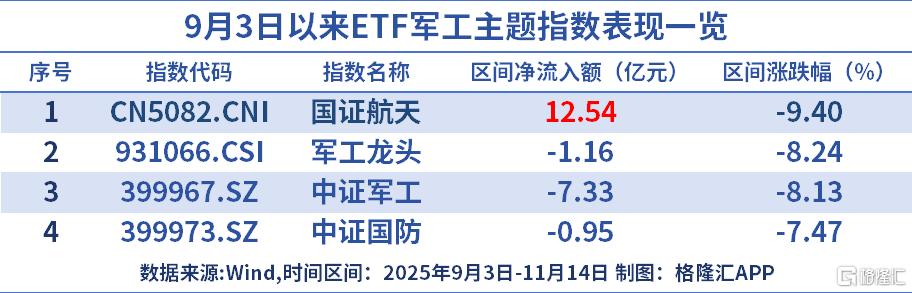
Core Viewpoint - The military industry sector is experiencing a significant rise due to increasing geopolitical risks, with the aerospace index leading the gains among military-themed indices [1][2]. Group 1: Short-term Catalysts - The military sector's strength is primarily driven by geopolitical factors, including recent provocative statements from Japan and renewed large-scale airstrikes by Russia on Ukraine, which have heightened global uncertainty [4]. - The upcoming maiden flight of China's reusable rocket "Zhuque-3" in mid-November is also a notable event that could attract market attention [4]. Group 2: Long-term Catalysts - The "14th Five-Year Plan" laid the groundwork for the military industry, achieving significant milestones in weapon systems development, transitioning from research to small-scale production [8]. - The "15th Five-Year Plan" focuses on large-scale production and systematic combat capabilities, indicating a shift towards mass production of previously developed equipment [9]. - The emphasis on "high-quality transformation" in the military sector will drive demand for advanced technologies and materials, particularly in critical areas like high-end chips and aerospace engines [11][12]. Group 3: Performance Metrics - The military sector has shown a recovery trend, with a reported 16.99% year-on-year increase in revenue and a 14.01% increase in net profit for the third quarter of 2025 [15]. - Various sub-sectors, including defense information, aerospace, and commercial space, are also showing signs of recovery [15]. Group 4: Institutional Holdings - Institutional investment in the military sector remains at historical lows, with a total market value of 101.36 billion yuan, ranking 14th among primary industries [21]. - There is a notable structural adjustment within institutional holdings, with active funds reducing their total positions while passive funds maintain stable increases [22]. Group 5: Strategic Opportunities - The military trade sector is expected to provide substantial growth opportunities, with exports of military equipment showing significant increases, such as a 30.6% year-on-year growth in September 2025 [20]. - The diversification of weapon procurement sources by various countries presents a strategic opportunity for China's military exports [20]. Group 6: Focus Areas - The aerospace index is highlighted as a key area of focus, with the aerospace ETF (159227) showing significant inflows and a strong performance in the market [34]. - The ETF's top holdings reflect the core supply chain of the aerospace industry, aligning with national strategic needs in defense and aerospace [34].
超60亿元资金抢筹!三重逻辑共振,这一赛道迎来价值重估
Zheng Quan Shi Bao Wang· 2025-11-17 07:53
Core Viewpoint - The military industry is positioned as a high-potential investment sector driven by national security needs, military trade exports, and technological innovation through civil-military integration [1][3][4] Industry Dynamics - The military industry is experiencing a positive trend characterized by "economic recovery, value reassessment, and event-driven catalysts" [3] - The defense industry reported a revenue growth of 6.7% year-on-year in the first three quarters, reversing a decline of 0.57% in the first half of the year [3] - The net profit attributable to shareholders improved from -8.59% in the first half to 0.02% in the third quarter, indicating a recovery in industry performance [3] Investment Opportunities - The military trade export structure has shifted from reliance on imports to high-value exports, with a significant decrease in import share from 4.3% in 2015 to 0.2% in 2024 [4] - The 2025 defense budget is projected at 1.78 trillion yuan, with a consistent growth rate of 7.2%, indicating a stable growth foundation for defense investments [3] Valuation Insights - The current price-to-earnings ratio (TTM) for the military industry is approximately 85.77, significantly higher than the overall market average of 22.59 [5][6] - The valuation premium in the military sector is attributed to high barriers to entry and the long-term investment required for core technology development [6] Investment Tools - The military industry presents complexities and information asymmetries, making it challenging for ordinary investors to participate directly [8] - The military leader ETF (code: 512710) offers a transparent and accessible investment vehicle, tracking the military leader index that focuses on leading companies across the military supply chain [8][9] Market Sentiment - As of October 30, the military leader ETF has seen a net inflow of 6.413 billion yuan this year, with a total scale of 13.735 billion yuan, reflecting strong market recognition [2][10] - The investment in the military sector is viewed as a long-term confidence in national technological strength and security, aligning with national strategies [10]
超60亿元资金抢筹!三重逻辑共振,这一赛道迎来价值重估
券商中国· 2025-11-17 07:43
Core Viewpoint - The military industry is positioned as a high-potential investment sector, driven by national security needs, military trade exports, and technological innovation through military-civilian integration, highlighting its long-term investment value as the country transitions from the "14th Five-Year Plan" to the "15th Five-Year Plan" [1] Group 1: Industry Dynamics - The military industry is experiencing a positive trend characterized by "economic recovery, value reassessment, and event-driven catalysts" [4] - The defense and military sector's revenue for the first three quarters showed a year-on-year growth of 6.7%, reversing a decline of 0.57% in the first half of the year [4] - The 2025 national defense budget is projected at 1.78 trillion yuan, with a consistent growth rate of 7.2%, indicating a stable foundation for continued investment [4] Group 2: Military Trade and Technological Integration - Military trade exports are a key variable for value reassessment, with China's military trade export structure shifting towards high-value areas such as drones and stealth fighters [5] - The integration of military and civilian technologies is creating new growth paths, with military high-tech accelerating its transition into civilian sectors like commercial aerospace and logistics [5] Group 3: Valuation and Market Perception - The current price-to-earnings ratio (TTM) for the A-share military industry is approximately 85.77, significantly higher than the overall market average of 22.59, raising concerns about overvaluation [7] - The valuation of military enterprises should consider their strategic importance, technological barriers, and profit certainty, rather than relying solely on traditional metrics [7] - The global military industry valuation logic is being restructured, with a shift from traditional manufacturing to technology-driven platforms, emphasizing long-term growth potential [8] Group 4: Investment Strategies for Ordinary Investors - The military industry presents significant complexity and information asymmetry, making direct investment challenging for ordinary investors [11] - The military leader ETF (code: 512710) offers a transparent and accessible investment tool, tracking the military leader index that focuses on leading enterprises across the military supply chain [11][13] - The military leader index includes key players from all segments of the military industry, providing a diversified investment approach that mitigates individual stock risks [12][13]