乌克兰战后重建

Search documents
苏交科(300284.SZ):目前无法预测乌克兰项目对公司营收和利润的贡献数据
Ge Long Hui· 2026-02-11 01:12
Core Viewpoint - The company is unable to predict the contribution of its Ukraine projects to revenue and profit due to the complex situation in Ukraine and uncertainties in project progress [1] Group 1: Company Operations - The company's Spanish subsidiary, Eptisa, has been operating in Ukraine since 2010 and is recognized as a mature engineering consulting firm in the region [1] - Eptisa is one of the few foreign engineering companies that have maintained continuous operations in the Ukrainian market [1] Group 2: Project Involvement - Eptisa has successfully executed key projects, including the reconstruction of the Kyiv Okhmadyt Children's Hospital, funded by the World Bank [1] - The company is expected to play a significant role in the post-war reconstruction efforts in Ukraine [1]

特朗普抛出贸易橄榄枝,乌副总理警示:乌克兰入欧盟恐成泡影!
Sou Hu Cai Jing· 2026-01-24 05:14
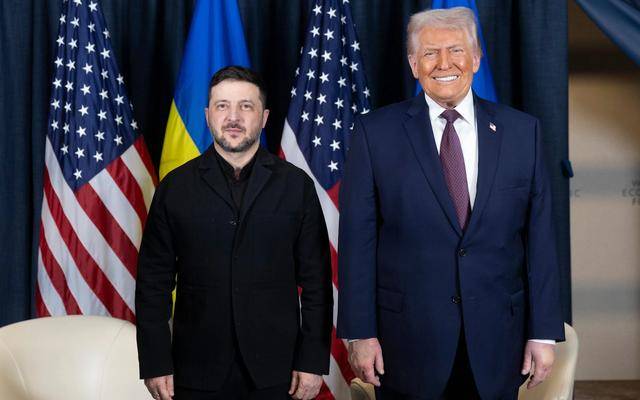
Core Viewpoint - The article discusses President Trump's initiative to establish a zero-tariff zone between the U.S. and Ukraine, which could complicate Ukraine's aspirations to join the European Union [1][4]. Group 1: Zero-Tariff Zone Initiative - Trump is actively promoting a plan to create a "zero-tariff zone" in Ukraine, aimed at eliminating trade tariffs and allowing free trade between Ukraine and the U.S. [1] - The implementation of this trade agreement is contingent upon Ukraine reaching a peace agreement with Russia [1]. - The initiative is expected to incentivize companies to establish factories in Ukraine, facilitating cheaper exports to the U.S. and aiding in post-war reconstruction [1]. Group 2: Implications for EU Membership - Former UK trade official Crawford Faulkner warns that this plan could complicate Ukraine's EU membership efforts and potentially undermine its chances of joining [4]. - Faulkner explains that EU rules prohibit member states from independently negotiating trade agreements with external countries, which is a core principle of the EU trade system [4]. - If Ukraine joins the EU, it would have to transfer its trade control to the EU Commission, which would set common external tariffs, limiting Ukraine's ability to negotiate with the U.S. [4][6]. Group 3: Diverging Opinions and Tensions - Trump's special envoy to Ukraine, Steve Witkoff, described the zero-tariff plan as "disruptive," suggesting it would attract significant business interest due to the absence of tariffs [7]. - Ukrainian Deputy Prime Minister Taras Kachka acknowledged the potential complications of establishing a free trade zone with the U.S. while pursuing EU membership [7]. - Tensions between Ukraine and the EU have surfaced, with President Zelensky criticizing the EU for its internal disputes and lack of political will to address the situation with Russia [7][8].

美俄惊天交易曝光!被冻资产对半分, 与乌克兰无关, 欧盟沦为局外人
Sou Hu Cai Jing· 2025-12-26 13:04
Core Viewpoint - The U.S. is developing a plan to unfreeze Russian assets, using them as leverage in negotiations with Russia, while the EU is sidelined in this process [1][10]. Group 1: U.S. Strategy - The U.S. intends to treat the frozen Russian assets as negotiation chips rather than merely tools for aiding Ukraine [1]. - The U.S. is looking to invest the unfreezing assets into U.S.-led reconstruction projects in Ukraine, potentially sharing profits equally with Russia [10]. - The U.S. has been directly engaging with certain EU member states, influencing their positions and undermining EU unity [8][10]. Group 2: EU's Position - The EU's influence in the negotiations is diminishing, as evidenced by the lack of consensus among member states regarding the use of frozen Russian assets [2][4]. - The EU has resorted to raising approximately €90 billion through joint debt to support Ukraine, which is seen as a fallback rather than a proactive measure [4][6]. - Concerns from financial centers within the EU about violating the principle of sovereign asset inviolability have hindered decisive action [6]. Group 3: Russia's Response - Russia has expressed strong opposition to the freezing of its assets, labeling the EU summit as a "gathering of thieves" and emphasizing the illegality of asset seizure [12][14]. - Russian officials have warned that Western banks involved in the asset management could face long-term legal repercussions and reputational damage [14]. - The situation is escalating, with the EU retreating, the U.S. positioning itself strategically, and Russia applying pressure [14][16].
泽连斯基:乌美就战后重建举行视频会晤
Xin Hua She· 2025-12-11 01:12
Group 1 - The core point of the article is that Ukraine's President Zelensky announced a video meeting with U.S. Treasury Secretary Mnuchin, Jared Kushner, and BlackRock CEO Larry Fink to discuss Ukraine's post-war reconstruction and economic recovery [1] - This meeting marks the first time both Ukrainian and U.S. teams convened to draft documents related to Ukraine's reconstruction and economic revival, focusing on key elements of recovery, cooperation mechanisms, and a vision for rebuilding [1] - The discussions included a 20-point ceasefire framework agreement, with both sides reaching a consensus on subsequent contacts [1] Group 2 - Ukrainian officials present at the meeting included Prime Minister Shmyhal, Deputy Prime Minister Kachka, Foreign Minister Kuleba, and Chief of General Staff Zaluzhny [1] - Prior reports indicated that a previously proposed 28-point peace plan by the U.S. has been divided into three documents: a 20-point framework agreement, a U.S.-EU security assurance document for Ukraine, and a document regarding Ukraine's post-war reconstruction [1]
美乌首次开会讨论“战后重建”,美欧争夺“万亿大蛋糕”,华尔街想在乌最大核电站旁建数据中心
Hua Er Jie Jian Wen· 2025-12-11 00:43
Core Viewpoint - The article discusses the emerging strategic rift between Washington and Brussels regarding the post-war economic landscape in Ukraine, particularly focusing on the management of approximately $200 billion in frozen Russian assets and the differing visions for Ukraine's reconstruction and economic recovery [1][2][5]. Group 1: Ukraine's Reconstruction Talks - Ukrainian President Zelensky announced the initiation of discussions on Ukraine's reconstruction and economic recovery with key U.S. officials, including Treasury Secretary Yellen and BlackRock's CEO Larry Fink, emphasizing the importance of security for economic stability [1][3]. - The Ukrainian team has outlined a 20-point core position for ending the conflict, highlighting that overall security is a prerequisite for economic safety and a conducive business environment [1][4]. Group 2: U.S. and European Divergence - The U.S. proposes a commercial-oriented reconstruction plan that aims to utilize around $200 billion of frozen Russian assets to support American business projects, including the construction of large data centers near major nuclear power plants in Ukraine [1][6]. - In contrast, European officials prefer to use the frozen funds directly to support the Ukrainian government and military, expressing skepticism about the U.S. approach and comparing it to historical power-sharing agreements [2][7]. Group 3: Financial and Investment Implications - BlackRock has previously collaborated with the Ukrainian government to establish a reconstruction bank aimed at attracting private investment, potentially amounting to hundreds of billions of dollars for reconstruction projects [4]. - The U.S. strategy includes a vision for "unfreezing" the Russian economy, allowing American companies to invest in strategic sectors, which has faced strong resistance from Europe, particularly in light of recent agreements to phase out reliance on Russian energy [7].

美乌迈阿密会谈:就乌克兰安全保障框架达成共识
Zhong Guo Xin Wen Wang· 2025-12-06 10:40
Core Points - The US and Ukraine have reached a consensus on a security framework for Ukraine and discussed the deterrent capabilities necessary for maintaining lasting peace [1] - This meeting marks the sixth discussion between the US and Ukraine in the past two weeks, following a visit by US Middle East envoy Wittekov to Russia [1] - The talks included key figures such as Wittekov, Jared Kushner, Ukraine's National Security and Defense Council Secretary Oleksiy Danilov, and Chief of General Staff Andriy Koval [1] Group 1 - The primary goal for Ukraine is to achieve a solution that maintains its independence and sovereignty, ensures the safety of its people, and lays a stable foundation for the future [1] - Both parties believe that real progress on any agreement depends on Russia's willingness to demonstrate a serious commitment to long-term peace [1] - Discussions also covered support for Ukraine's post-war reconstruction, US-Ukraine joint economic initiatives, and long-term recovery projects [1] Group 2 - A follow-up meeting is scheduled for December 6 to continue advancing discussions on the aforementioned topics [1]
俄乌战让欧洲经济低迷,对华投资减少,中企海外机遇受影响
Sou Hu Cai Jing· 2025-11-06 10:09
Group 1 - The Russia-Ukraine conflict is impacting European economies, which in turn affects investment opportunities for Chinese companies abroad [1][5][13] - European countries are experiencing a triple crisis of security, energy, and economic challenges due to the conflict, leading to a significant slowdown in economic growth [5][11][14] - The energy crisis has resulted in soaring energy prices, causing many European factories to halt production and leading to a decrease in consumer spending [8][10][11] Group 2 - European companies are tightening cash flow and reducing overseas investment budgets, prioritizing domestic business stability over investments in China [13][15] - The war has created a need for substantial reconstruction funding in Ukraine, which adds further strain to the already struggling European economy [14] - Despite the challenges, there are emerging opportunities for Chinese companies in sectors like renewable energy and high-end manufacturing, as European firms seek partnerships to address their economic difficulties [17][19][21] Group 3 - Chinese companies are leveraging their strengths in renewable energy technologies to collaborate with European nations, helping them transition away from Russian energy dependence [17] - The demand for Chinese electric vehicles is rising in Europe, with some companies planning to establish R&D centers to better meet local market needs [19] - Collaboration between Chinese and European firms in high-end manufacturing and digital economy sectors is becoming increasingly viable, as European SMEs face financial constraints [19][21]

加拿大总理:不排除向乌克兰派遣地面部队的可能性
Yang Shi Xin Wen· 2025-08-24 14:25
Core Points - Ukrainian President Zelensky and Canadian Prime Minister Carney held discussions in Kyiv, resulting in the signing of significant documents and reaching consensus on various issues [1] - The two countries signed a roadmap for the implementation of a security agreement and a cooperation agreement for drone production, highlighting the importance of defense collaboration [1] - Canada announced an additional $500 million in aid, specifically allocated for Ukraine's drone production, which was a key focus of the discussions [1] - Carney expressed support for Canada's involvement in the "voluntary alliance" and did not rule out the possibility of deploying ground troops to Ukraine, although the exact nature of such deployment remains unclear [1] Summary by Categories Security and Defense Cooperation - A security agreement implementation roadmap was signed between Ukraine and Canada [1] - Discussions included defense collaboration and the potential deployment of Canadian ground troops to Ukraine [1] Financial Aid and Economic Support - Canada committed an additional $500 million in aid, specifically for the production of drones in Ukraine [1] Diplomatic Relations - The meeting covered topics such as diplomatic cooperation, sanctions against Russia, energy collaboration, and Canada's role in Ukraine's post-war reconstruction and veteran rehabilitation [1]
美银证券:国防支出攀升引爆金属“军工红利“ 铝铜需求迎结构性强增
智通财经网· 2025-07-17 08:09
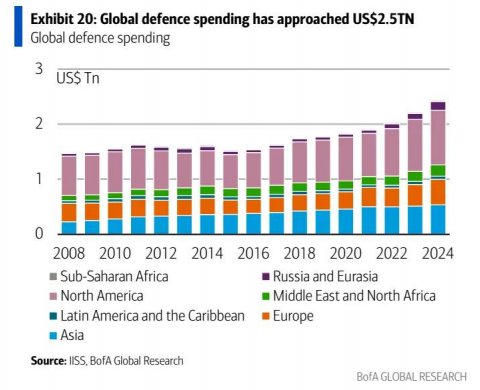
Group 1 - The core viewpoint is that increasing defense spending and its impact on metal demand are gaining more attention as the world becomes more multipolar, with NATO committing to allocate 5% of GDP for defense [1] - Defense metal demand is expected to grow structurally, driven by NATO's upgraded spending targets, with NATO countries (excluding the US) projected to spend $507 billion on core defense in 2024, potentially increasing by an additional $371 billion if they reach the 3.5% GDP target [2] - Germany's defense budget is set to rise from €62.4 billion in 2024 to €154 billion in 2029, with 40% allocated for equipment procurement, which will significantly boost metal demand [2] Group 2 - The reconstruction of Ukraine is identified as a "second battlefield" for metal demand, with direct damages estimated at $170 billion and total reconstruction costs ranging from $543 billion to $1.23 trillion [4] - Using two methods to estimate metal demand, it is projected that if reconstruction takes 10 years, annual copper demand could increase by 200,000 tons (0.65% of global share), aluminum by 750,000 tons (1.1%), and steel by 1.76 million tons (1%) [6] - If reconstruction extends to 14 years with a $1 trillion cap, copper demand could reach 1.8 million tons (6.8% annual market), aluminum 720,000 tons (1%), and steel 1.6 million tons (1.8%), which could tighten an already constrained market given the global copper production growth rate of only 2% [6] Group 3 - The combination of defense modernization and post-war reconstruction is expected to drive up metal demand, with steepening demand curves for copper, aluminum, and steel, while strategic metals like rare earths, gallium, and germanium may become bottlenecks [7] - Factors such as spending efficiency, technological advancements (lightweight, intelligent, unmanned systems), and geopolitical dynamics will ultimately determine the intensity of metal consumption [7]
乌克兰与美国矿产协议细节剖析
制裁名单· 2025-02-27 03:23
Core Points - A landmark mineral agreement between Ukraine and the United States is set to strengthen economic ties, with Ukraine committing 50% of future natural resource revenues to a reconstruction fund [1][2] - The agreement includes a long-term financial commitment from the U.S. to support Ukraine's stability and economic prosperity, although it does not directly address security arrangements against Russian aggression [2][6] U.S. Business Perspective - The American Chamber of Commerce in Ukraine views the agreement positively, highlighting the establishment of a new fund focused on state-owned enterprises and Ukraine's rich underground resources [3] - The fund is expected to introduce professional management to state-owned enterprises, which currently face mismanagement issues, potentially leading to profitability [3] - Discussions about Ukraine's economic potential have been a priority in U.S.-Ukraine relations since early 2024, with the expectation that peace must be achieved for these opportunities to be realized [3] Agreement Details - Negotiations for the agreement resulted in more favorable terms for Ukraine, reducing the initial U.S. demand for $500 billion from Ukraine's natural resources [5] - The agreement does not include the security guarantees that Ukraine originally sought, and the U.S. retains decision-making authority over the fund under U.S. law [5] Geopolitical Impact - The agreement is framed by the U.S. as a step towards strengthening Ukraine's economy, despite controversies surrounding President Trump's comments about Ukraine's leadership [6] - There are concerns about whether this economic partnership can lead to lasting peace and stability in Ukraine [7]