
在地创新

Search documents
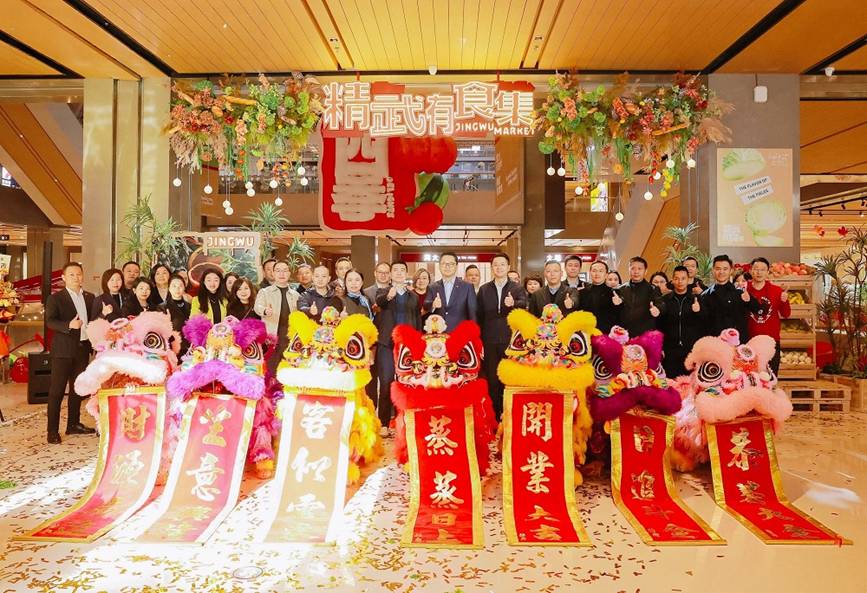
全新『城市•有食集』产品线,越秀商管创新打造可复制的“好商业”
Zhong Guo Shi Pin Wang· 2025-11-28 03:57
Core Insights - The article discusses the transformation of commercial spaces in response to new consumer demands driven by economic recovery, emphasizing the importance of quality and scenario-based innovations in urban commercial environments [1][16] - The launch of "Jingwu Food Collection" at Wuhan's Yuexiu International Financial Center marks a significant step in integrating local culture with modern commercial experiences, aiming to create a dialogue between urban memory and commercial space [1][3] Group 1: Commercial Space Transformation - The State Council has outlined measures to support the development of international consumer cities, focusing on upgrading commercial facilities and creating diverse business districts [1][16] - The "Jingwu Food Collection" project aims to revive local culinary culture by incorporating traditional flavors and modern aesthetics, thus enhancing consumer experience [3][5] Group 2: Design and Experience - The design of "Jingwu Food Collection" is inspired by traditional Wuhan architecture, utilizing materials like red brick and wood to evoke a sense of warmth and nostalgia [5][10] - The project emphasizes a sensory experience through innovative spatial design, creating an environment that fosters community interaction and cultural connection [5][8] Group 3: Long-term Operational Philosophy - Yuexiu Commercial Management adheres to a "long-termism" operational philosophy, focusing on sustainable growth through refined management and cultural integration rather than short-term gains [7][10] - The "Jingwu Food Collection" offers a variety of experiences, from breakfast ordering to family baking classes, enhancing customer engagement through a membership platform [7][8] Group 4: Ecosystem and Community Engagement - The success of "Jingwu Food Collection" is supported by a comprehensive ecosystem that integrates commercial, cultural, and office spaces, enhancing the overall urban experience [14][16] - The project aims to create a sense of belonging for various community members, including office workers and residents, through cross-industry collaboration [14][16] Group 5: Future Expansion Plans - "Jingwu Food Collection" serves as a pilot project for Yuexiu's broader strategy to launch similar concepts in other major cities, each tailored to local cultural contexts [11][18] - The company plans to continue developing the "City Food Collection" series, ensuring that each location reflects its unique urban narrative and culinary heritage [11][18] Group 6: Company Overview - Yuexiu Commercial Management, a subsidiary of Yuexiu Real Estate, focuses on comprehensive asset management across various commercial real estate sectors, with a total operational area exceeding 7.3 million square meters and total assets over 109 billion [19]

日媒:GDP超全球一半,欢迎来到“亚洲世纪”
Huan Qiu Shi Bao· 2025-07-24 22:50
Core Insights - The concept of "Asian Century" has evolved, with Asia expected to contribute nearly 55% of global GDP by 2024, surpassing earlier predictions [1] - The narrative of Asia's rise is shifting from dominance to balance, focusing on local adaptation and inclusive growth [1] - The re-evaluation of the "Galapagos Syndrome" highlights the importance of localized innovations, which are now seen as advantages rather than limitations [1] Group 1: Localized Innovations - The model of "localized innovation" is thriving across Asia, with mobile-centric platform designs and inclusive fintech infrastructure [2] - Super apps, such as WeChat and Alipay, are emerging as ecosystems that integrate various functions and are being emulated in regions like Africa and Latin America [2] Group 2: Financial Services and Digital Infrastructure - Asia is reshaping global perceptions of "scale, innovation, and inclusivity" in financial services and public digital infrastructure [3] - India's Unified Payments Interface is a global benchmark in digital payments, processing billions of low-cost, secure transactions monthly [3] - Southeast Asia's QR code payment networks are inspiring developments in the U.S. and Europe due to their compatibility and rapid adoption [3] Group 3: Diverse Economic Landscape - Asia's transition from "technology adopters" to "innovation sources" is complex, characterized by diverse economic conditions and challenges [3] - Japan's use of robotics and AI to address labor shortages in healthcare and eldercare serves as a model for other nations facing similar issues [3] - Challenges in Asia often act as catalysts for innovation rather than obstacles [3] Group 4: Global Perspective Shift - The focus has shifted from whether Asia can "Westernize" to what the next adoptable Asian model will be, indicating the true arrival of the Asian Century [4]