基金净值修复

Search documents
天赐良基日报|跨境ETF规模突破9000亿元;“百亿基金经理”重回百人大关
Mei Ri Jing Ji Xin Wen· 2025-11-07 07:40
Group 1: Fund Market Overview - The cross-border ETF market has surpassed 900 billion yuan, reaching 915.47 billion yuan as of November 6, with an increase of 491.25 billion yuan since the beginning of the year and 48 new products launched [1] - The number of active equity fund managers managing over 10 billion yuan has increased to 109 by the end of Q3, a nearly one-third expansion compared to Q2. This number has risen to 112 with new products launched in Q4, driven primarily by performance [2] - Ten funds that had a net value below 0.6 yuan at the end of last year have seen their net value return above 1 yuan as of November 5, with one fund achieving a year-to-date return of 137.02% [3] Group 2: ETF Market Performance - The market experienced fluctuations, with all three major indices retreating after initial gains. The lithium battery sector surged in the afternoon, while the chemical sector continued to rise, and the organic silicon sector showed strength. Conversely, the robotics sector declined [5] - Chemical-related ETFs saw gains exceeding 3%, while internet-related ETFs in the Hong Kong market dropped over 2% [6][8] Group 3: Notable Fund Manager Updates - Fund managers Yan Siqian and Wang Zijian from Penghua Fund denied rumors of a conflict, stating that the claims are malicious defamation and urging the public to stop spreading false information [4] Group 4: Investment Opportunities - Current chemical product prices and spreads are at low levels, with leading companies' valuations also at the bottom. The strong safety margin in valuations, combined with the integrated supply chain and cost advantages of leading companies, suggests potential for profit and valuation recovery in core chemical assets [10]


站在修复的十字路口:向左还是向右
淡水泉投资· 2025-09-10 09:33
Core Viewpoint - The article discusses the phenomenon of fund net value rising while experiencing net redemptions, questioning whether this is a sound investment decision for investors [1][2]. Group 1: Fund Performance and Market Trends - Since September 24 of the previous year, the Chinese capital market has experienced a strong upward trend, leading to a positive cycle of profit-making effects and incremental capital [1]. - Despite the improved market sentiment, actively managed equity public funds have not seen significant growth in their shares and have instead experienced continuous net redemptions [1][3]. Group 2: Historical Context of Fund Redemptions - Historical data shows that the phenomenon of fund net value rising while experiencing redemptions is not uncommon, with similar occurrences noted during previous market rallies [3]. - Many investors tend to redeem their funds after experiencing a long recovery period, often leading to a pattern of redeeming after reaching breakeven [3][5]. Group 3: Recovery and Long-term Performance - An analysis of 2,418 public funds established since 2001 reveals that over half of the more than 3,300 instances of drawdowns exceeding 20% have fully recovered [6]. - Funds that have experienced significant drawdowns often continue to provide returns to patient investors, with a probability of over 75% for positive returns if held for an additional six months to two years post-recovery [6][8]. Group 4: Investment Decision-Making - Investors often base their redemption decisions on the cost price or net value during drawdowns, which can lead to impulsive actions driven by loss aversion [12]. - Redemption decisions should consider future risk and return comparisons, including current market conditions and personal investment goals [12][13]. Group 5: Risks of Timing and Reallocation - Timing the market is challenging, and missing out on the best trading days can significantly reduce overall returns, as evidenced by the performance of equity mixed funds since 2014 [13][14]. - Switching to other funds after a redemption may not yield better results, as historical data indicates that 61% of original funds outperformed the top 10% of funds from the previous year [16][17].

指数新高VS基金滞涨:张坤、朱少醒“赚而不盈”!8只百亿权益基金净值未及去年10月(名单)
Xin Lang Ji Jin· 2025-08-14 01:46
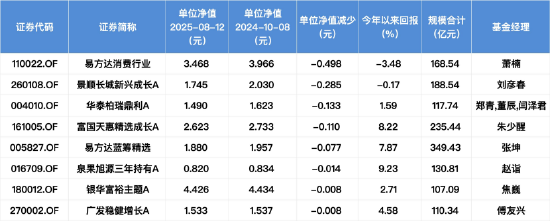
Market Performance - The A-share market showed strong performance on August 13, with the Shanghai Composite Index breaking the high point from October 8 of the previous year, reaching a nearly four-year high [1] - The Shenzhen Component Index and the ChiNext Index also reached their annual peaks, with total trading volume exceeding 2 trillion yuan for the first time in 114 trading days [1] - Over 2,700 stocks rose, led by growth sectors such as non-ferrous metals and AI hardware [1] Fund Performance - Despite the strong market indices, not all funds benefited, with over 2,700 out of more than 13,000 funds having unit net values below the level of October 8 of the previous year [1] - Notably, eight large-cap equity funds managed by well-known fund managers are facing issues with "net value recovery lag" [1] Specific Fund Analysis - The E Fund Consumer Industry fund (110022.OF) saw its unit net value drop by 0.50 yuan to 3.468 yuan, with a year-to-date return of -3.48%, despite a scale of 168.54 billion yuan [3][4] - The Invesco Great Wall New Emerging Growth A fund (260108.OF) experienced a net value decline of 0.29 yuan to 1.745 yuan, with a year-to-date return of -0.17% and a scale of 188.54 billion yuan [7][9] - The Fortune Select Growth A fund (161005.OF) had a slight net value drop of 0.11 yuan to 2.623 yuan, but achieved a year-to-date return of 8.22% [10] - The E Fund Blue Chip Select fund (005827.OF) reported a net value decrease of 0.08 yuan to 1.880 yuan, with a year-to-date return of 7.87% [12] - The Qian Guo Xu Yuan Three-Year Holding A fund (016709.OF) saw a minor net value drop of 0.01 yuan to 0.820 yuan, with a year-to-date return of 9.23% [15] - The Silver Hua Wealth Theme A fund (180012.OF) and the GF Stable Growth A fund (270002.OF) both experienced a net value decline of 0.008 yuan, with year-to-date returns of 2.71% and 4.58%, respectively [18] Market Insights - The decline in the E Fund Consumer Industry fund is attributed to the significant drop in liquor stocks in the fourth quarter of last year and a sluggish recovery in the consumer sector this year [4] - Fund managers express concerns over slow domestic demand recovery and low inflation, but maintain confidence in the long-term economic outlook [9][14] - The current market environment highlights a divergence between index performance and fund net values, signaling a need for investors to assess funds' maximum drawdown and recovery capabilities [18]