增长耐久度

Search documents
横盘两季又如何?大摩坚定看好:英伟达还是芯片“首选”
华尔街见闻· 2026-03-03 08:10
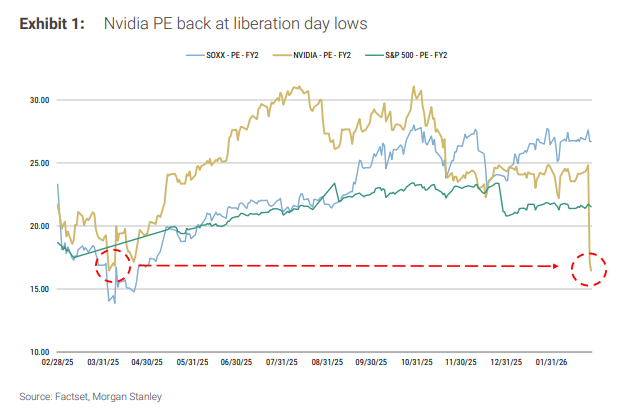
英伟达过去两个季度的股价几乎没动,但摩根士丹利的判断是:基本面反而在变强,市场只是被两件事卡住——增长能不能"熬过"2026,以及市场份额会不会 被ASIC、AMD慢慢啃掉。大摩把英伟达重新抬回半导体板块的"首选",维持增持评级与260美元目标价,并把当前估值视作少见的介入窗口。 据追风交易台,摩根士丹利北美半导体分析师Joseph Moore在最新报告中表示,英伟达以2027年盈利计仅约18倍市盈率,是一个出人意料的好切入点。他的 逻辑不是押注下个季度再超预期,而是押注投资人对"增长耐久度"的怀疑,会在未来几个月开始松动。 它提到一个反常对比——当初把板块首选从英伟达换到SanDisk、再换到美光之后,内存股累计涨幅达到300%—900%,而英伟达股价"原地踏步";与此同 时,英伟达"当前季度"的盈利预期在6个月里上调了38%。这意味着,压着股价的不是数据,而是对周期寿命的怀疑。 报告也把这种情绪波动放进历史模式: 过去三年里,每年年初市场都会对"下一年"不放心,直到可见度补上,股价才出现阶段性跑赢。它押注2026年会重复 这一过程。 供应链给出的信号偏"硬":三年锁单、甚至全额预付 摩根士丹利认为,持续性 ...


芯片“首选”英伟达、取代存储,大摩的理由:股价滞涨已久,而“2026年增长见顶”论已破产
Hua Er Jie Jian Wen· 2026-03-03 01:49
Core Viewpoint - Morgan Stanley believes that Nvidia's fundamentals are strengthening despite stagnant stock prices over the past two quarters, attributing this to market concerns about growth sustainability until 2026 and potential market share erosion from ASIC and AMD competitors [1][4]. Group 1: Market Sentiment and Stock Performance - Nvidia's stock price has remained flat, reflecting market skepticism about the durability of its growth rather than a rejection of current strong performance [4]. - Morgan Stanley has reinstated Nvidia as a top pick in the semiconductor sector, maintaining an "overweight" rating with a target price of $260, viewing current valuations as a rare entry point [1][4]. - The report highlights that Nvidia's earnings expectations have been raised by 38% over the past six months, indicating that the pressure on stock prices is driven by concerns over the longevity of the growth cycle [4]. Group 2: Supply Chain Dynamics - Evidence from the supply chain indicates a trend of large cloud providers locking in longer-term orders, with some instances of three-year contracts and full upfront payments, suggesting confidence in sustained demand [5][6]. - Morgan Stanley interprets these prepayments as signals of growth durability, as it is difficult to reconcile such commitments with plans for a slowdown in the near future [6]. Group 3: Cash Flow and Financial Health - Some cloud infrastructure businesses are experiencing negative cash flow, which could lead to a slowdown in capital expenditures next year, although this is not seen as a long-term issue due to strong balance sheets and financing options [7]. - The report suggests that while short-term cash flow may appear weak, it does not negate the potential for investment returns, particularly in the high-margin cloud GPU business [7]. Group 4: Competitive Landscape - Morgan Stanley projects that Nvidia will hold approximately 85% of the revenue share, with ASICs slightly above 10% and AMD below 5%, anticipating a slight decline in Nvidia's market share by 1-2 percentage points by 2026 due to its larger scale and supply constraints [2][8]. - Despite some erosion of its competitive moat, Nvidia remains the preferred choice for many customers, even in areas where lower total cost of ownership is emphasized [8]. - The report notes that major ASIC users and potential AMD customers could still contribute to Nvidia's business growth exceeding 80% in 2026 [8]. Group 5: Future Outlook and Events - Morgan Stanley emphasizes that semiconductor capacity cannot rapidly scale to meet demand, and feedback from the global supply chain indicates a trend of locking in growth through cash commitments extending into 2028 [9]. - The upcoming GTC conference is expected to clarify market share discussions and provide a comprehensive four-year roadmap, highlighting that competition extends beyond chips to include cabinet and ecosystem development [9].