
国产化

Search documents
电子2026年度策略:算力闭环加速,重塑价值新锚点
GOLDEN SUN SECURITIES· 2026-03-25 12:24
Investment Rating - The report maintains a "Buy" rating for the semiconductor and related sectors, indicating a positive outlook for investment opportunities in these industries [5]. Core Insights - The report emphasizes the transformative impact of AI on various sectors, particularly in storage, PCB, and semiconductor equipment, highlighting a shift towards a new growth era driven by AI and domestic production [1][2][3][4]. Storage Sector - The storage industry is entering a new growth phase, driven by AI, with companies like Nanya Technology showing significant performance improvements due to rising DDR4 prices [1]. - The demand for high-quality storage components is expected to increase, benefiting manufacturers that can secure stable supplies amid tight market conditions [1]. PCB Sector - The PCB industry is experiencing a new wave of capital expenditure driven by AI hardware architecture and performance upgrades, with expectations of sustained high demand in 2026 [2]. - New technologies and solutions are emerging, pushing the PCB materials segment into the M9 and M9+ era, which will be crucial for industry growth [2]. Domestic Computing Power - The domestic AI chip market is projected to grow significantly, with a forecasted market size of 153 billion yuan by 2025, reflecting a compound annual growth rate (CAGR) of 53% from 2020 to 2025 [3]. - The report identifies a strong upward trend in demand, policy support, and technological advancements as key drivers for investment in domestic computing power chips [3]. Semiconductor Equipment - The semiconductor equipment market is expected to reach $145 billion in sales by 2026, with domestic manufacturers gaining ground in high-end equipment due to favorable policies and external pressures [4]. - The report highlights the rapid growth of domestic semiconductor equipment companies, with a CAGR of 42% from 2020 to 2024, significantly outpacing market growth [4]. Semiconductor Materials - The global semiconductor materials market is projected to grow from $43.3 billion in 2015 to $67.5 billion in 2024, with China's market expanding at a faster rate [7]. - Domestic semiconductor material manufacturers are expected to benefit from increased wafer production capacity and a growing demand for localized supply chains [7]. Semiconductor Components - The domestic semiconductor components market is forecasted to grow from 76.54 billion yuan in 2020 to 160.52 billion yuan in 2024, with a CAGR of 20.3% [8]. - The report emphasizes the need for increased localization of components to ensure supply chain security amid geopolitical tensions [8]. Packaging and Testing - The packaging and testing sector is expected to see increased utilization rates and price hikes due to high demand for advanced packaging solutions [9]. - The report notes that the CoWoS technology is becoming increasingly critical in the AI chip market, with domestic manufacturers poised to capitalize on this trend [9]. Foundry Services - The foundry sector is experiencing a structural shortage in 8-inch capacity, with price increases anticipated in early 2026 due to strong AI demand [10]. - Major players like TSMC are expected to see robust performance driven by AI and consumer electronics, with a projected capital expenditure increase [10]. Digital IC - The digital IC sector is witnessing a growth cycle, with revenues reaching 52.6 billion yuan in Q3 2025, reflecting a year-on-year increase of 35% [11]. - The report highlights the acceleration of domestic replacements in the CIS and SoC segments, driven by AI and IoT applications [11]. Passive Components - The passive components market is projected to grow significantly, driven by AI and automotive applications, with demand for specific components like MLCC expected to surge [14]. - The report indicates a structural price increase in the passive components sector, influenced by rising costs and demand from new applications [14]. Display Panels - The display panel market is showing signs of recovery, with price increases expected as demand stabilizes ahead of major promotional events [15]. - Domestic manufacturers are exploring new growth avenues, such as perovskite technology, to enhance their competitive edge [15]. Power Components - The report highlights the increasing power demands of AI servers, necessitating advancements in power density and efficiency, with wide bandgap semiconductors like SiC and GaN becoming critical [16][17]. - The market for GaN is expected to grow significantly, driven by applications in consumer electronics and data centers [17]. Consumer Electronics - The consumer electronics sector is entering a new innovation cycle, with AI integration expected to drive growth in high-end markets [18]. - Key developments include the launch of AI-enabled devices and advancements in foldable technology, which are anticipated to boost market penetration [18].
英大证券晨会纪要-20260325
British Securities· 2026-03-25 02:52
Market Overview - The current macro liquidity in the domestic market remains positive, providing strong support for the market [4][8] - Geopolitical conflicts are significant factors causing market adjustments, but historically, such impacts do not alter the long-term market direction [4][8] - The A-share market experienced a rebound, with major indices rising over 1%, and over 5100 stocks closing in the green [4][5][10] Trading Volume and Market Sentiment - The trading volume in the two markets decreased significantly compared to the previous day, indicating a potential weakness in the recovery process [4][9] - The performance of the indices in the short term will continue to be influenced by external events, particularly geopolitical developments [9][10] - Investors are advised to focus on changes in trading volume, rotation of market hotspots, and the adjustment structure of quality stocks rather than short-term index fluctuations [2][9] Sector Performance - The power sector showed strong performance, driven by the government's emphasis on "collaborative computing and electricity" as part of national strategic deployment, which is expected to boost infrastructure investment and demand in the power industry [6] - The military industry, particularly ground equipment stocks, also performed well due to geopolitical tensions and the increasing importance of self-sufficiency in defense technology [7] - Key sectors that saw significant gains include electric power, environmental protection, medical services, and industrial metals, among others [4][5] Future Market Outlook - The report suggests that the current market rebound provides a respite after continuous adjustments, with short-term risks largely alleviated [9][10] - However, the potential for repeated fluctuations remains due to declining trading volume and ongoing external disturbances [9][10] - Investors are encouraged to identify fundamentally supported directions that may emerge from market differentiation as sentiment gradually improves [2][9]
佳能小泽秀树:看好14亿人市场,持续加码中国
Feng Huang Wang Cai Jing· 2026-03-20 11:14
Group 1 - Canon views China as the largest market with significant growth potential, emphasizing the importance of local production and strategic investment in the region [1] - The company aims to strengthen its Suzhou factory as a production base for all B2B products sold in China by around 2035, with plans to expand the Dalian factory as well [1] - Canon's localization strategy includes adapting its products to domestic operating systems and collaborating with local software companies, reflecting its commitment to the "for China, in China" approach [1] Group 2 - Canon's core printing business is positioned within its B2B strategy, with a focus on strong products and solutions to address industry challenges, particularly in the declining A3 and A4 printing markets [2] - The imageFORCE winning series is seen as a catalyst for B2B business growth, integrating AI technology and evolving from traditional hardware sales to comprehensive solution offerings [2] - Canon aims for a balanced revenue stream between B2B and B2C businesses, targeting a 50% share for each, while also seeking to rejuvenate its B2C segment by appealing to younger consumers [2] Group 3 - On March 17, Canon (China) launched four new digital multifunction printers in the imageFORCE winning series and updated its laser printing product family with 12 new models [3] - The new products include high-performance A3 color multifunction printers for large enterprises and cost-effective black-and-white multifunction printers for startups and small businesses [3] - The updated laser printers feature enhancements over previous models, catering to various office needs and improving operational efficiency [3]

光大证券晨会速递-20260320
EBSCN· 2026-03-20 01:58
Group 1: Macro Insights - The recent FOMC meeting decided to pause interest rate cuts, aligning with market expectations, and highlighted a more optimistic view on inflation, suggesting that the recent energy supply shock is likely a one-time event [2] - There are concerns about potential stagflation, with the Fed raising its PCE inflation forecast and noting that the absolute level of new job creation is too low, posing risks [2] - Powell's comments on his future at the Fed depend on whether the new chairman, Waller, can be confirmed by the Senate in a timely manner, and whether the Trump administration will conclude its investigations [2] Group 2: Company Research - AIA Group (1299.HK) reported a 8.8% year-on-year decline in net profit attributable to shareholders for 2025, while new business value (NBV) increased by 17.1%. The company expects continued growth in NBV driven by agency and partner distribution channels [3] - Haitan International (1882.HK) achieved a 10.0% year-on-year revenue growth and a 7.2% increase in net profit attributable to shareholders for 2025. The company has adjusted its net profit forecasts for 2026-2027 downwards by 6.7% and 6.1% respectively, while introducing a new forecast for 2028 [4] - Geely Automobile (0175.HK) has adjusted its net profit forecasts for 2026 and 2027 down by 0.4% and 0.8% respectively, while introducing a new forecast for 2028. The company remains optimistic about product structure improvements and export growth [4] - Shengmei Shanghai (688082.SH) is progressing steadily in its cleaning equipment business, with new product development on track. The company is expected to see net profit attributable to shareholders of 1.829 billion, 2.285 billion, and 2.667 billion for 2026-2028 [5] - Saint Bella Group (2508.HK), a leader in high-end postpartum care, is well-positioned to benefit from industry upgrades and is expanding into overseas markets. The company forecasts adjusted net profits of 121 million, 178 million, and 279 million for 2025-2027 [6]

国产仪器靠什么赢得用户?2025液质联用仪中标年报(上)
仪器信息网· 2026-03-12 09:02
Core Viewpoint - The article analyzes how domestic mass spectrometry brands are achieving breakthroughs in structural competition under the banner of "domestic innovation," highlighting brands that are gaining user trust through solid internal capabilities [1][2]. Group 1: Market Trends - In 2025, the winning bid share of domestic LC-MS increased from approximately 11% in 2024 to 17%, indicating a clearer penetration path for domestic brands despite the dominance of imported brands [2]. - The industry is transitioning from expansion to stock competition, with domestic brands focusing on specific application scenarios that are most defined and have the most rigid demand [2]. Group 2: Public Safety Applications - In 2025, domestic brands such as Huayi Ningchuang, Puyutech, and Suzhou Anyi Pu were active in public safety tenders, with Huayi Ningchuang winning the most bids at 16 [6][9]. - Huayi Ningchuang's HTQ-5310 series products have been implemented in multiple regions for wastewater toxic monitoring, achieving a detection limit reduction from 100 ppb to 0.1 ppb for hair drug testing [9]. - Puyutech's SUPEC 5220 system has also won multiple bids for county-level wastewater toxic monitoring projects, enhancing the ability to discover and analyze drug-related clues [9][10]. Group 3: Academic Research - Domestic mass spectrometry manufacturers are increasingly winning bids in key laboratories and major projects in top universities, marking a significant change in a market traditionally dominated by imported brands [12][14]. - Puyutech's EXPEC 5310 has been successfully bid for projects at several universities, including Tianjin University and Southwest University, indicating a growing acceptance of domestic instruments in academic settings [14]. Group 4: Healthcare System - In 2025, several leading medical companies accelerated their investment in the mass spectrometry industry, with domestic brands achieving significant success in tenders within the healthcare system [16][19]. - Kailai Pu won 27 bids across 13 provinces and cities, showcasing strong penetration in hospitals, while Shandong Yingsheng and Hunan Demit also achieved multiple successful bids with their respective products [19]. - The increasing completeness of domestic reagent systems and advantages in cost-effectiveness and localized service are driving the acceleration of domestic liquid chromatography-mass spectrometry (LC-MS) into secondary hospitals and third-party medical laboratories [19][20]. Group 5: Future Outlook - The domestic liquid chromatography-mass spectrometry market in 2025 is characterized by "structural penetration," with advancements in public safety, academic research, and healthcare systems [20]. - The core support for this growth remains the continuous improvement and performance optimization of domestic triple quadrupole technology [20]. - As the industry matures, the focus is shifting from mere technical competition to understanding real user needs and effective market strategies [20].


兴福电子(688545.SH):2025年度净利润2.08亿元,同比增长30.37%
Ge Long Hui A P P· 2026-02-25 08:12
Core Viewpoint - The company reported strong financial performance for the fiscal year 2025, with significant growth in revenue and net profit driven by the expanding domestic integrated circuit industry and increased sales of electronic-grade chemical products [1] Financial Performance - The company achieved total operating revenue of 1.475 billion yuan, representing a year-on-year increase of 29.72% [1] - The net profit attributable to the parent company was 208 million yuan, reflecting a year-on-year growth of 30.37% [1] - The net profit attributable to the parent company after deducting non-recurring gains and losses was 198 million yuan, with a year-on-year increase of 25.89% [1] Industry Context - The domestic integrated circuit industry chain has been continuously improving, leading to a steady increase in the localization rate and self-controllable capabilities [1] - The rapid development of the industry has resulted in strong sales growth of general wet electronic chemicals such as electronic-grade phosphoric acid and electronic-grade hydrogen peroxide [1] - The company has also enriched its product offerings with high-value-added functional wet electronic chemical products, contributing to overall performance growth [1]
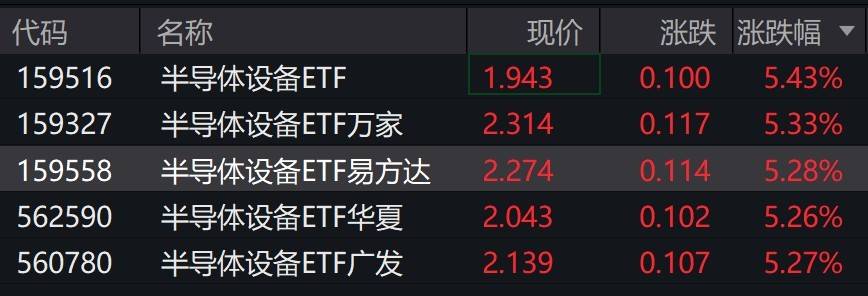
半导体概念股走强,半导体设备相关ETF涨超5%
Sou Hu Cai Jing· 2026-02-25 06:09
Group 1 - Semiconductor concept stocks have strengthened, with Tuojing Technology rising over 11%, and Hu Silicon Industry and Chip Source Micro both increasing over 6%, while Zhongwei Company and Huahai Qingke rose over 5% [1] - The semiconductor equipment-related ETFs have also seen gains of over 5% [1] Group 2 - Specific performance of semiconductor equipment ETFs includes: - ETF code 159516 at a price of 1.943, up 0.100, or 5.43% - ETF code 159327 at a price of 2.314, up 0.117, or 5.33% - ETF code 159558 at a price of 2.274, up 0.114, or 5.28% - ETF code 562590 at a price of 2.043, up 0.102, or 5.26% - ETF code 560780 at a price of 2.139, up 0.107, or 5.27% [2] Group 3 - Analysts indicate that under the backdrop of the AI wave and domestic production, there is a continuous demand for expansion in advanced production lines in China, making semiconductor equipment a cornerstone for wafer foundry expansion and an important link for achieving self-controllable industrial chains, thus domestic semiconductor equipment companies are expected to encounter development opportunities [2]
2026年中国CPU市场现状分析:国产化率提升至50%以上,市场规模将达2579亿元[图]
Sou Hu Cai Jing· 2026-02-24 04:22
Core Viewpoint - The report titled "2026-2032 China CPU Industry Market Status Analysis and Market Trend Forecast" provides essential insights for decision-makers and investors in the CPU sector, highlighting the current market dynamics and future trends [1][11]. Group 1: Industry Overview - The CPU (Central Processing Unit) is the core of computer systems, responsible for executing program instructions and processing data, often referred to as the "brain" of the computer [6]. - The report emphasizes the significance of the CPU industry's technological advancements and market structure, which profoundly impact the global technology sector [8]. - The Chinese CPU market is projected to grow by 3.8% year-on-year by 2026, driven by policy support and technological innovation [8]. Group 2: Data Collection and Analysis Methodology - The research team employed multiple data collection methods, including annual reports from listed companies, manufacturer surveys, and expert validations, to ensure data accuracy and relevance [3]. - The report utilizes a proprietary industry analysis model developed by the research institute, allowing for a comprehensive understanding of the current market status, trends, and dynamics [3][11]. Group 3: Competitive Landscape - Key players in the Chinese CPU market, such as Feiteng, Haiguang, Longxin, and Zhaoxin, are leveraging proprietary instruction sets or compatible ecosystems to gain market share [9]. - Longxin's 3A6000 processor aims to compete with international mainstream products while adhering to a proprietary instruction set approach [9]. Group 4: Report Structure - The report consists of twelve chapters covering various aspects of the CPU industry, including definitions, business models, risk factors, and market dynamics [12]. - It provides a detailed analysis of the CPU industry's operating environment, including political, economic, social, and technological factors [14]. Group 5: Future Projections - The report forecasts supply and demand, pricing, market size, and strategic recommendations for the CPU industry from 2026 to 2032, offering a scientific and rigorous outlook [12][21]. - It highlights the expected trends in CPU performance, power efficiency, and intelligence, supporting strategic industries like AI, cloud computing, and the Internet of Things [8].
中芯国际:中性”评级-20260214
Ubs Securities· 2026-02-13 09:45
Investment Rating - The report maintains a "Neutral" rating for Semiconductor Manufacturing International Corporation (SMIC) [1] Core Insights - UBS has raised the revenue forecast for SMIC for 2026 to 2029 by 4% to reflect greater domestic opportunities and improved supply-demand dynamics, but has lowered the profit forecast by 8% to 18% due to higher depreciation burdens [1] - The target price is set at HKD 76, based on a projected price-to-book ratio of 3.3 times over the next 12 months, with a long-term return on equity of 11.3% [1] - SMIC's net profit for the last quarter increased by 4.5% quarter-on-quarter, exceeding previous guidance of a 0% to 2% increase and market expectations of a 1.3% increase, driven by slight growth in wafer shipments and average selling prices [1] - The gross margin was reported at 19.2%, aligning with the guidance range of 18% to 20%, but below the market expectation of 20% [1] Revenue and Capacity Outlook - With the 8-inch chip capacity utilization exceeding 100% and the 12-inch chip capacity nearing full operation, management forecasts that capital expenditures this year will remain at USD 8.1 billion, with a projected capacity increase of 40k wafers per month for 12-inch capacity by year-end to meet strong domestic demand from fabless companies [1] - SMIC aims to focus on expanding in areas with tight supply, such as BCD chips, memory, and memory-related products [1] - Management predicts that sales will remain flat in the first quarter, with a gross margin expected to be between 18% and 20%, and sales growth anticipated to exceed the industry average for the year [1] Depreciation and Margin Pressure - The report indicates that due to ongoing business expansion, management expects depreciation expenses to increase by 30% year-on-year this year, maintaining high levels into next year, which will further pressure gross margins [2] - UBS currently forecasts a gross margin of 20% for the first quarter and 21.2% for the entire year, with depreciation pressure expected to be offset by a more favorable pricing environment [2]

机构称消费板块有望持续受益于政策支持,关注港股通消费ETF华夏(513230)布局机遇
Sou Hu Cai Jing· 2026-02-12 02:16
Group 1 - The Hong Kong stock market experienced a decline, with the Hang Seng Index dropping by 0.72%, the Hang Seng Tech Index falling by 1.44%, and the National Enterprises Index decreasing by 0.71% [1] - The consumption sector in Hong Kong showed slight fluctuations, with the Hong Kong Stock Connect Consumption ETF (Hua Xia, 513230) down approximately 0.7%, indicating a continued opening of low-position allocation channels [1] - The Ministry of Commerce announced the launch of multiple consumption activities, including the "Happy Shopping Spring" special event, with a total of 2.05 billion yuan allocated for direct consumer benefits through measures like consumption vouchers [1] Group 2 - The Hong Kong Stock Connect Consumption ETF (Hua Xia, 513230) tracks the CSI Hong Kong Stock Connect Consumption Theme Index, which includes leading companies in traditional service industries such as hospitality and dining, as well as high-elasticity assets like trendy toys and gold jewelry [2] - The index also encompasses high-dividend stocks in sectors like sportswear and white goods, covering nearly all areas of Hong Kong consumption, including major players like Pop Mart, Yum China, Lao Pu Gold, Anta Sports, Nongfu Spring, and Mixue Ice City [2] Group 3 - According to a report from Galaxy Securities, the short-term expectation for interest rate cuts by the Federal Reserve has decreased, which may affect investor risk appetite [1] - The technology sector is expected to remain a long-term investment focus due to multiple favorable factors such as price increases in the supply chain, trends in domestic production, and accelerated AI applications [1] - The consumption sector is anticipated to benefit from policy support, with current valuations at relatively low levels, indicating significant medium to long-term upside potential, contingent on the effectiveness of policy implementation and improvements in consumption data [1]