多杀多行情

Search documents
惊心动魄!金价深夜飙涨至5000美元,过山车行情背后:投行精准狙击散户
Hua Xia Shi Bao· 2026-02-04 08:19
Core Viewpoint - The recent volatility in international gold prices, characterized by sharp fluctuations, is primarily driven by a combination of policy expectations, a rebound in the dollar, and forced liquidations due to margin increases, rather than solely by the nomination of Kevin Warsh as the next Federal Reserve Chairman [3][4][5]. Market Dynamics - On February 2, gold and silver futures experienced significant declines, attributed to a reversal in policy expectations, a rebound in the dollar, and a combination of factors leading to forced liquidations [4]. - The Chicago Mercantile Exchange (CME) announced an increase in trading margins for precious metals, which contributed to the market's volatility. For instance, the margin for non-high-risk accounts in gold futures was raised from 6% to 8% [5][6]. Investor Behavior - The market has seen a shift from passive selling to active repositioning by institutions, with a notable reduction in net long positions by major institutions like JPMorgan and Goldman Sachs, while retail investors continued to increase their positions [8][11]. - The crowded positions in both long and short trades have led to extreme market volatility, with the potential for rapid price movements in either direction [7][8]. Future Outlook - Despite the recent downturn, analysts believe that the long-term bull market for gold remains intact, supported by factors such as central bank purchases, de-dollarization, and a decline in real interest rates [10][11]. - Short-term price support for gold is expected around the $4600 to $4700 per ounce range, with potential further declines if this support is breached [12]. Market Sentiment - The upcoming Chinese New Year is anticipated to boost physical demand for gold, which may lead to a technical rebound in prices after reaching support levels [12].


金价跳水后,男子斥资20多万元抄底买入200克,称不在意短期涨跌
Mei Ri Jing Ji Xin Wen· 2026-02-01 02:57
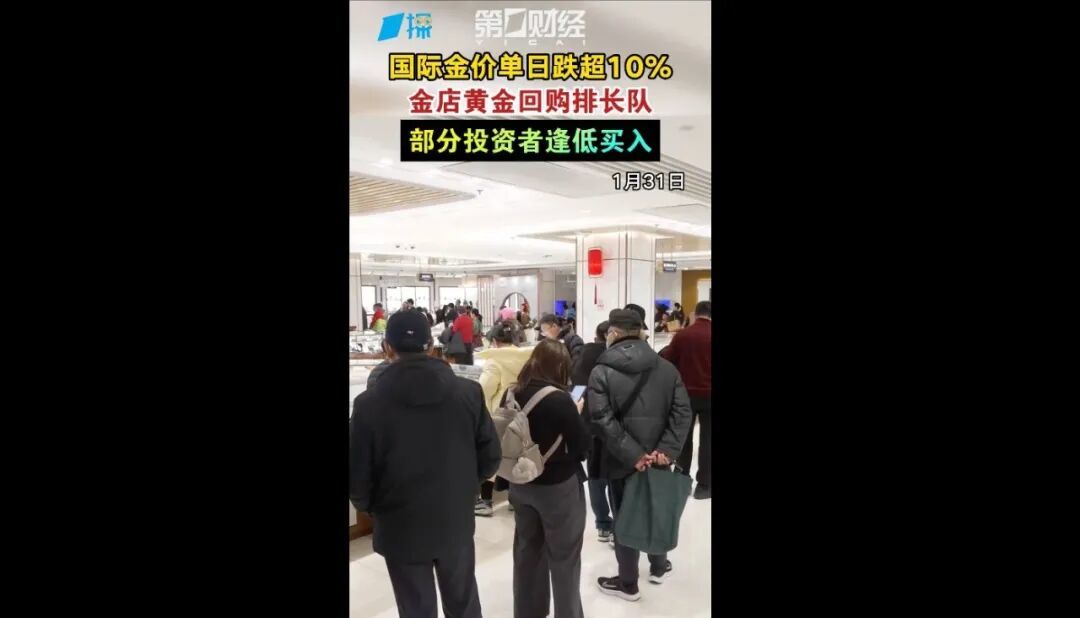
Core Viewpoint - Gold prices have experienced a significant decline after a strong rally, with the April gold futures price dropping below $4,800 per ounce, marking a decline of over 10% [1]. Price Movements - On January 30, the spot gold price fell by more than 12%, reaching a low of $4,682 per ounce, and closed down 9.25% at $4,880.03 per ounce [1]. - Domestic gold jewelry prices have also been adjusted downward, with most products seeing a price drop of around 80 yuan per gram within two days [1]. - Major gold brands in China, such as Chow Tai Fook and Chow Sang Sang, reported significant price drops, with Chow Tai Fook's gold price falling from 1,706 yuan per gram on January 29 to 1,625 yuan per gram on January 31, a decrease of 81 yuan over two days [11]. Market Reactions - Consumers are responding to the price drop by purchasing gold, with reports of long queues at gold recycling centers and increased buying activity for investment gold bars [1][3][6]. - A consumer in Beijing spent over 200,000 yuan to buy 200 grams of gold, viewing it as a long-term investment despite short-term price fluctuations [3]. - In Nanchang, consumers expressed urgency to buy gold due to recent price declines, indicating a belief that prices may rise again soon [6][8]. Market Analysis - The recent drop in gold prices is attributed to an overheated market, with volatility nearing historical extremes and speculative funds seeking to take profits [14][15]. - The gold price's steep ascent has been rare, with monthly increases exceeding 20% being historically uncommon since 1968 [15]. - Analysts suggest that the market may need time to stabilize and find a new equilibrium price following the recent volatility [16]. Institutional Responses - Major banks, including Agricultural Bank of China and Bank of Communications, have increased risk assessment requirements for clients engaging in gold transactions, reflecting heightened market risks [17][19]. - Other banks have adjusted investment thresholds and trading limits to remind investors of the risks associated with recent price fluctuations [22][23].