
通胀约束

Search documents
【招银研究|海外宏观】美国关税有望边际下行——美国IEEPA关税判决点评(2026年2月)
招商银行研究· 2026-02-27 08:52
Core Viewpoint - The U.S. Supreme Court ruled that tariffs imposed by Trump under the International Emergency Economic Powers Act (IEEPA) are unconstitutional, leading to a structural shift in U.S. tariff policy [1]. Group 1: Taxation Methods - The ruling will drive a structural shift in U.S. tariff policy, moving from comprehensive taxation to more targeted measures. The IEEPA allowed the president to impose tariffs without limits during a national emergency, but all IEEPA tariffs will become invalid following the Supreme Court's decision [4]. - As a transitional measure, the Trump administration has initiated a 10% tariff on global imports under Section 122 of the Trade Act of 1974, with plans to raise it to the maximum limit of 15% for a period of 150 days [7]. - The U.S. Trade Representative indicated that future tariff policies will focus on continuity and maintaining previously negotiated tariff levels with various countries, with tariffs on China expected to remain in the 35-50% range [7]. Group 2: Short-term Implications - In the short term, U.S. tariff rates may see a significant reduction. Before the ruling, the overall nominal tariff rate was approximately 16%, which could decrease by 2.3 percentage points after the transition to Section 122. Tariffs on China may drop by 5 percentage points from around 40% [8]. - The elimination of IEEPA tariffs will align U.S. tariffs on certain goods with global levels, benefiting products like steel, aluminum derivatives, copper, wood derivatives, and pharmaceuticals [8]. Group 3: Mid-term Constraints - In the mid-term, while the Trump administration aims to maintain pre-ruling tariff rates, there are dual constraints that may prevent a complete replacement of IEEPA tariffs [9]. - Administrative costs are a constraint, as investigations under Sections 232 and 301 require significant time, making it difficult to establish a comprehensive tariff system within 150 days [10]. - Inflation constraints are also present, as the upcoming midterm elections will focus on living costs, and raising tariffs could exacerbate inflationary pressures [10]. Group 4: Forward Outlook - Overall, the ruling suggests a shift in U.S. tariff policy from comprehensive taxation to more precise targeting. Under the constraints of administrative costs and inflation, the overall U.S. tariff rate may trend downward [11]. - There is potential for further easing of tariffs on China, especially with anticipated high-level meetings between U.S. and Chinese leaders throughout the year. However, there remains a risk of structural increases in tariffs on key Chinese industries under Sections 232 or 301 [11].

板块情绪转弱 锡镍携手下挫【盘中快讯】
Wen Hua Cai Jing· 2026-02-02 01:57
Group 1 - Precious metals and non-ferrous sectors experienced a collective decline last Friday night, with Shanghai tin dropping over 10% and Shanghai nickel falling more than 5% [1] - The nomination of Kevin Warsh as the next Federal Reserve Chairman by President Trump is interpreted by the market as a shift towards a more hawkish monetary policy, emphasizing inflation control and balance sheet reduction [1] - This nomination alleviates previous concerns regarding the independence of the Federal Reserve and undermines the aggressive easing logic that had previously supported the rise of risk assets, putting pressure on the non-ferrous metal sector [1]
金价跳水后,男子斥资20多万元抄底买入200克,称不在意短期涨跌
Mei Ri Jing Ji Xin Wen· 2026-02-01 02:57
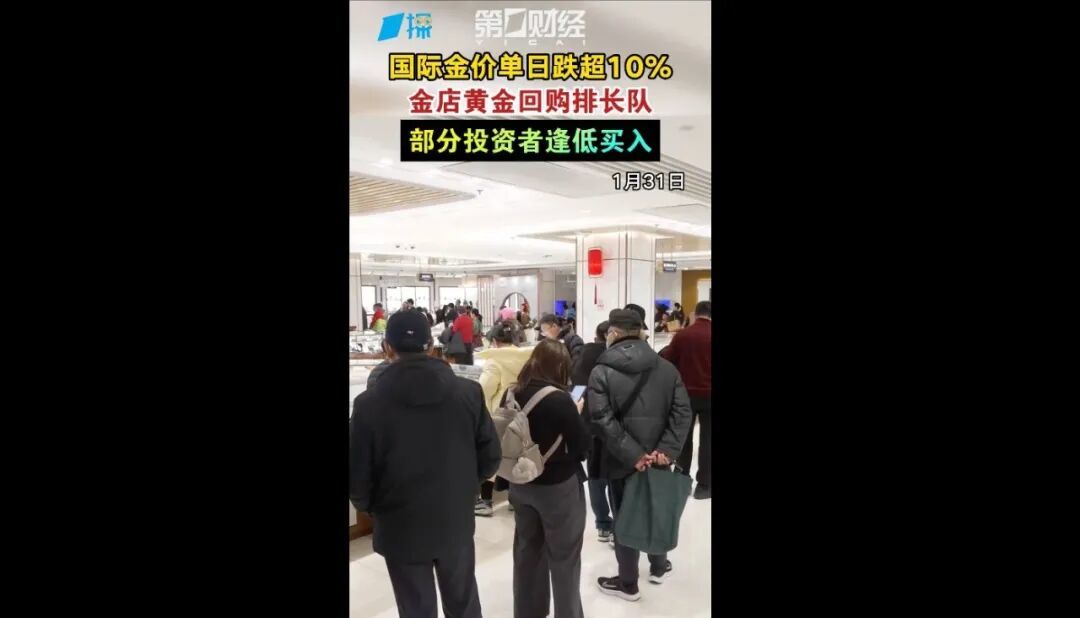
Core Viewpoint - Gold prices have experienced a significant decline after a strong rally, with the April gold futures price dropping below $4,800 per ounce, marking a decline of over 10% [1]. Price Movements - On January 30, the spot gold price fell by more than 12%, reaching a low of $4,682 per ounce, and closed down 9.25% at $4,880.03 per ounce [1]. - Domestic gold jewelry prices have also been adjusted downward, with most products seeing a price drop of around 80 yuan per gram within two days [1]. - Major gold brands in China, such as Chow Tai Fook and Chow Sang Sang, reported significant price drops, with Chow Tai Fook's gold price falling from 1,706 yuan per gram on January 29 to 1,625 yuan per gram on January 31, a decrease of 81 yuan over two days [11]. Market Reactions - Consumers are responding to the price drop by purchasing gold, with reports of long queues at gold recycling centers and increased buying activity for investment gold bars [1][3][6]. - A consumer in Beijing spent over 200,000 yuan to buy 200 grams of gold, viewing it as a long-term investment despite short-term price fluctuations [3]. - In Nanchang, consumers expressed urgency to buy gold due to recent price declines, indicating a belief that prices may rise again soon [6][8]. Market Analysis - The recent drop in gold prices is attributed to an overheated market, with volatility nearing historical extremes and speculative funds seeking to take profits [14][15]. - The gold price's steep ascent has been rare, with monthly increases exceeding 20% being historically uncommon since 1968 [15]. - Analysts suggest that the market may need time to stabilize and find a new equilibrium price following the recent volatility [16]. Institutional Responses - Major banks, including Agricultural Bank of China and Bank of Communications, have increased risk assessment requirements for clients engaging in gold transactions, reflecting heightened market risks [17][19]. - Other banks have adjusted investment thresholds and trading limits to remind investors of the risks associated with recent price fluctuations [22][23].
“踩踏式”暴跌之后,金银价格“到底”了吗?
Qi Huo Ri Bao· 2026-02-01 00:07
Core Viewpoint - The gold and silver markets experienced a sudden shift with panic selling, leading to significant price declines, with gold prices dropping by up to 12% and silver prices falling over 35% in the last two trading days of January [1][2]. Price Adjustments - Domestic gold jewelry brands adjusted their prices in response to the drop in gold and silver prices. For instance, on January 31, Chow Tai Fook's gold jewelry price fell to 1625 CNY per gram, and its gold bars dropped to 1425 CNY per gram, compared to 1706 CNY and 1496 CNY per gram on January 29 [1]. Market Conditions - The recent decline in gold prices is attributed to an overheated market, with indicators showing extreme conditions. The volatility of gold ETFs reached 46.02%, nearing historical highs, and the monthly increase in gold prices exceeded 20%, a rare occurrence since 1968 [2]. Influencing Factors - The market interpreted President Trump's nomination of Kevin Warsh as the next Federal Reserve Chair as a potential shift towards a more hawkish monetary policy, increasing risks associated with future monetary easing [3]. Future Outlook - Analysts suggest that the precious metals market may require time to stabilize and find a new equilibrium price. The current market dynamics indicate a potential for continued high volatility, with the possibility of a second bottom and back-and-forth movements in prices [4]. Long-term Perspective - Despite short-term fluctuations, the fundamental support for gold and silver remains intact. Factors such as high global debt, inflation risks, and geopolitical uncertainties continue to drive strategic demand for gold. Additionally, silver's demand is supported by structural needs in energy transition and AI, with supply constraints likely to persist [4].