大国兴衰

Search documents
沈联涛:欧洲能否走出瘫痪
Sou Hu Cai Jing· 2026-02-24 00:38
Group 1 - The EU's decision-making process has become slow and painful due to the division between France and Germany, particularly in response to geopolitical changes affecting defense, technology, and capital markets [2][5] - The year 2025 is highlighted as a critical turning point, with escalating conflicts in various regions and significant climate-related challenges, marking it as one of the hottest years on record [2] - The financial markets have reached historical highs, with gold prices increasing by nearly 70% and silver by 150%, indicating a significant shift in investment dynamics [2] Group 2 - The EU has frozen $210 billion of Russian assets since the Ukraine conflict, leading to legal challenges from Russia, which poses a threat to Europe's status as a financial center [3] - The EU's economic share of global GDP has declined from 25% in 1990 to 14% today, raising concerns about its future viability and influence [4] - Europe's reliance on a few suppliers for critical raw materials and the high cost of electricity compared to the US and China highlight its vulnerabilities in the global market [5][6] Group 3 - The former ECB President Mario Draghi identified three potential futures for Europe: paralysis, member states exiting the EU, or further integration, with the latter being the only hope for survival [6] - The lack of a unifying political figure with vision and influence has hindered the EU's ability to act cohesively, leading to a fragmented response to external threats [6] - The competition among powerful non-European countries like the US, China, and India suggests that Europe may not play a significant role in future global narratives [6][7]


人大澄海全球发展与安全高等研究院重磅发布:探索中国崛起的战略理论
Xin Lang Cai Jing· 2025-12-25 06:06
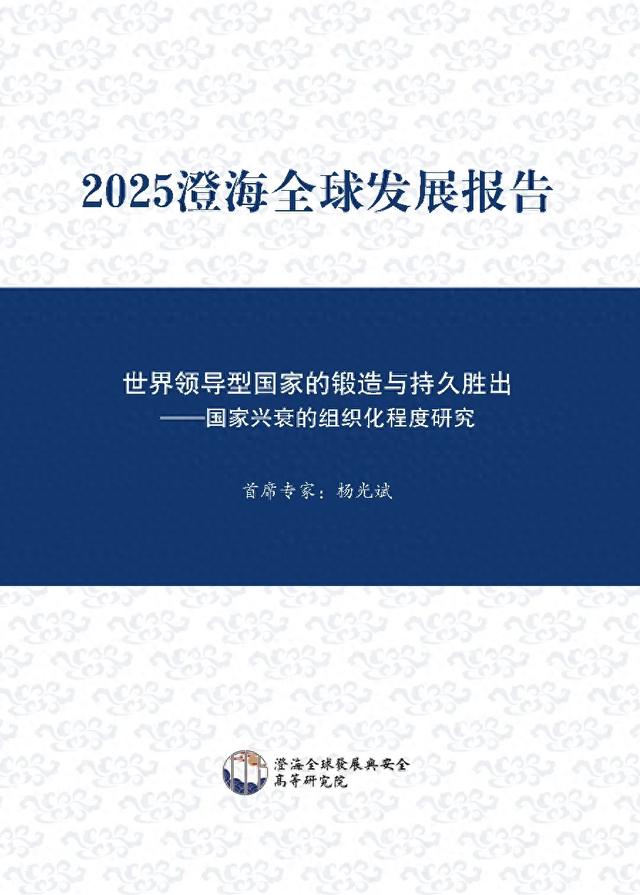
Core Insights - The report titled "The Forging and Lasting Success of World Leading Countries: A Study on the Organizational Degree of National Rise and Fall" was released by the Chenghai Global Development and Security Research Institute of Renmin University of China, focusing on the relationship between organizational degree and the rise and fall of great powers [1][3][31] - The report emphasizes the dual significance of addressing the rise and fall of great powers, particularly China, and aims to provide a new perspective on this issue through the lens of organizational sociology [3][8] Summary by Sections Organizational Degree and National Development - The report identifies a close relationship between the rise and fall of great powers and their organizational degree, suggesting that balancing organizational degree to adapt to social development is crucial [3][4] - It highlights the concept of organizational paradox, where there are both organizational benefits and traps, indicating that the degree of organization can lead to different outcomes over time [3][8] Historical Context and Comparative Analysis - The report analyzes historical cases of China and Western countries, noting that China experienced organizational benefits during the pre-modern period, establishing a centralized state earlier than Western nations [8][9] - It contrasts the rise of military-fiscal nation-states in Europe with China's traditional governance model, suggesting that the former has a stronger resource extraction capability, placing China at a competitive disadvantage [9][26] Theoretical Contributions and Methodological Approaches - The report proposes using organizational degree as a variable to connect historical context and economic development, offering a more nuanced understanding of state development compared to traditional institutionalism [11][12] - It calls for a broader examination of factors influencing organizational degree, including political, economic, and ideological dimensions, to enrich the understanding of national rise and fall [16][18] Future Research Directions - Suggestions for future research include expanding the theoretical framework to incorporate the impact of technological revolutions and examining the organizational degree in various global contexts beyond just China and Europe [12][18] - The report advocates for a more inclusive analysis that considers both leading and follower states to enhance the understanding of organizational degree and its implications for national success [18][20]
雷少华:美国“脱实向虚”因为金融赚钱容易?这里面藏了一个大隐患
Guan Cha Zhe Wang· 2025-11-22 01:06
Group 1 - The core issue of major countries transitioning from the real economy to the financial sector is attributed to technological stagnation, where old technologies fail to foster new industries, leading capital to flow into finance [1][10] - The report highlights the contrasting paths of the US and China, with the US experiencing relative decline due to a fragmented industrial system and reliance on external core technologies, while China benefits from a complete and resilient industrial system [1][7] - The report emphasizes that a strong industrial system is fundamental for driving technological advancement, and finance should serve the real economy rather than operate independently [10][11] Group 2 - The discussion at the seminar underscores the importance of organizational structure and economic forms, such as "de-industrialization," in determining the rise and fall of great powers [2] - The historical context of industrial revolutions illustrates that technological advancements have historically driven new industries, but the current technological landscape lacks disruptive innovations, leading to stagnation [6][10] - The US faces challenges due to its globalized industrial and talent systems, which, while initially beneficial, have created vulnerabilities in the face of new competitors like China [7][8]