
天空地一体化监测网络

Search documents
世界湿地日 | 守护“地球之肾” 以开放姿态分享“中国方案”
Yang Shi Wang· 2026-02-02 02:54
Core Viewpoint - China's wetland area is stable at over 55 million hectares, ranking first in Asia and fourth in the world, with a focus on high-quality protection and technological empowerment in wetland conservation [1][8]. Group 1: Wetland Protection and Conservation Efforts - Since the "14th Five-Year Plan," approximately 11 million hectares of wetlands have been included in the national park system, receiving the highest level of protection [8]. - The integration of technology in conservation efforts is highlighted, with initiatives such as the intelligent monitoring platform for migratory birds at Poyang Lake and the "smart rainforest" project in Hainan [10][12]. Group 2: Biodiversity and Species Recovery - Strong conservation measures have led to significant recovery of endangered species, such as the crested ibis population increasing from 7 to over 10,000, and the giant panda's threat level being downgraded [14]. - The establishment of a natural protected area system centered around national parks is nearly complete, with plans to further enhance this system and include more globally valuable natural areas and rare species [14].


连云港:生态环境监测监控工作迈向精准智能
Xin Hua Ri Bao· 2025-12-17 06:49
Group 1: Infrastructure and Environmental Monitoring - Lianyungang's new Xinxu Port terminal has completed the construction of a membrane warehouse, covering an area of 105,000 square meters and standing 48 meters high, making it the largest membrane warehouse for general bulk cargo in China [1] - The warehouse is equipped with advanced monitoring sensors and dust suppression facilities, effectively preventing dust emissions and reducing environmental impact [1] - The Lianyungang Environmental Monitoring and Control Center has expanded its team from 15 to 41 members, enhancing its organizational structure to ensure high-quality ecological monitoring during the 14th Five-Year Plan [3] Group 2: Biodiversity and Ecological Protection - A second round of biodiversity baseline surveys has been launched in Lianyungang, covering various species including vascular plants, mammals, birds, and aquatic organisms, with significant findings such as the reappearance of the Great Bustard in Haizhou Bay [1][2] - Lianyungang has been recognized for its ecological quality monitoring, being selected for the national ecological quality comprehensive monitoring network during the 14th Five-Year Plan [1][2] Group 3: Technological Advancements and Data Integration - The city has established a "sky-ground integrated" ecological environment monitoring network, achieving data interconnectivity and intelligent early warning systems [6] - The Lianyungang Environmental Monitoring and Control Center has expanded its laboratory area from 1,000 square meters to 2,900 square meters, increasing monitoring capabilities by 87.9% [5] - The center has implemented a closed-loop management mechanism for environmental issues, enabling precise forecasting and early warning for major environmental problems [7]

候鸟翔集绘生态新篇 “天空地一体化”监测网络体现迁徙路上的“中国温度”
Yang Shi Wang· 2025-10-29 08:33
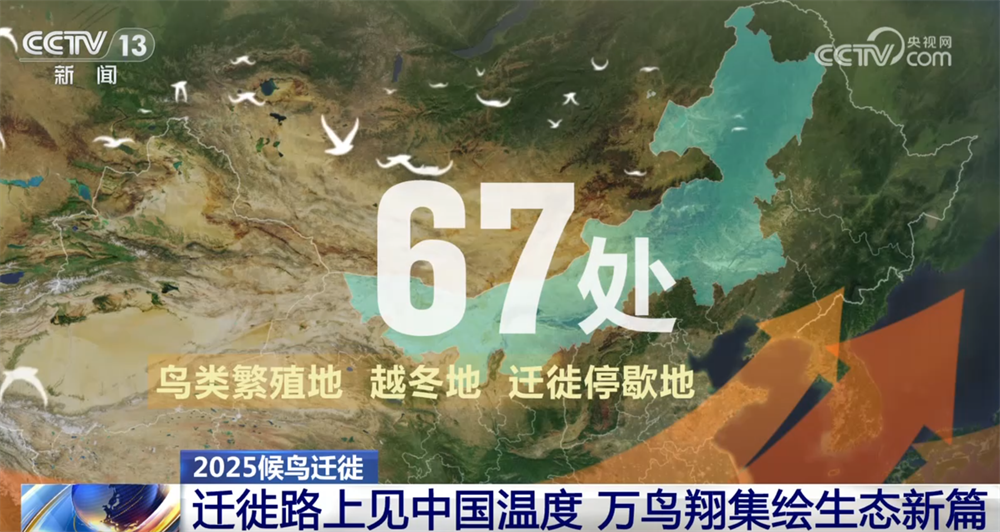
Group 1 - The core viewpoint of the news is the launch of the "Action Plan for the Protection and Restoration of Migratory Bird Flyways in China (2024-2030)" aimed at enhancing the protection and restoration of migratory bird habitats in China, identifying 821 key habitats along four major migratory routes [1] - The plan includes the establishment of an integrated monitoring network utilizing satellite remote sensing, drone inspections, and ground monitoring stations to track bird populations and habitat changes in real-time [1] - The plan reflects a commitment to scientific decision-making and emphasizes the importance of protecting migratory routes for birds [1] Group 2 - Inner Mongolia has 67 breeding, wintering, and stopover sites for birds, with significant improvements in habitat quality and bird population recovery during the 14th Five-Year Plan period [4] - As of January 2025, the number of wintering waterbirds in Inner Mongolia reached 160,000, with the population of the common teal exceeding 132,000, accounting for over 60% of the global total [4] - The Hohhot Lake Nature Reserve has seen an increase in the number of geese from fewer than 600 in 2013 to over 20,000 by February 2025, with 346 bird species recorded, including 85 nationally protected species [4] Group 3 - The Tumuji National Nature Reserve in Inner Mongolia is a crucial stopover for migratory birds along the East Asia-Australasia flyway, with thousands of birds currently resting and foraging in preparation for their southward migration [5][7] - The reserve's unique geographical location provides abundant food and stable habitats for migratory birds, with over 300 species passing through annually, including rare and endangered species [9] - The reserve covers an area of 1.14 million acres, with 270,000 acres of grassland and 340,000 acres of wetland, making it a vital stopover for migratory birds [11] Group 4 - During the 14th Five-Year Plan period, ecological protection measures such as complete grazing bans and reforestation have improved grassland vegetation coverage from 71% to 75%, attracting more migratory birds [13] - The number of white cranes in the reserve has reached 3,880, while the population of the great bustard has increased from 207 to nearly 280 [13] - The reserve staff are enhancing patrols to ensure the safety of migratory birds as they prepare for their journey to wintering grounds [13] Group 5 - The Khorchin National Nature Reserve in Inner Mongolia serves as a key node along the East Asia-Australasia migratory route, with thousands of birds currently resting and feeding [14] - Monitoring has recorded over 30,000 migratory birds, including various species of cranes, which typically stay for about 50 days before continuing their migration [18] - The reserve covers 119,587 hectares, with wetlands providing essential resting and breeding grounds for migratory birds, and the populations of six crane species are showing a stable and increasing trend [23]
以重大工程推进生物多样性系统保护|生物多样性治理系列解读⑤
Zhong Guo Huan Jing Bao· 2025-08-19 00:19
Core Viewpoint - Biodiversity has become a global focus for environmental and development issues, with countries increasing governance efforts to achieve a balance between economic development and ecological protection, particularly highlighted by China's systematic policy deployment in response to the "Kunming-Montreal Global Biodiversity Framework" [1][9]. Policy Framework - The Chinese government has prioritized biodiversity protection as a key component of ecological civilization, with the release of the "Biodiversity Protection Major Project Implementation Plan (2025-2030)" which outlines seven major projects and 24 initiatives aimed at enhancing biodiversity protection [2][3]. - The implementation plan emphasizes a systematic approach to address existing gaps in biodiversity protection, focusing on institutional frameworks, technical support, and capacity building [2]. Engineering Initiatives - The seven major engineering projects include: 1. On-site protection focusing on optimizing natural reserves and restoring habitats for endangered species 2. Off-site protection centered on botanical gardens and genetic resource banks 3. Biological safety measures to control invasive species and disease risks 4. Sustainable utilization promoting biodiversity-friendly industries 5. Assessment systems for monitoring biodiversity changes 6. Collaborative efforts integrating climate change and pollution control 7. Mainstreaming biodiversity awareness among the public and financial institutions [4][5]. Technological Empowerment - The plan aims to enhance biodiversity monitoring through advanced technologies such as remote sensing, AI recognition, and eDNA analysis, addressing current limitations in manual monitoring methods [6][7]. - A national biodiversity big data platform will be established to integrate various data sources, facilitating scientific governance and decision-making [7]. Social Collaboration - The implementation of biodiversity protection requires multi-stakeholder engagement, with proposed mechanisms for dynamic management, cross-department coordination, and financial support systems [8]. - Encouragement of public participation and the establishment of ecological public welfare positions aim to raise awareness and foster community involvement in biodiversity initiatives [8]. International Contribution - The implementation plan is a key measure for China to fulfill its commitments under the "Kunming Framework," aiming to enhance global cooperation in biodiversity governance and contribute to international goals for biodiversity protection [9].