太空数据中心成本平价

Search documents
这不是科幻!2030年,太空数据中心成本将追平地面
华尔街见闻· 2026-01-15 07:56
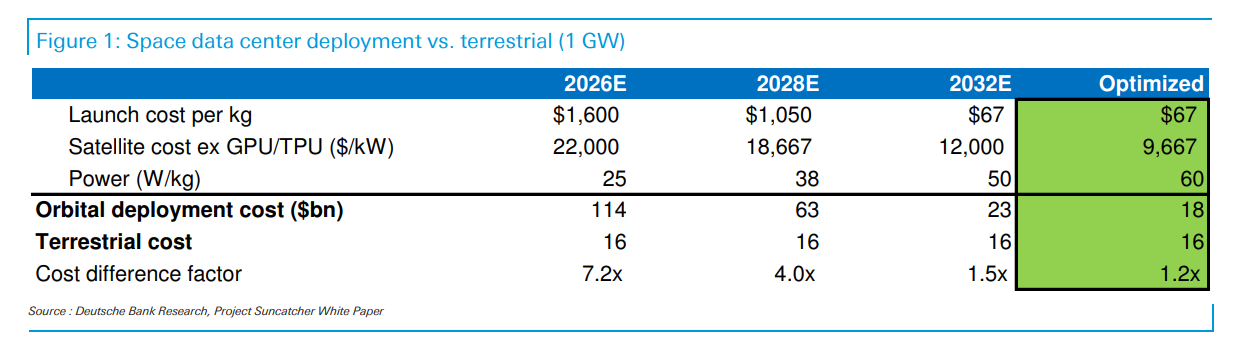
Core Viewpoint - The transition of high-energy AI computing to space is moving from theoretical discussions to economically viable validation, with the cost gap between space and terrestrial data centers rapidly narrowing [2][3]. Cost Gap Rapidly Closing - Deutsche Bank's model indicates that while the current cost of deploying a 1 GW space data center is at least 7 times that of terrestrial centers, this ratio is expected to decrease to 4 times by the late 2020s and reach cost parity in the 2030s [3][4]. - The decline in costs is primarily driven by reductions in launch costs and improvements in satellite design and energy efficiency, leading to a significant decrease in the mass required for orbital deployment [3][4]. Projected Cost Data - In the estimated scenario for 2026, the cost of space deployment is projected to be $114 billion, compared to $16 billion for terrestrial deployment, resulting in a difference factor of 7.2 times. By the "optimized scenario" in 2032, space deployment costs are expected to drop to $18 billion, nearly equal to the terrestrial cost of $16 billion, with a difference factor of 1.2 times [4][5]. Key Factors for Economic Reversal - The critical variable for achieving this economic reversal is the dramatic drop in launch costs, which are projected to fall from $1,600 per kg in 2026 to $67 per kg by 2032 [6]. - The report emphasizes the importance of fully reusable rockets and economies of scale in operations, suggesting that launch costs could potentially decrease to as low as $1 million or even below $70 per kg over time [7]. Hardware Optimization - In addition to launch costs, significant advancements in orbital hardware are anticipated. By the 2030s, the cost of a single satellite is expected to drop below $2 million, or just $10,000 per kW, featuring a 150 kW power system and custom chips designed for space AI infrastructure [9]. - However, the model's assumptions are based on the premise that ground capacity costs remain unchanged, and it does not account for the expensive procurement costs of GPU/TPU chips. The report warns that if ground-based energy sources, such as nuclear power, become rapidly available and inexpensive, the assumptions may no longer hold [9][10].


这不是科幻!2030年,太空数据中心成本将追平地面
Hua Er Jie Jian Wen· 2026-01-15 06:12
Core Insights - The transition from theoretical discussions to economic feasibility for deploying high-energy AI computing in space is underway, with significant cost reductions anticipated in the coming decade [1] Cost Gap Rapidly Closing - Deutsche Bank's model indicates that while current costs for deploying a 1 GW space data center are at least seven times higher than terrestrial costs, this gap is expected to narrow to four times by the late 2020s and achieve cost parity in the 2030s [2] - In a projected scenario for 2026, the cost for space deployment is estimated at $114 billion compared to $16 billion for terrestrial setups, resulting in a 7.2x difference. By the "2032 optimized scenario," space deployment costs could drop to $18 billion, nearly equal to terrestrial costs at $16 billion, with a difference factor of only 1.2x [2] Launch Cost Decline as a Key Factor - The dramatic decrease in launch costs is identified as a critical variable for achieving economic viability. The model predicts that launch costs per kilogram will plummet from $1,600 in 2026 to $67 by 2032 [4] - The report emphasizes the importance of complete rocket reusability and operational scaling, suggesting that launch costs could potentially fall to as low as $1 million or even below $70 per kilogram over time [4] Hardware Optimization - Significant advancements in orbital hardware are also expected, with projections indicating that the cost of a single satellite could drop below $2 million (or just $10,000 per kW) by the 2030s [7] - These optimized satellites will feature a 150 kW power system and custom chips designed specifically for space AI infrastructure, connected via optical laser terminals [7] Considerations and Assumptions - Deutsche Bank acknowledges that its model is based on the assumption that terrestrial capacity costs remain unchanged. The model primarily compares costs related to power, cooling, and weight, excluding expensive GPU/TPU chip procurement costs [8] - The report warns that if rapid and inexpensive power generation methods (e.g., nuclear energy) emerge on the ground, the assumptions regarding space data centers may no longer hold true [8] - This indicates that the logic behind space data centers depends not only on advancements in space technology but also on the stagnation of ground energy revolutions [9]