
奢侈品市场放缓

Search documents
职场霸凌? 华伦天奴大中华区CEO,遭多员工联名举报 | 贵圈
Xin Lang Cai Jing· 2025-12-05 01:13
Core Viewpoint - Valentino, the Italian luxury brand, is facing significant challenges due to allegations of misconduct by its Greater China CEO, Janice Lam, and deteriorating financial performance, leading to increased debt and potential default issues [3][4][6]. Financial Performance - Valentino's revenue declined by 5% in 2023 to €1.35 billion, with operating profit dropping 18% to €99 million [4][12]. - In 2024, revenue further decreased by 3% to €1.31 billion, and operating profit fell by 22% to €246 million [4][12]. - By the end of 2024, net debt reached €1.08 billion, triggering debt covenant breaches [4][6]. Management Issues - Employees have reported serious allegations against Janice Lam, including performance falsification and workplace bullying, highlighting issues within the management structure [3][5]. - The internal management problems are exacerbated by high employee turnover and pressure to meet performance targets, leading to a chaotic work environment [9][17]. Market Challenges - Valentino's performance is particularly weak in traditional markets like Europe and Asia, with a notable decline in the Chinese luxury goods market [5][12]. - The brand's reliance on outdated marketing strategies, such as celebrity endorsements and a singular focus on iconic products, has failed to resonate with the evolving preferences of younger consumers [8][16]. Strategic Developments - In July 2024, Valentino's financial struggles led to a breach of terms in a €530 million financing agreement, which requires maintaining specific debt-to-EBITDA ratios [6][14]. - The company announced a CEO change in August 2024, which some industry insiders believe is linked to the brand's declining performance and pressures from its parent company, Kering [6][15]. Industry Context - The global luxury market is experiencing its first significant slowdown since 2009, with both the U.S. and Chinese markets stagnating [8][16]. - Analysts suggest that Valentino's issues reflect broader trends in the luxury sector, where brands must adapt to changing consumer behaviors and preferences [8][16].

LVMH老板又来上海了,今天还去老铺黄金“逛了一圈”
Di Yi Cai Jing· 2025-09-16 14:06
Group 1 - Bernard Arnault, the CEO of LVMH, has been visiting China for three consecutive years, indicating the importance of the Chinese market for luxury brands [3] - LVMH, which owns brands like Louis Vuitton, Dior, and Tiffany, is facing challenges as the global luxury market is cooling down, with a projected decline in the number of luxury consumers from 400 million in 2022 to 350 million by the end of 2024 [3][4] - The luxury goods market is expected to see a total consumption of approximately €1.48 trillion in 2024, reflecting a year-on-year decline of 1%-3% [3] Group 2 - LVMH's revenue is projected to decline by 4% year-on-year to €39.81 billion in the first half of 2025, with net profit decreasing by 22% to €5.69 billion [3] - There is a growing interest among Chinese consumers in local brands, with LVMH planning to continue investing in China despite the market slowdown [4] - The overlap in consumer demographics between local brand Lao Pu Huang Jin and international luxury brands like LV and Cartier is significant, with a 77.3% overlap rate [4]

连LV、爱马仕都扛不住了
3 6 Ke· 2025-08-04 02:31
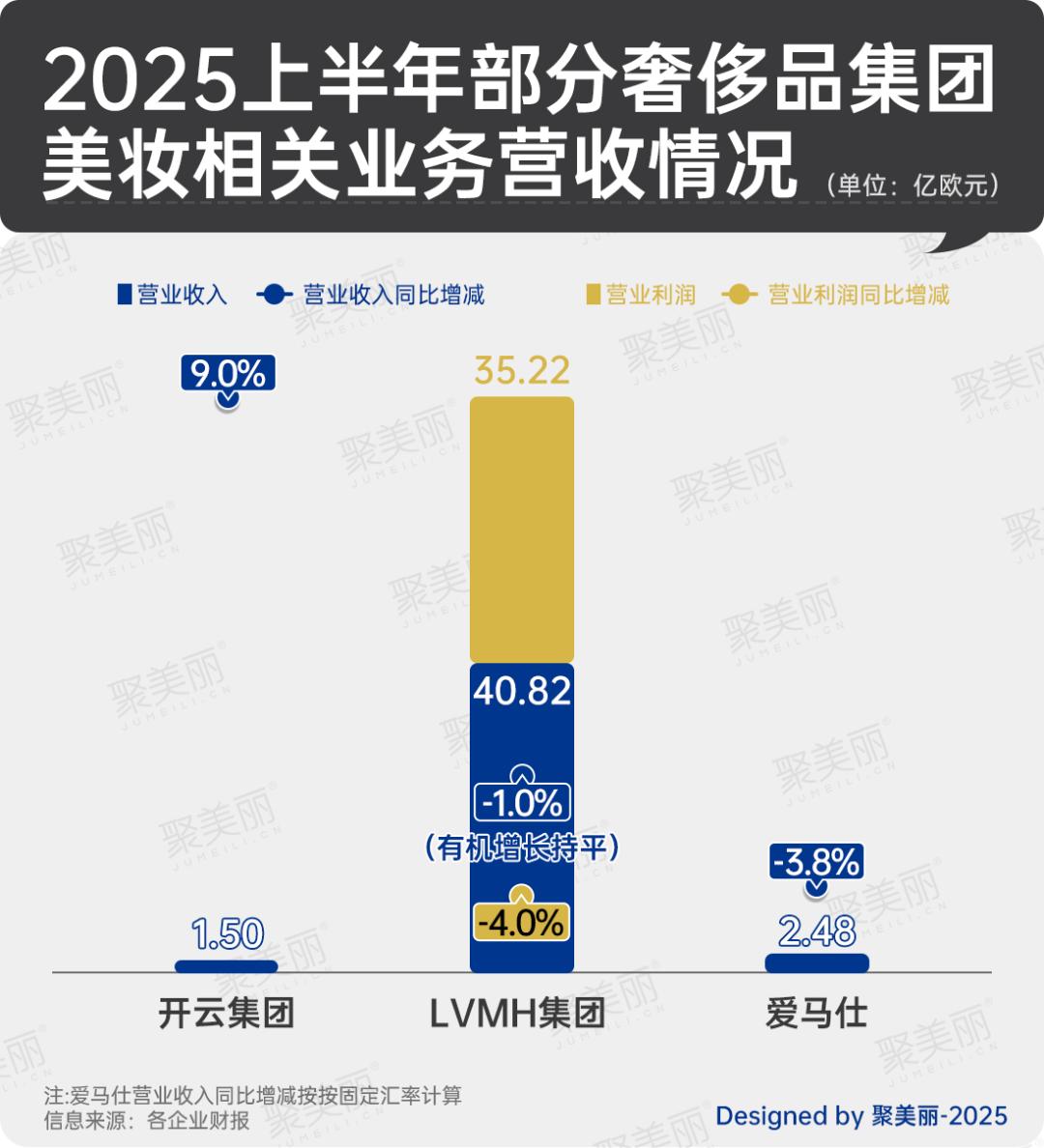
Group 1 - Sales in the perfume and beauty sector decreased by 4% compared to the second quarter of the previous year, with the Asia-Pacific market (excluding Japan) showing relatively slow growth [2] - LVMH's beauty-related business declined by 1%, with both the Asia-Pacific and Japanese markets experiencing year-on-year decreases [3] - Kering Group reported a 7% decline in sales in China, Hong Kong, and Macau, with mainland performance being particularly weak [3] Group 2 - Kering Group's overall revenue for the first half of 2025 was €7.587 billion (approximately ¥62.918 billion), a reported decline of 16%, with net profit plummeting by 46% to €474 million (approximately ¥3.930 billion) [8] - Kering's main brand Gucci saw a significant profit drop of 52%, with expectations of closing 80 stores, up from an initial estimate of 50 [9][13] - Kering's beauty segment, however, showed growth, with a 9% increase in revenue for the first half of the year, driven by the performance of Creed perfume [14][16] Group 3 - The luxury goods market is facing a slowdown, with LVMH and Kering both reporting declines in operating income and net profit for the first half of 2025 [20] - The Asia-Pacific region experienced the largest decline, with Kering's sales down by 22% year-on-year [26] - The Japanese market also showed significant declines, with LVMH's sales down 15% and Kering's down 20% [31] Group 4 - Despite the challenges, the luxury beauty market is projected to grow, with a compound annual growth rate (CAGR) of 5.80% from 2023 to 2030 [32] - Kering has issued €750 million (approximately ¥6.218 billion) in bonds to enhance financial flexibility for expanding its beauty product portfolio [35] - Collaborations for beauty product lines are becoming common, with LVMH partnering with Pat McGrath and Prada with L'Oréal [36]
净利润再暴跌46%,开云集团触底了吗?
2 1 Shi Ji Jing Ji Bao Dao· 2025-07-30 07:01
Core Viewpoint - Kering Group reported a significant decline in net profit and sales for the first half of 2025, indicating ongoing struggles in the luxury goods market, particularly with its flagship brand Gucci [1][2]. Financial Performance - Kering's net profit fell by 46% to €474 million in the first half of 2025, down from €878 million in the same period of 2024 [1]. - Sales decreased by 16% to €7.6 billion in the first half of 2025 [1]. - Gucci's sales dropped by 26% to €3 billion, compared to over €4 billion a year earlier [2]. Brand Performance - The performance of Kering's brands varied, with Saint Laurent's revenue declining by 11% to €1.288 billion, while other brands saw a 15% drop to €1.459 billion [1]. - Bottega Veneta experienced a 1% revenue increase to €846 million, contributing 11% to the group's total revenue [1]. - Kering's eyewear and beauty segments grew by 2% to €1.092 billion, with beauty revenue increasing by 9% [1]. Market Conditions - The luxury goods market is facing a slowdown, with weakened consumer confidence and adverse currency fluctuations impacting tourism [2]. - The Asia-Pacific region (excluding Japan) and Japan experienced the most significant declines in sales [2]. - A strong euro negatively affected Kering's revenue growth by nearly 1% [2]. Strategic Changes - Kering appointed Demna, formerly of Balenciaga, as the creative director for Gucci in hopes of revitalizing the brand [2]. - Gucci's spring/summer women's fashion show scheduled for September has been postponed to March next year, with a new collection set to be launched [2]. Tariff Implications - The U.S. and EU have agreed to impose a 15% tariff on European products exported to the U.S., which could impact Kering's sales in North America, accounting for 24% of its revenue [3]. - Kering's CFO stated that the impact of tariffs is manageable and may lead to price adjustments in the fall [3].