存储器国产替代

Search documents
500亿存储器牛股年涨超370%
2 1 Shi Ji Jing Ji Bao Dao· 2025-12-02 06:11
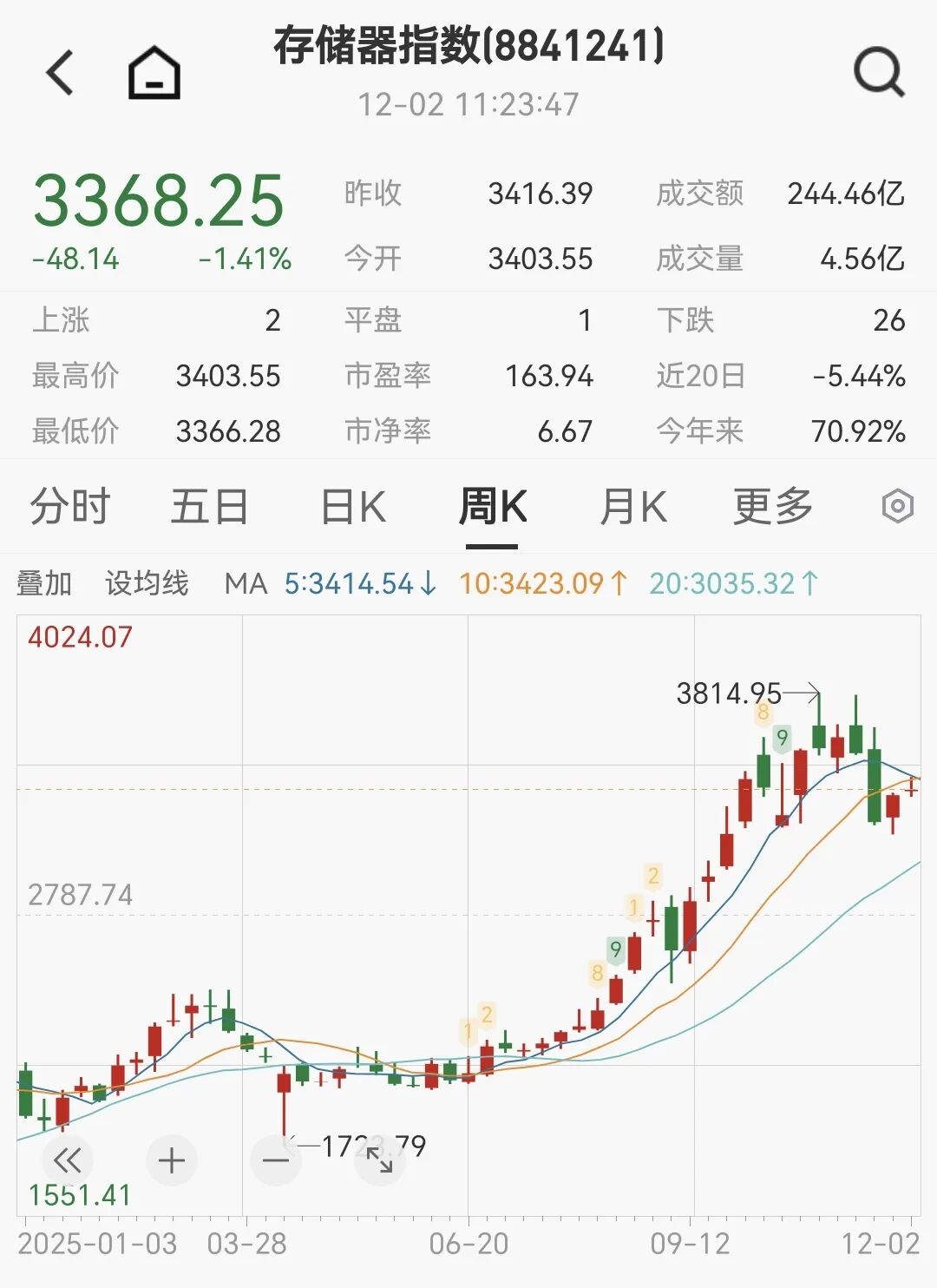
Core Viewpoint - The storage market experienced a significant downturn in late November due to concerns over the AI bubble, but has shown signs of recovery as of December 1, with a notable increase in the storage index and individual company performances [1][2]. Market Performance - As of December 1, the storage index (8841241.WI) closed at 3416.39 points, marking a daily increase of 1.99% and a consecutive four-day rise [2]. - Year-to-date, the storage sector has seen a remarkable increase of 97.7% in market capitalization weighted average, with leading companies like Dongxin Co. (688110.SH), Demingli (001309.SZ), and Jiangbolong (301308.SZ) achieving gains of 382.73%, 244.60%, and 189.63% respectively [2]. Industry Dynamics - The market's volatility is attributed to concerns over the mismatch between accelerated capital expenditures and delayed revenue recovery in the AI sector, although analysts argue that fears of an AI bubble are unfounded [5]. - The demand for high-bandwidth memory (HBM) is surging, driven by major companies like NVIDIA and OpenAI securing significant contracts, which has led to a squeeze on consumer-grade NAND Flash and DRAM production [5][6]. Structural Changes - The semiconductor industry is undergoing a strategic shift, with companies like SK Hynix expanding production to meet the demands of large tech firms, indicating a focus on high-margin products [6]. - The storage industry is experiencing a supply-demand imbalance, with prices for DDR4 memory doubling and supply constraints affecting DDR5 and SSD pricing [7]. Regional Development - Guangdong province is solidifying its dominant position in the storage and AI hardware industry, with a significant number of storage index component companies based in the region [9]. - The industrial layout in Guangdong is evolving towards a multi-polar development model, with companies like Jiangbolong expanding their manufacturing bases beyond Shenzhen to optimize costs and leverage regional advantages [9][10]. Market Demand - The demand for storage is expected to remain robust, driven by increasing requirements in mobile devices and data centers, with projections indicating that relief from supply constraints may not occur until late 2026 [7][8]. - Major tech firms in Guangdong, including Huawei and OPPO, contribute to a diverse market demand that supports the region's supply chain advantages [11][12]. Conclusion - The storage industry is poised for a prolonged upward cycle driven by AI advancements and regional industrial collaboration, with Guangdong's strategic advantages providing a solid foundation for companies to navigate market fluctuations [12][13].


500亿存储器牛股年涨超370%
21世纪经济报道· 2025-12-02 06:06
Core Viewpoint - The storage market experienced a significant downturn in late November due to concerns over the AI bubble, but has shown signs of recovery as of December 1, with the storage index rising by 1.99% and a year-to-date increase of 97.7% [1][8]. Market Performance - As of December 1, the storage index closed at 3416.39 points, marking a 1.99% increase on that day and a continuous rise over four trading days [1]. - Leading companies in the storage sector include Dongxin Co. (382.73%), Demingli (244.60%), and Jiangbolong (189.63%) [1]. Market Dynamics - Concerns about the AI bubble stem from a mismatch between accelerated capital expenditure and delayed revenue recovery, but analysts argue that the AI bubble theory is unfounded [8]. - The demand for high-bandwidth memory (HBM) is surging, driven by major companies like NVIDIA and OpenAI securing significant contracts with manufacturers like Samsung and SK Hynix [8][9]. Supply Chain Adjustments - SK Hynix is shifting its strategy to meet the demand from large tech companies, focusing on expanding HBM production while also increasing general DRAM capacity [9]. - The storage industry is experiencing a structural change, with a supply-demand imbalance leading to price increases for DDR4 memory and a halt in pricing for DDR5 and SSDs due to supply constraints [10]. Regional Development - Guangdong's dominance in the storage and AI hardware industry is strengthening, with a notable concentration of companies in Shenzhen and a trend towards multi-polar development [13][15]. - Companies like Jiangbolong are expanding their operations beyond Shenzhen to optimize costs and leverage regional advantages [13]. Market Demand - The demand for storage is expected to remain robust, with projections indicating that supply constraints may not ease until late 2026 [10]. - Major tech firms and automotive companies based in Guangdong contribute to a diverse and substantial market demand for storage solutions [15]. Industry Outlook - The storage cycle is anticipated to continue its upward trend, supported by increasing demand from AI applications and data centers [11]. - The structural upgrades driven by AI are expected to provide resilience to the storage industry, despite short-term market fluctuations [15].