
宏观政策调整

Search documents
国泰君安期货商品研究晨报:黑色系列-20260319
Guo Tai Jun An Qi Huo· 2026-03-19 05:18
Group 1: Investment Ratings - No investment ratings are provided in the report. Group 2: Core Views - Iron ore shows a pattern of near - strong and far - weak, and the 5 - 9 positive spread should be held continuously [2][4]. - The market sentiment for rebar and hot - rolled coil is weak, and they will fluctuate widely [2][7]. - In the short term, due to the influence of the geopolitical situation, the long - short game of silicon iron and manganese silicon commodities intensifies [2][11]. - Coke and coking coal will fluctuate widely [2][14]. - The price of thermal coal is rising in the producing areas and stabilizing at the ports [2][17]. - The cost of logs is rising, and the price will fluctuate at a high level [2][19]. Group 3: Summary by Commodity Iron Ore - **Fundamental Data**: The closing price of I2605 was 811.0 yuan/ton, down 5.5 yuan/ton (-0.67%); the open interest decreased by 6,207 hands. Spot prices of imported ores such as PB and super special decreased, while domestic ores remained stable. The basis and spreads changed to some extent [4]. - **News**: Near - term prices rebounded due to the escalation of the US - Iran conflict and potential restrictions on BHP iron ore purchases. The 2026 government work report adjusted the GDP growth target, and the daily average pig iron output of 247 steel enterprises decreased [4][5]. - **Trend Intensity**: 1 [5] Rebar and Hot - Rolled Coil - **Fundamental Data**: The closing price of RB2605 was 3,140 yuan/ton, down 3 yuan/ton (-0.10%); the closing price of HC2605 was 3,310 yuan/ton, up 7 yuan/ton (0.21%). Spot prices in most regions remained stable. There were changes in basis and spreads [7]. - **News**: In February 2026, the decline in the sales price of commercial residential buildings in 70 large and medium - sized cities continued to narrow. There were changes in steel production, inventory, and demand. Import and export data of steel and iron ore also changed. The CPI rose, and the PPI decline narrowed. There were policies related to the "15th Five - Year Plan" and real estate [8][9]. - **Trend Intensity**: 0 for both rebar and hot - rolled coil [10] Silicon Iron and Manganese Silicon - **Fundamental Data**: The closing prices of silicon iron 2605 and 2607 decreased, as well as those of manganese silicon 2605 and 2607. Spot prices of silicon iron decreased, and that of manganese silicon increased. There were changes in basis, near - far month spreads, and cross - variety spreads [11]. - **News**: There were price quotes from iron alloy online, and the daily output of silicon iron increased. Some steel mills determined the purchase prices of silicon iron and manganese silicon [11][13]. - **Trend Intensity**: 0 for both silicon iron and manganese silicon [13] Coke and Coking Coal - **Fundamental Data**: The closing price of JM2605 was 1156.5 yuan/ton, down 19.5 yuan/ton (-1.7%); the closing price of J2605 was 1721.5 yuan/ton, down 10.5 yuan/ton (-0.6%). Spot prices of coking coal and coke had some changes. There were changes in basis and spreads [14]. - **News**: There were changes in the CCI metallurgical coal index. The coking coal online auction had a 10% non - successful bid rate and an average premium of 53.35 yuan/ton [14]. - **Trend Intensity**: 0 for both coke and coking coal [16] Thermal Coal - **Fundamental Data**: The prices in the producing areas such as Shanxi, Inner Mongolia, and Shaanxi increased slightly, and the port prices remained stable. The long - term agreement prices increased slightly [17]. - **News**: The market sentiment in the northern ports was positive on March 18. The national raw coal output from January to February 2026 decreased slightly year - on - year [18]. - **Trend Intensity**: 0 [18] Logs - **Fundamental Data**: There were changes in the closing prices, trading volumes, and open interests of log futures contracts. Spot prices in most regions remained stable, and there were changes in spreads [19]. - **News**: The 2026 government work report adjusted the GDP growth target, and there were real estate policies in Shanghai [21]. - **Trend Intensity**: 0 [22]
值得收藏!刘世锦在2025新浪金麒麟论坛演讲的PPT
Xin Lang Cai Jing· 2026-01-15 03:22
Core Viewpoint - The conference emphasizes the need to reshape the growth paradigm in China, transitioning from investment and export-driven growth to innovation and consumption-driven growth during the 14th Five-Year Plan period [5][54]. Consumption Structure - China is not yet a consumption powerhouse, with consumption accounting for about 20 percentage points less of GDP compared to the global average [9][55]. - Addressing this structural gap is essential for China to become a consumption-driven economy, which includes increasing both domestic and international consumption [11][58]. - The focus on consumption is shifting from investment as the primary driver of economic growth to consumption as the key factor [11][58]. Industrial Structure - The manufacturing sector's share of GDP may decline, but this does not indicate a lack of transformation; rather, it highlights the need for high-tech, knowledge-intensive service industries to support manufacturing upgrades [12][59]. - The complexity of industrial structure transformation is increasing, necessitating a fair competitive environment for businesses [15][61]. Foreign Trade - Despite a challenging international environment, China's exports have remained strong, reflecting improvements in technology and industrial competitiveness [16][63]. - A significant trade deficit indicates reduced domestic consumption, which is unsustainable in the long term; thus, a balanced import-export strategy is needed [16][65]. Financial Structure - The evolution of the financial system is accelerating, with a shift from traditional banking to capital markets, which will play a more significant role in supporting economic growth [22][70]. - The capital market should foster large, innovative enterprises and increase the participation of institutional investors to support social security systems [26][72]. Urban-Rural Structure - Urbanization is slowing as the population approaches 70%, leading to more internal migration within urban areas rather than from rural to urban [27][75]. - Addressing disparities in public services between urban and rural populations is crucial for achieving balanced development [31][79]. Income Distribution - To avoid the middle-income trap, China should aim to reduce the Gini coefficient to around 0.4, promoting a stable middle-income group that constitutes over half of the population [33][84]. - Policies should focus on increasing labor income's share of GDP and improving social security for low- and middle-income groups [37][86]. Macroeconomic Policy - While macroeconomic policies are currently focused on short-term stabilization, they cannot provide the foundational growth momentum needed for the economy [40][87]. - Structural reforms are essential to address deep-rooted issues, and reliance on macroeconomic policies should be carefully managed to avoid dependency [42][89].



多家机构预测前三季度GDP增速约5.1%,后续仍有降准降息空间
Sou Hu Cai Jing· 2025-10-17 03:17
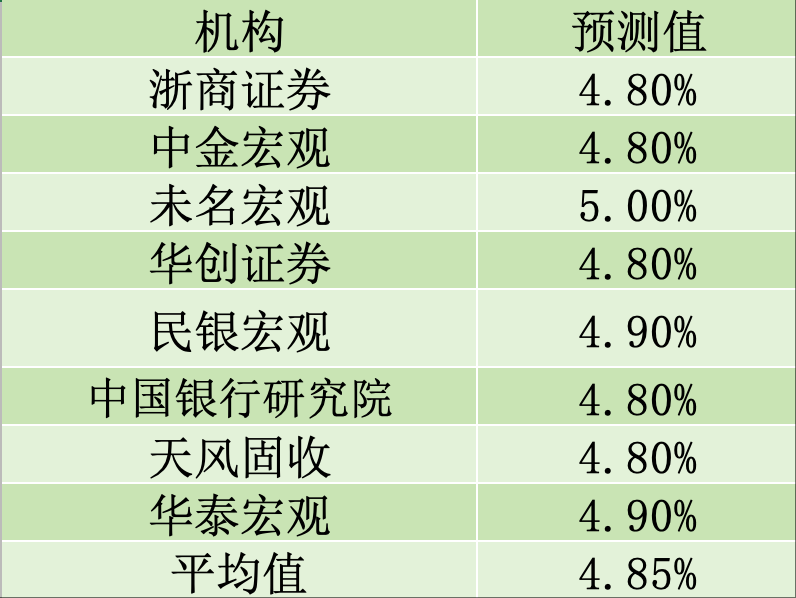
Core Viewpoint - The GDP growth rate for the third quarter of 2025 is projected to be around 4.85%, contributing to an estimated cumulative GDP growth rate of approximately 5.1% for the first three quarters of the year [1][3]. GDP Growth Predictions - Eight institutions have provided GDP growth predictions for the third quarter, with estimates ranging from 4.80% to 5.00%, averaging at 4.85% [2][4]. - The predictions include: - Zheshang Securities: 4.80% - CICC Macro: 4.80% - Weiming Macro: 5.00% - Huachuang Securities: 4.80% - Minyin Macro: 4.90% - Bank of China Research Institute: 4.80% - Tianfeng Fixed Income: 4.80% - Huatai Macro: 4.90% [2]. Economic Factors - The economic uncertainty is increasing, and there is a possibility of "timely strengthening" of fiscal policies in the fourth quarter to achieve the annual growth target of around 5% [3][17]. - The monetary policy is shifting towards "moderate easing," with potential for reserve requirement ratio cuts to release long-term liquidity [3][20]. Export Performance - Exports remain resilient, with a total export value of 19.95 trillion yuan for the first three quarters, reflecting a year-on-year growth of 7.1% [6]. - The changing structure of export destinations has led to faster growth in exports to Germany, ASEAN, and Belt and Road countries, partially offsetting declines due to US-China trade tensions [6]. Pressure Factors - Several pressure factors are noted, including challenges in the construction and real estate sectors, as well as a slowdown in industrial production and consumer spending [7][8]. - The average industrial production growth rate for July and August was around 5.4%, with a projected growth of 5.6% for the third quarter [7]. - Retail sales growth is expected to decline, with predictions of 3.2% for September due to high base effects from previous years [7][8]. Investment Trends - Fixed asset investment growth is projected to be low, with an estimated increase of only 0.4% for the first nine months of 2025 [13]. - Manufacturing investment is expected to fall below GDP growth for the first time since 2021, with a cumulative growth rate of 4.0% [13]. Inflation and Price Trends - In September, the Consumer Price Index (CPI) increased by 0.1% month-on-month but decreased by 0.3% year-on-year, indicating a narrowing decline [14]. - The Producer Price Index (PPI) remained stable, with a year-on-year decrease of 2.3% [14]. Future Policy Directions - The government is expected to implement policies to stimulate demand, particularly in consumer sectors, and may introduce new measures to support foreign trade [18][19]. - Fiscal policies may focus on enhancing social security and healthcare support, while monetary policies are likely to maintain a stable and accommodating stance [19][20].
中央政治局定调下半年经济工作,传递多重有力信号
Zhong Guo Xin Wen Wang· 2025-07-30 13:02
Economic Performance - China's economy has shown better-than-expected performance in the second quarter despite significant external pressures, with a GDP growth rate of 5.3% year-on-year [2] - The retail sales of consumer goods reached 24.55 trillion yuan, with consumption contributing 52% to economic growth, highlighting consumption as a key driver [2] Macroeconomic Policy - Several foreign financial institutions have raised their growth forecasts for China, citing the consistency and foresight of macroeconomic policies as a key reason [3] - The political bureau meeting emphasized maintaining policy continuity and stability while enhancing flexibility and foresight, with a focus on effective implementation of fiscal and monetary policies [3] - The meeting outlined plans to stimulate domestic demand, improve consumption, and boost effective investment, particularly in service consumption and private investment [3] Market Competition - The Chinese government is focusing on addressing "involution" in competition, aiming to optimize market competition order and regulate disorderly competition among enterprises [4] - Recent measures include revising pricing laws and addressing issues related to subsidy wars in various sectors, expanding the focus from previously highlighted industries to include e-commerce and food delivery platforms [4] - The government aims to use legal means to curb excessive price competition and promote a healthier competitive environment [5]
铜价波动待观察:宏观与基本面共振 78000 元/吨在望
Sou Hu Cai Jing· 2025-05-08 04:23
Group 1: Metal Market Overview - LME copper experienced a decline of 1.2%, settling at $9,406 per ton, while SHFE copper dropped 0.74% to 77,450 CNY per ton, with domestic import profits slightly positive [1] - LME nickel fell by 0.38% to $15,630 per ton, and SHFE nickel decreased by 0.35% to 123,640 CNY per ton, with LME inventory down by 300 tons and SHFE warehouse receipts down by 416 tons [1] - Aluminum and alumina markets showed weakness, with alumina at 2,700 CNY per ton (down 0.22%) and SHFE aluminum at 19,340 CNY per ton (down 1.55%), indicating a potential oversupply situation [1] Group 2: Supply and Demand Dynamics - The supply side for nickel iron shows signs of production cuts, while demand remains under pressure, leading to short-term price fluctuations [1] - The silicon market is also experiencing weakness, with polysilicon at 35,520 CNY per ton (down 3.14%) and industrial silicon at 8,290 CNY per ton (down 0.96%), as traders push for lower prices ahead of the holiday [1] - Lithium carbonate futures fell by 1.99% to 64,160 CNY per ton, with spot prices for battery-grade lithium carbonate also declining, indicating ongoing inventory accumulation despite some demand replenishment [1]