宏观经济稳定性

Search documents
【环球财经】吉尔吉斯斯坦央行将基准利率上调至10%
Xin Hua Cai Jing· 2025-10-28 06:22
Core Viewpoint - The National Bank of Kyrgyzstan has raised the benchmark interest rate by 75 basis points to 10% as of October 28, 2023, in response to inflationary pressures and economic conditions [1] Economic Indicators - Kyrgyzstan's inflation rate since 2025 stands at 6.2%, with an annualized inflation rate of 8.4% [1] - Current inflation is influenced by foreign market energy supply constraints, rising costs in certain service sectors, and strong consumer demand [1] Economic Growth Factors - The expansion of domestic financing channels has led to increased fixed capital investment, significantly boosting the construction industry [1] - Growth in household income due to active fiscal policies and increased remittance inflows remains a primary driver of domestic demand [1] Monetary Policy - The National Bank of Kyrgyzstan is implementing a balanced monetary credit policy and continues to assess both internal and external inflation factors [1] - The bank does not rule out adjustments to current monetary policy in response to risks affecting price stability [1]
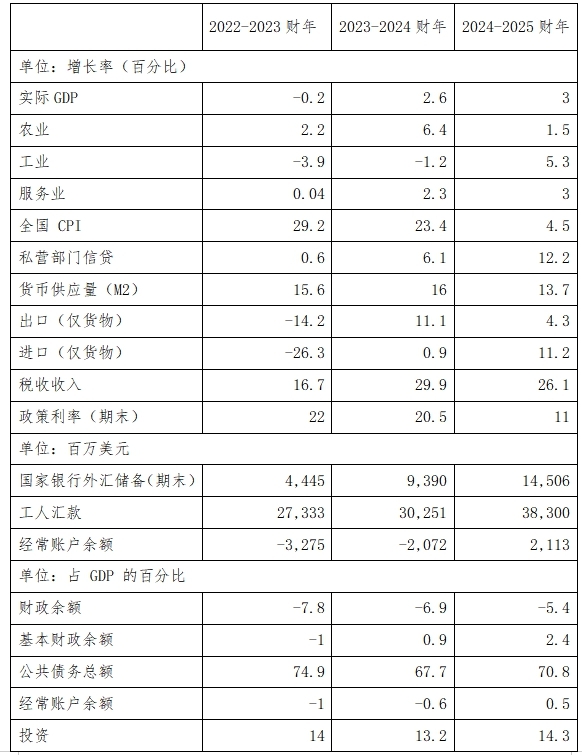
巴基斯坦2024-2025财年宏观经济出现企稳向好态势
Zhong Guo Jing Ji Wang· 2025-10-22 08:37
Group 1 - The State Bank of Pakistan released its annual report for the fiscal year 2024-2025, indicating significant macroeconomic stability and positive trends in the financial sector, laying a solid foundation for economic recovery [1] - The GDP growth for the fiscal year 2024-2025 is projected at 3.0%, an increase from 2.6% in the previous fiscal year, driven mainly by the services and industrial sectors, which grew by 3.0% and 5.3% respectively [1][3] - Inflation has been effectively controlled, with the Consumer Price Index (CPI) dropping from 23.4% in the previous fiscal year to 4.5%, marking an eight-year low [1][3] Group 2 - The current account recorded a surplus of $2.113 billion, the first surplus in fourteen years, indicating an improvement in the international balance of payments [1][3] - The State Bank's foreign exchange reserves reached $14.506 billion by the end of the fiscal year, reflecting a year-on-year increase of 54.48% [1][3] - Remittances from overseas workers continued to grow, totaling $38.3 billion for the year [1][3] Group 3 - The monetary policy committee of the State Bank reduced the policy interest rate by 1100 basis points during the fiscal year, ending at 11.0%, which has stimulated private sector credit growth by 12.2%, doubling from the previous fiscal year [1][3] - The fiscal deficit narrowed to 5.4% of GDP, while public debt as a percentage of GDP was 70.8%, slightly up from the previous year, but improved tax revenue and foreign exchange income enhanced debt repayment capacity [1][3] Group 4 - Three major international rating agencies upgraded Pakistan's credit rating at the start of the new fiscal year, although challenges remain due to flood damage to agriculture and infrastructure, geopolitical factors, and global trade uncertainties [2] - The State Bank forecasts GDP growth for the new fiscal year to be near the lower end of the previous estimate range of 3.25% to 4.25%, with the fiscal deficit potentially reaching 3.8% to 4.8% of GDP [2]