
实体投资

Search documents
全球投资总量回升但分布失衡
Sou Hu Cai Jing· 2026-01-28 01:11
Group 1 - The core viewpoint of the report indicates that global foreign direct investment (FDI) is expected to grow by 14% in 2025, reaching $1.6 trillion, primarily due to a technical rebound rather than a comprehensive recovery in physical investments [2] - The report highlights that over $140 billion of the FDI increase in 2025 will come from financial hubs like the UK, Luxembourg, Switzerland, and Ireland, but when excluding this type of FDI, the real growth is only about 5% [2] - There is a significant disparity in global investment distribution, with developed economies experiencing a 43% increase in FDI to $728 billion, while developing economies saw a 2% decrease to $877 billion, and low-income economies faced a 5% decline [2] Group 2 - International project financing in infrastructure and other sectors has declined for the fourth consecutive year, with a drop of 16%, and the number of new greenfield projects has also decreased by 16% [3] - The report attributes the weakening of corporate investment intentions to structural reasons, as companies are more inclined to manage funds rather than commit to physical investments due to increased uncertainty in trade, industry, and investment policies [3] - Global FDI is increasingly concentrated in data centers and semiconductors, with data centers accounting for about 20% of global greenfield investment, while traditional manufacturing and renewable energy sectors are experiencing a notable decline [4] Group 3 - The report anticipates a modest recovery in FDI in 2026, but the risks of decline are significant, with unstable recovery foundations [4] - Favorable factors for potential recovery include expected decreases in inflation and financing costs, as well as a possible rebound in merger and acquisition activities [4] - Adverse factors include escalating geopolitical conflicts, increased policy uncertainty, and heightened economic fragmentation, which may lead to capital expenditures concentrating further in a few countries and strategic industries [4]

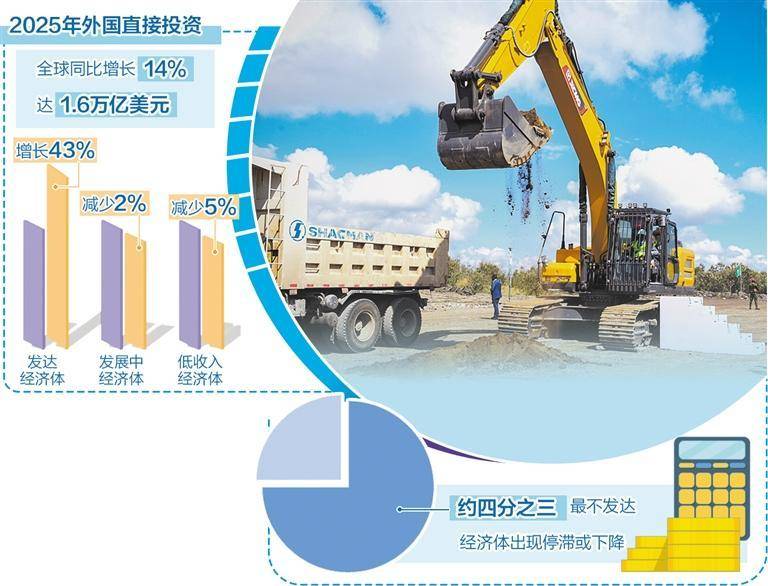
联合国贸发会议报告指出——全球投资总量回升但分布失衡
Jing Ji Ri Bao· 2026-01-27 22:10
Core Insights - The UN Conference on Trade and Development (UNCTAD) projects a 14% increase in global Foreign Direct Investment (FDI) by 2025, reaching $1.6 trillion, primarily driven by a technical rebound rather than a comprehensive recovery in real investment [1] - The report highlights a significant disparity in FDI distribution, with developed economies experiencing a 43% increase to $728 billion, while developing economies saw a 2% decrease to $877 billion, and low-income economies faced a 5% decline [1] Group 1 - The increase in FDI is largely attributed to over $140 billion in inflows from financial hubs like the UK, Luxembourg, Switzerland, and Ireland, indicating that much of this FDI is not linked to actual physical investments [1] - The report indicates a structural weakening in corporate investment intentions, with a 16% decline in international project financing for infrastructure and a 10% drop in cross-border mergers and acquisitions [2] - There is a notable shift in global capital from efficiency to security logic, leading to a preference for cautious and short-term investments rather than long-term commitments [2] Group 2 - The report identifies a growing concentration of FDI in data centers and semiconductors, with data centers accounting for approximately 20% of global greenfield investment and semiconductor projects exceeding 35% [2] - Traditional manufacturing and renewable energy sectors are experiencing a significant downturn, with greenfield investment projects in these areas declining by 25% [2] - The outlook for 2026 suggests a potential mild recovery in FDI, but with significant downside risks due to geopolitical conflicts and increasing policy uncertainties [3]