对标提升

Search documents
对标提升典型案例展播 | 通汇集团:深化对标提升,驱动高质量发展
Xin Lang Cai Jing· 2026-01-04 11:30
Core Insights - The year 2025 marks the conclusion of the "Striving for Excellence" initiative, with Shandong Hi-Speed Group focusing on enhancing core functions and competitiveness through reform and innovation [1][8] - Tonghui Group emphasizes digital empowerment and industrial collaboration to support high-quality development by identifying gaps and strengthening weaknesses [1][8] Group 1: Strategic Initiatives - The company has established six benchmarking systems covering business development, corporate governance, party leadership, and technological innovation to drive performance [1][8] - A total of 15 improvement measures have been formulated to address identified gaps and enhance operational efficiency [1][8] Group 2: Digital Transformation - Tonghui Group has built an industry-leading supply chain technology platform that provides digital payment services, having served over 23,000 clients with more than 330 billion yuan in digital payments by December 2025 [3][10] - The company is the only supply chain information service provider in China to receive unified access permission from China UnionPay, offering 24/7 digital payment services [3][10] Group 3: Investment Strategy - The investment strategy focuses on "investing in technology and scenarios," targeting high-growth sectors such as intelligent manufacturing, semiconductors, and new energy [5][12] - As of December, the company's equity investment balance exceeded 6.5 billion yuan, including a significant investment in Baidu's core AI chip platform, Kunlun [5][12] Group 4: Business Development - The leasing business is centered on green finance and digital transformation, with nearly 8.1 billion yuan in new investments and over 700 million yuan in revenue generated in 2025 [7][14] - The factoring business has also seen significant growth, with over 9.6 billion yuan in new investments and more than 500 million yuan in revenue, contributing to a total asset balance exceeding 10 billion yuan [7][14]

以标准化体系培育内涵式增长新动力,水发集团对标一流靶向发力新路径
Da Zhong Ri Bao· 2025-11-14 03:23
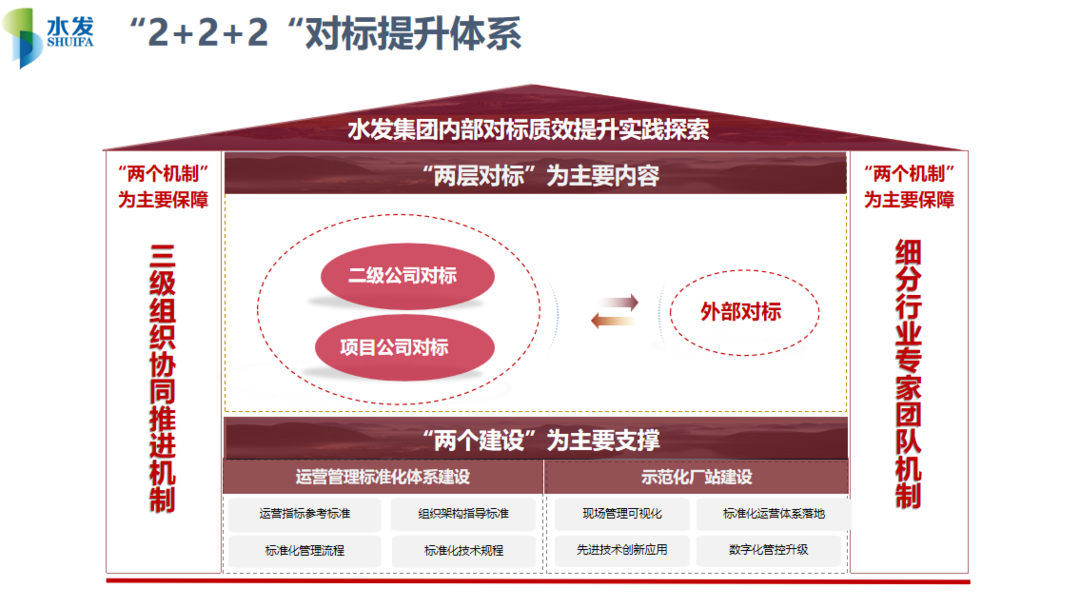
Core Viewpoint - The implementation of benchmarking against world-class enterprises is a crucial measure for advancing state-owned enterprise (SOE) reform and enhancing efficiency and development [1][3] Group 1: Benchmarking Implementation - The benchmarking initiative aims to address the disparity in performance among SOEs, as many exhibit strong asset totals and revenue but lack competitive profitability compared to industry leaders [3][4] - Water Development Group has established a "2+2+2" operational management benchmarking system, focusing on internal and external benchmarking to enhance performance in various sectors such as water supply, wastewater treatment, and renewable energy [2][5] Group 2: Challenges in Benchmarking - A common issue faced by SOEs is the difficulty in finding comparable external benchmarks due to differing development stages and operational contexts, leading to ineffective benchmarking practices [4][5] - Previous benchmarking efforts often focused on external comparisons, which did not yield actionable insights due to the unique circumstances of each enterprise [4][5] Group 3: Benchmarking System Features - The "2+2+2" system includes two levels of benchmarking (secondary companies and project companies), supported by standardized operational management and demonstration facilities [5][8] - The internal benchmarking indicators include return on net assets, income profit margin, gross profit margin, and direct operating costs, evaluated dynamically to encourage continuous improvement [8][9] Group 4: Performance Improvements - Water Development Group reported significant reductions in operational costs across various sectors, with specific decreases in unit costs for water supply, heating, and renewable energy [12][14] - The profitability of Water Development Group's subsidiaries has improved, with notable increases in profit and cash flow, indicating the effectiveness of the benchmarking system [14][15] Group 5: Future Directions - The company plans to maintain a focus on internal benchmarking while enhancing the conversion of external benchmarking experiences into actionable strategies for continuous improvement [16]