居民收入差距

Search documents
超7成省份人均收入不及“全国线”
Mei Ri Jing Ji Xin Wen· 2025-12-28 02:36
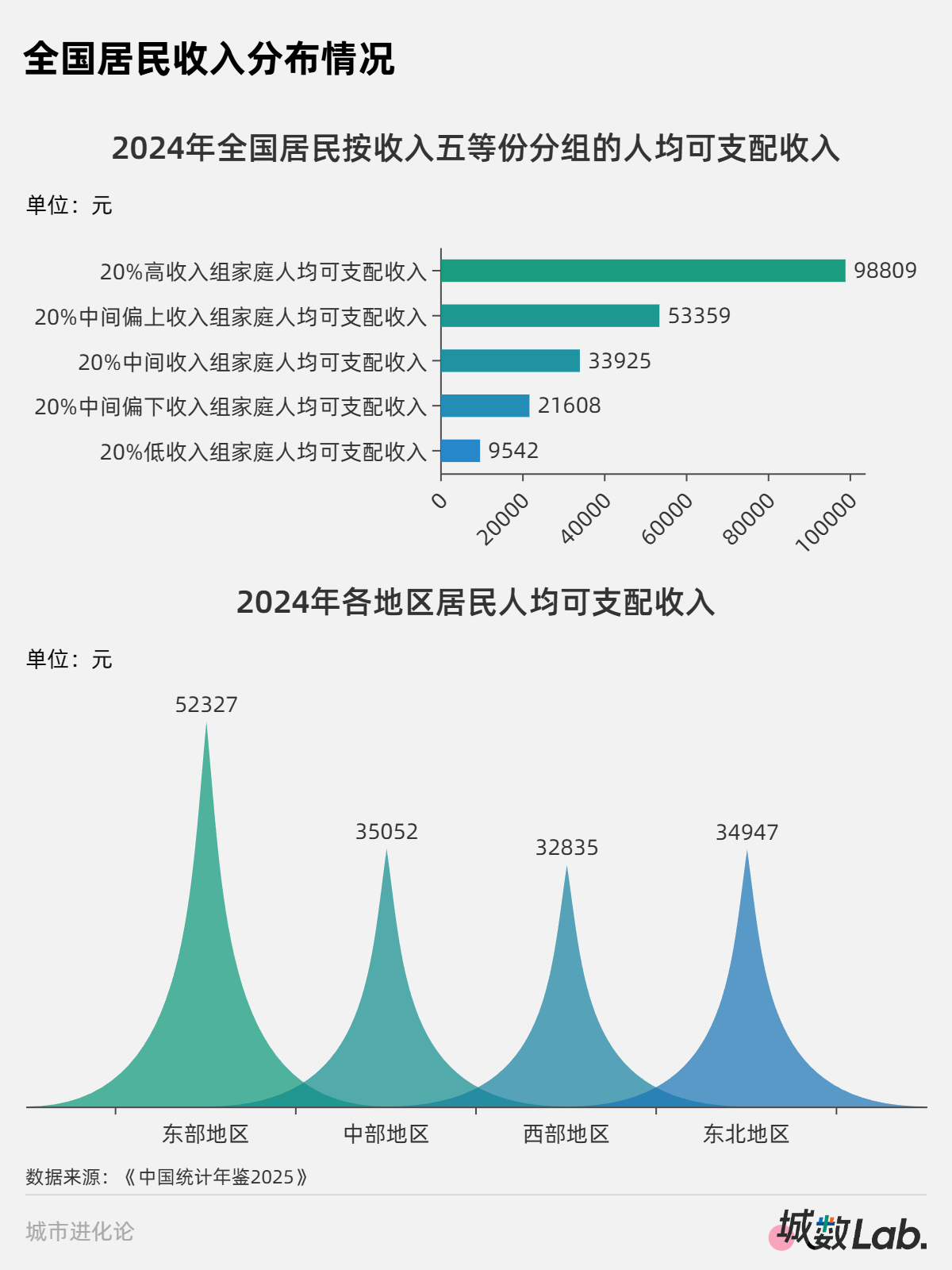
Group 1 - The core viewpoint of the article emphasizes that insufficient domestic demand is a major challenge facing the current economic operation, particularly highlighted by the low resident consumption rate [1] - Experts have analyzed that the low proportion of resident consumption in total demand is primarily due to the low share of resident income in national income, significant income disparity, and a large low-income population [1] - According to the latest data from the National Bureau of Statistics, in 2024, the per capita disposable income of the low-income group is 9,542 yuan, which is only 9.7% of the high-income group (98,809 yuan) and 28.1% of the middle-income group (33,925 yuan) [1] Group 2 - There is a significant regional disparity in per capita disposable income, with the eastern region showing much higher income levels compared to the central, western, and northeastern regions, with a difference exceeding 19,000 yuan between the east and west [6] - In 2024, only eight provinces have a per capita disposable income that meets the national average, including Shanghai, Beijing, Zhejiang, Jiangsu, Tianjin, Guangdong, Fujian, and Shandong, with Shanghai and Beijing exceeding 85,000 yuan [6] - In contrast, provinces like Yunnan, Guizhou, and Gansu have per capita disposable incomes below 30,000 yuan, with Gansu's income being only about 30% of Shanghai's [6] Group 3 - Analyzing the sources of resident income, wage income is the primary source of disposable income, accounting for 56.5% of the national average in 2024, while the other three components (operating net income, property net income, and transfer net income) account for 16.7%, 8.3%, and 18.5% respectively [9] - In regions like Guangdong, Beijing, and Shanghai, the proportion of wage income is even higher, exceeding 60% [9] Group 4 - The significant impact of wage income on overall income levels is evident, with notable disparities among different groups [15] - In 2024, the national average per capita wage income is 23,327 yuan, aligning with the eight provinces that meet the average disposable income level [15] - Shanghai has the highest per capita wage income at 55,999 yuan, while Guizhou has the lowest at 14,632 yuan, making Shanghai's income 3.8 times that of Guizhou [15] Group 5 - This year, the central government has repeatedly emphasized "increasing income," with the Central Economic Work Conference including "formulating and implementing a plan for increasing urban and rural resident income" as a key task for the coming year [19] - The "14th Five-Year Plan" explicitly proposes to "increase the proportion of resident income in national income distribution and raise the share of labor remuneration in primary distribution" [19]

城数Lab. | 超7成省份人均收入不及“全国线”
Mei Ri Jing Ji Xin Wen· 2025-12-28 02:28
Group 1 - The core viewpoint of the article emphasizes that insufficient domestic demand is a major challenge facing the current economic operation, particularly manifested in the low resident consumption rate [1] Group 2 - Experts have analyzed that the low proportion of resident consumption in total demand is primarily due to the low share of resident income in national income, significant income disparity, and a large low-income group with low income [2] - In 2024, the per capita disposable income of the low-income group is 9,542 yuan, which is only 9.7% of the high-income group (98,809 yuan) and 28.1% of the middle-income group (33,925 yuan) [2] Group 3 - There is a significant regional disparity in per capita disposable income, with the eastern region having a notably higher income than the central, western, and northeastern regions, with a difference exceeding 19,000 yuan [7] - In 2024, only eight provinces have a per capita disposable income that meets the national average, including Shanghai, Beijing, Zhejiang, Jiangsu, Tianjin, Guangdong, Fujian, and Shandong, with Shanghai and Beijing exceeding 85,000 yuan [7] - In contrast, provinces like Yunnan, Guizhou, and Gansu have per capita disposable incomes below 30,000 yuan, with Gansu's income being only about 30% of Shanghai's [7] Group 4 - Analyzing the sources of resident income, wage income is the primary source of disposable income, accounting for 56.5% of the national average in 2024, while the other three components account for 16.7%, 8.3%, and 18.5% respectively [11] - In regions like Guangdong, Beijing, and Shanghai, the proportion of wage income exceeds 60% [11] Group 5 - The average per capita wage income in 2024 is 23,327 yuan, with Shanghai having the highest at 55,999 yuan and Guizhou the lowest at 14,632 yuan, making Shanghai's wage income 3.8 times that of Guizhou [15] Group 6 - The central government has repeatedly emphasized "increasing income" this year, with the Central Economic Work Conference including "formulating and implementing urban and rural resident income increase plans" as a key task for the coming year [20] - The "14th Five-Year Plan" explicitly proposes to "increase the proportion of resident income in national income distribution and raise the proportion of labor remuneration in primary distribution" [20]
提振消费的关键是改善收入|宏观经济
清华金融评论· 2025-12-26 09:29
Core Viewpoint - The low proportion of final consumption by the household sector in GDP and insufficient consumer capacity and willingness are significant reasons for weak consumption in China. The central economic work conference in December 2024 and the government work report for 2025 prioritize "boosting consumption, improving investment efficiency, and expanding domestic demand" as key tasks for 2025. Improving residents' income levels, diversifying income sources, and enhancing the income distribution system are crucial for stimulating consumption [1][2]. Group 1: Consumption and Income Distribution - The final consumption only accounts for about 65% of disposable income, which is significantly lower than international levels, lagging behind Germany by 16 percentage points and the United States by 18 percentage points [2]. - The proportion of household final consumption in GDP is approximately 15 percentage points lower than the international average, indicating a need for improvement in domestic consumption [2]. - The adjustment of household disposable income (AHDI) is a critical indicator for assessing living conditions across countries, reflecting the distribution of income between the household and non-household sectors [5][4]. Group 2: AHDI and International Comparison - China's AHDI has consistently been lower than international levels, which restricts the growth of household consumption. In 2007, the AHDI was only 59.9%, a decline of 11.2 percentage points since 1992, with a widening gap compared to other countries [6]. - In 2022, the proportion of disposable income in GDP for households was 60.3%, nearing levels in France (61.9%), Germany (61.3%), and Japan (60.9%), but the AHDI gap with major economies remains significant [8]. Group 3: Income Sources and Growth - The primary source of income for residents is wage income, which is overly reliant and affects marginal consumption propensity, leading to slower income growth [11]. - Labor income constitutes nearly 85% of disposable income, significantly higher than in Germany (71%), Japan (78%), France (75%), and the United States (64%), which results in lower consumption propensity [12]. - The average number of people per small business in China is over 100, compared to 30 in Japan and about 10 in the U.S., indicating a lack of capital income sources [12]. Group 4: Income Growth Trends - After 2020, the growth rate of household income has slowed, with the median growth rate of urban residents' disposable income lagging behind GDP growth [13]. - The average growth rate of urban residents' disposable income from 2013 to 2023 was 6.8%, while the GDP growth rate was 6.0%. Post-COVID, this growth rate further declined to 4.6%, below GDP growth [13]. - Income growth disparities are evident, with only Tibet and Xinjiang showing growth rates above 5% in 2024, while major cities like Guangdong, Shanghai, and Beijing reported lower growth rates [13]. Group 5: Wealth Distribution and Inequality - There is a significant income distribution gap, with high-income households earning 10.3 times more than low-income households, compared to 8.4 times in the U.S. and around 5 times in Western Europe [15]. - Wealth concentration is even more pronounced, with the top 10% of the population holding 82.8% of total wealth, and the top 1% holding 31.5% [15]. Group 6: Social Security and Healthcare - The social safety net is not adequately established, with low pension coverage and sustainability concerns. The average monthly pension for rural residents is only 205 yuan, while urban retirees receive an average of 3605 yuan [17]. - High out-of-pocket medical expenses, particularly in rural areas, burden low-income groups, with a self-payment ratio of 35% in 2020, higher than in the U.S. and Europe [17].