
居民消费率偏低

Search documents
超7成省份人均收入不及“全国线”
Mei Ri Jing Ji Xin Wen· 2025-12-28 02:36
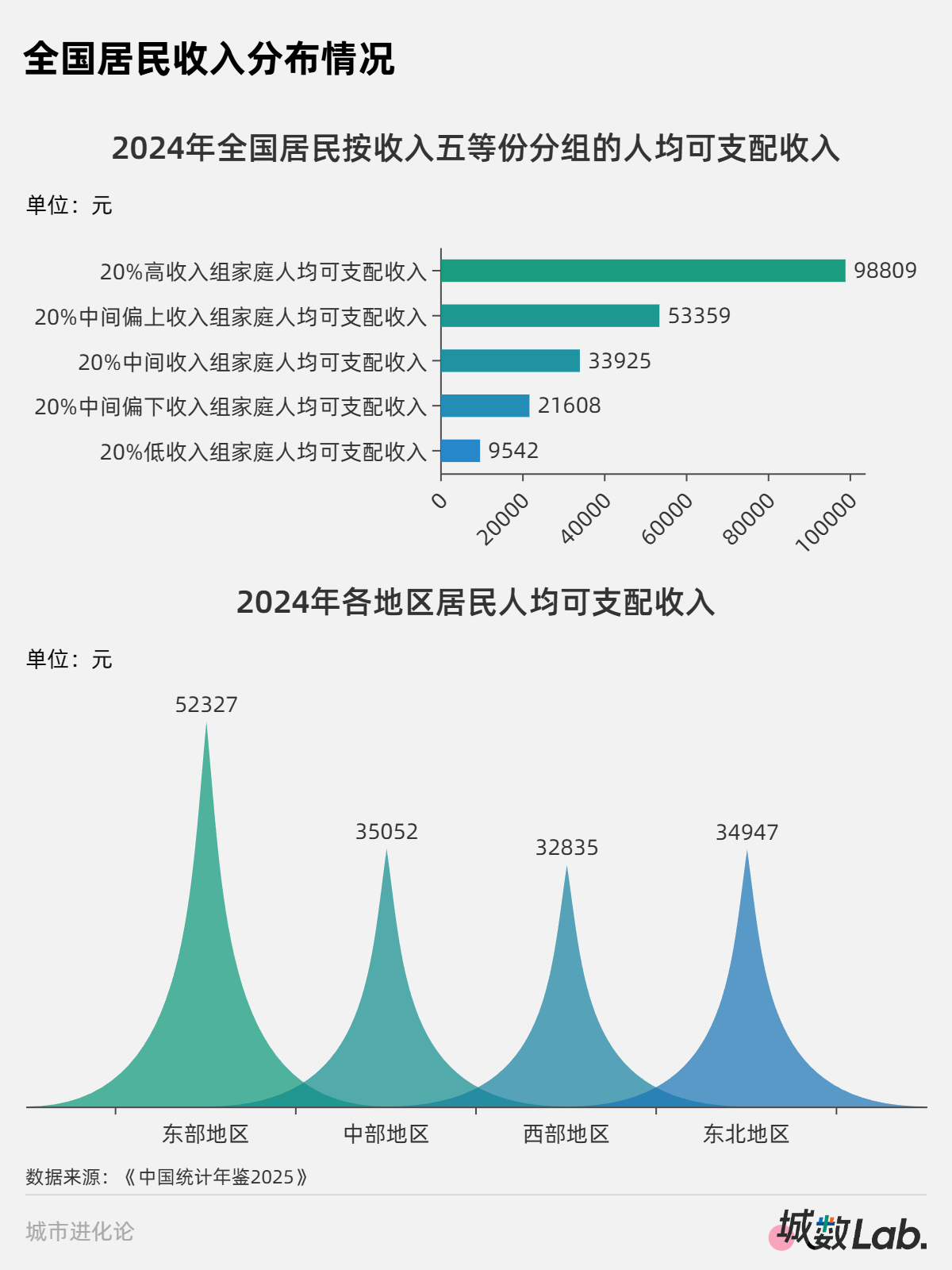
Group 1 - The core viewpoint of the article emphasizes that insufficient domestic demand is a major challenge facing the current economic operation, particularly highlighted by the low resident consumption rate [1] - Experts have analyzed that the low proportion of resident consumption in total demand is primarily due to the low share of resident income in national income, significant income disparity, and a large low-income population [1] - According to the latest data from the National Bureau of Statistics, in 2024, the per capita disposable income of the low-income group is 9,542 yuan, which is only 9.7% of the high-income group (98,809 yuan) and 28.1% of the middle-income group (33,925 yuan) [1] Group 2 - There is a significant regional disparity in per capita disposable income, with the eastern region showing much higher income levels compared to the central, western, and northeastern regions, with a difference exceeding 19,000 yuan between the east and west [6] - In 2024, only eight provinces have a per capita disposable income that meets the national average, including Shanghai, Beijing, Zhejiang, Jiangsu, Tianjin, Guangdong, Fujian, and Shandong, with Shanghai and Beijing exceeding 85,000 yuan [6] - In contrast, provinces like Yunnan, Guizhou, and Gansu have per capita disposable incomes below 30,000 yuan, with Gansu's income being only about 30% of Shanghai's [6] Group 3 - Analyzing the sources of resident income, wage income is the primary source of disposable income, accounting for 56.5% of the national average in 2024, while the other three components (operating net income, property net income, and transfer net income) account for 16.7%, 8.3%, and 18.5% respectively [9] - In regions like Guangdong, Beijing, and Shanghai, the proportion of wage income is even higher, exceeding 60% [9] Group 4 - The significant impact of wage income on overall income levels is evident, with notable disparities among different groups [15] - In 2024, the national average per capita wage income is 23,327 yuan, aligning with the eight provinces that meet the average disposable income level [15] - Shanghai has the highest per capita wage income at 55,999 yuan, while Guizhou has the lowest at 14,632 yuan, making Shanghai's income 3.8 times that of Guizhou [15] Group 5 - This year, the central government has repeatedly emphasized "increasing income," with the Central Economic Work Conference including "formulating and implementing a plan for increasing urban and rural resident income" as a key task for the coming year [19] - The "14th Five-Year Plan" explicitly proposes to "increase the proportion of resident income in national income distribution and raise the share of labor remuneration in primary distribution" [19]

张军扩:通过体制和政策改革,有效投资仍然是拉动增长的重要力量
2 1 Shi Ji Jing Ji Bao Dao· 2025-09-04 10:05
Group 1 - The core theme of the forum is "Financial Strong Momentum, New Picture of the Bay Area," emphasizing the need for comprehensive measures to effectively release domestic demand potential during the upcoming "14th Five-Year Plan" period [1] - The main contradiction in economic operation is gradually shifting from the supply side to the demand side, indicating that resolving demand issues is crucial for smooth economic circulation and stable development [1] - The long-standing low consumption rate among Chinese residents is attributed to insufficient social security, unstable expectations, and weak consumer confidence, which have been exacerbated by changes in investment and export demand [1][2] Group 2 - To address the structurally low consumption rate, it is essential to significantly improve social security levels, fostering a long-term sense of security among residents [2] - Investment potential remains substantial across various sectors, including traditional industry upgrades, strategic emerging industries, and infrastructure projects, necessitating innovative and optimized policy environments [2] - Policies aimed at stabilizing expectations and invigorating private enterprises should be effectively implemented, including the development of detailed regulations following the introduction of the "Private Economy Promotion Law" [3] Group 3 - Financial support is critical for the development of the real economy, as it must address the challenges faced by the real economy to achieve its own growth [3] - The Guangdong-Hong Kong-Macao Greater Bay Area is positioned as a leader in reform, opening up, innovation, and development, with a focus on exploring ways to effectively release domestic demand potential through institutional innovation [3]