
工厂化养殖

Search documents
从黄金海岸线到国家储备林
Jin Rong Shi Bao· 2026-01-20 02:12
Group 1 - The coastal city of Fangchenggang in China has a favorable ecological environment and rich marine biodiversity, which has led to the implementation of biodiversity financial standards [1] - Fangchenggang is focusing on developing a modern shrimp farming industry, with Hai Zhi Heng Aquaculture Co., Ltd. primarily cultivating whiteleg shrimp and banana shrimp [1] - The company has adopted a factory farming model since 2018, utilizing a water circulation system and IoT smart control to optimize feeding and reduce pollution [1] - In early 2024, the company invested over 23 million yuan to expand its capacity by building a new 28-acre high-level pool greenhouse, which initially strained its liquidity [1] - Guilin Bank Fangchenggang Branch provided a tailored financing solution, issuing a loan of 2.5 million yuan to alleviate the company's financial pressure and support its transition to factory farming [1] Group 2 - The Fangchenggang National Reserve Forest Base is primarily used for cultivating eucalyptus and other broadleaf tree industrial raw materials [2] - Under the guidance of the People's Bank of China Fangchenggang Branch, the Agricultural Development Bank Fangchenggang Branch launched a "sustainable forestry + biodiversity" credit support program, providing a total credit of 700 million yuan to the reserve forest base [2] - By November 2025, the Agricultural Development Bank Fangchenggang Branch had disbursed 510 million yuan in loans to support the construction of the national reserve forest base, promoting a shift from traditional resource utilization to a comprehensive model of ecological restoration and rural revitalization [2]
兴文早虾 不止于早
Si Chuan Ri Bao· 2026-01-19 22:22
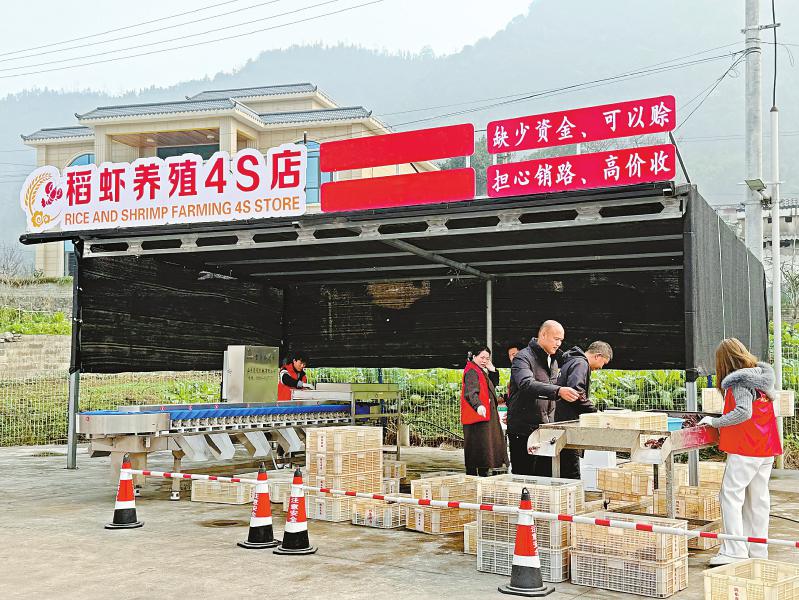
Core Insights - The early shrimp from Yibin County, particularly from Xingwen, has entered the market earlier than other major production areas due to favorable climate conditions, with market prices exceeding 50 yuan per pound, three times higher than summer prices [2][4] Group 1: Industry Development - The traditional shrimp farming model is being transformed by the "separation of breeding and farming," leading to improved survival rates and uniformity of shrimp through factory-like breeding processes [3] - By 2025, Xingwen aims to produce over 1 billion shrimp seedlings annually, establishing itself as a key source for the early shrimp industry in southern Sichuan [3] - A regional standard for early shrimp production will be implemented by 2025, enhancing quality and price advantages for Yibin early shrimp [4] Group 2: Logistics and Sales - The establishment of the Southern Sichuan Lobster Distribution Center has created a regional hub for shrimp trading and logistics, generating an annual output value exceeding 20 million yuan [4] - The center has improved logistics efficiency and reduced costs, with air freight prices dropping from 2.4 yuan to 1.4 yuan per kilogram, potentially saving 3 to 5 million yuan in annual transportation costs [4][5] - The center also provides support to farmers by ensuring uniform product specifications and enhancing their bargaining power through an information platform [5] Group 3: Future Goals - By 2025, the area for early shrimp farming in Xingwen is expected to expand to 85,000 acres, with a projected output of over 7,300 tons and a value of approximately 560 million yuan [5] - The county aims to develop a comprehensive agricultural industry chain, targeting over 100,000 acres of farming, an annual output of over 20,000 tons, and a total output value exceeding 5 billion yuan [5]

海大集团董事长薛华:打造水产育种“远洋舰”
Nan Fang Nong Cun Bao· 2025-08-26 09:03
Core Viewpoint - The chairman of Haida Group, Xuehua, emphasizes the importance of technological innovation in building a modern agricultural industry system, particularly in the field of aquatic breeding and food security [4][5][6]. Group 1: Aquatic Breeding Strategy - Haida Group aims to create a "deep-sea breeding flagship" by enhancing collaboration between breeding enterprises and research institutions to tackle the challenges of deep-sea breeding [9][12]. - The company has established a comprehensive commercial breeding system that covers major economic species consumed nationally, focusing on breakthroughs in factory-based and deep-sea breeding [10][11]. Group 2: Modern Aquaculture Facilities - The company proposes the construction of "super factories" for near-sea aquaculture to overcome traditional aquaculture limitations and achieve controllable production [13][14]. - Factory-based aquaculture is seen as a modern approach to enhance efficiency and reduce risks, especially in the context of marine ranching [15][16]. Group 3: Feed Supply and Market Position - Haida Group is currently the world's largest feed producer, with an expected feed volume of over 30 million tons this year, aiming to be the first agricultural enterprise to reach this milestone [18]. - The company plans to increase research investment to improve feed supply, particularly focusing on the nutritional needs of marine aquaculture species [20][21]. Group 4: Future Growth Targets - Over the next five years, Haida Group aims to double the growth of its main business segments, with a target revenue of over 200 billion yuan by 2030 and feed sales reaching 51.5 million tons [22][23].


海大集团(002311) - 2025年3月14日投资者关系活动记录表
2025-03-16 04:22
Group 1: Company Overview - The company, Guangdong Haida Group Co., Ltd., reported a 9% year-on-year growth in total feed sales for 2024, surpassing the industry average [2][3] - The poultry and aquaculture feed segments achieved double-digit growth, while pig feed sales experienced a slight decline [2][3] Group 2: Strategic Planning - The company aims to enhance its core capabilities and expand its scale in the feed business, which is its primary focus [3] - The second core business includes breeding and animal health, with plans to invest more resources to expand product varieties, regions, and scale [3] - The company is exploring a light-asset pig farming model and industrialized shrimp farming, which will become key future business areas [3] Group 3: Market Insights - The price of common freshwater fish has been on an upward trend since the beginning of the year, while prices for specific varieties have shown some differentiation [4] - The recent price increase for common freshwater fish is attributed to a prolonged period of low prices and significant capacity reduction in 2023 [5] Group 4: Customer Structure and Adaptation - The company is adapting to the trend of smallholders exiting the pig farming market by enhancing its capabilities and adjusting its customer structure [7] - The focus is on developing partnerships with family farms that have strong farming advantages and profitability, as well as targeting medium to large-scale farming companies [7] Group 5: International Expansion - The company has set a target to achieve 7.2 million tons in overseas feed sales by 2030, employing targeted market expansion strategies in different regions [8] - Factors influencing overseas market selection include population size, stable development environment, rich farming resources, and potential demand for protein [8] Group 6: Risk Management - The company employs foreign exchange hedging to mitigate risks associated with currency and interest rate fluctuations [8]