工程型国家

Search documents
“中国赶上了西方,但未来西方可能赶不上中国了”
Guan Cha Zhe Wang· 2025-12-08 11:47
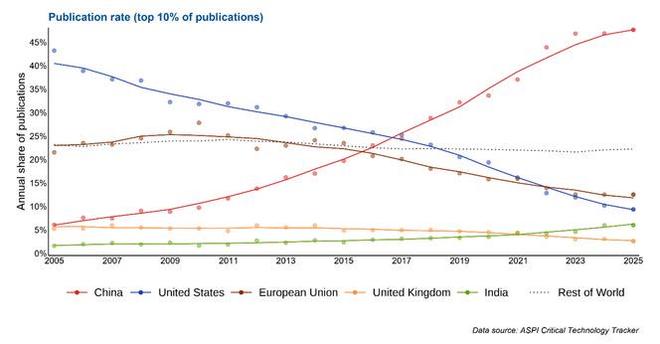
Core Viewpoint - China has achieved a dominant position in defining modern technologies, surpassing other regions in various fields such as artificial intelligence, defense, aerospace, energy, and biotechnology [1][3]. Group 1: Technological Advancements - A report by the Australian Strategic Policy Institute indicates that China leads in 66 out of 74 key technologies, while the U.S. maintains an advantage in only 8 [1]. - In the AI sector, China is ahead in 7 out of 8 technologies; in advanced materials and manufacturing, it leads in all 13 technologies; and in defense, aerospace, robotics, and transportation, it ranks first in all 7 technologies [1]. - In the energy and environment sector, China leads in 9 out of 10 technologies, and in biotechnology, genetics, and vaccines, it is ahead in 5 out of 9 technologies [1]. Group 2: Recent Technological Achievements - Recent months have seen China showcase remarkable technological feats, including a bionic robot the size of a mosquito for battlefield reconnaissance and the completion of the world's highest bridge [2]. - The DeepSeek team introduced a mathematical reasoning model, DeepSeekMath-V2, which has demonstrated significant capabilities in theorem proving, marking a milestone in AI development [2]. Group 3: Investment and Policy - China's technological achievements are closely linked to substantial investments in strategic emerging industries, amounting to 8.6 trillion yuan since the start of the 14th Five-Year Plan [6]. - Analysts highlight the difference in governance models, with China being described as an "engineering state" focused on practical solutions, while the U.S. is characterized as a "lawyerly society" that often resorts to legal measures [6][7]. Group 4: Comparative Analysis - Australia's recent AI strategy, which includes a budget of 30 million AUD (approximately 140 million yuan) for AI safety research, is seen as significantly less robust compared to China's comprehensive industrial policies [7]. - The speed of China's technological acceleration is noted as unprecedented compared to other regions, with experts suggesting that the West may struggle to catch up [8].

华人学者:中国造船、无人机,美国再不改,公厕都建不成
Guan Cha Zhe Wang· 2025-09-16 04:11
Core Insights - Dan Wang's perspective highlights the contrasting governance models of China and the United States, labeling China as an "engineering state" and the U.S. as a "lawyerly society" [5][6][21] - Wang's new book, "Breakneck: China's Quest to Engineer the Future," aims to clarify the significant changes occurring in China and has been recognized in the Financial Times' annual business book list [3][11] Governance Models - Wang argues that China's governance is characterized by practical and efficient problem-solving led by individuals with engineering backgrounds, while the U.S. is dominated by legal professionals who prioritize procedures over outcomes [5][6] - The difference in governance models has resulted in the U.S. struggling with infrastructure development, as exemplified by the comparison of train speeds between historical and current data [7][10] Industrial Capacity - By 2030, China is projected to account for 45% of global industrial capacity, while high-income economies, including the U.S., Europe, and Japan, will collectively hold only 38% [11] - Wang emphasizes that the inability of other countries to match China's industrial capacity is alarming and poses a significant challenge to global dynamics [13] Economic Development - Wang identifies 5% of China's economy, particularly in high-tech manufacturing, as exceptionally strong and a potential threat to Western interests, including sectors like electric vehicles and semiconductors [15] - The contrasting approaches to industrial policy between the U.S. and China are highlighted, with China consistently supporting strategic industries, while the U.S. has been more conservative until recent policy shifts [17][18] Technological Competition - Wang notes that U.S. sanctions against China have inadvertently accelerated China's push for technological self-sufficiency, particularly in semiconductors, as companies seek to reduce reliance on American technology [20] - The competitive landscape is further complicated by the shared traits of urgency and ambition among the populations of both countries, despite their perceived rivalry [21] Global Dynamics - Wang reflects on the slower pace of European and Japanese economies compared to the dynamic nature of U.S. and Chinese growth, suggesting that these regions may fall behind in the evolving global order [23]