工程师治企

Search documents
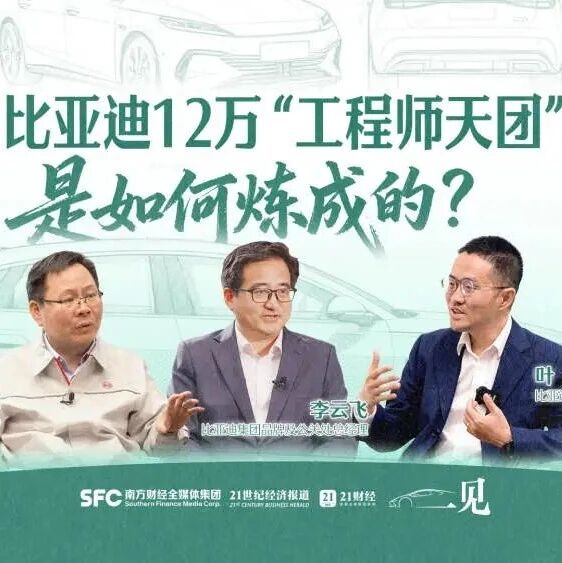
揭秘比亚迪工程师方法论:12万“技术天团”是如何炼成的
2 1 Shi Ji Jing Ji Bao Dao· 2026-01-26 23:12
Core Insights - BYD has experienced a remarkable growth in electric vehicle sales, increasing from 58,000 units to 4.6 million units by 2025, leveraging vertical integration to combat supply chain fluctuations and define costs [1] - The company has built a strong technical moat with a research and development team of 120,000 engineers, surpassing many traditional automotive giants [2] - The founder, Wang Chuanfu, plays a crucial role in the company's technical decision-making, fostering a culture of deep involvement and hands-on problem-solving [3][10] Group 1: Company Growth and Strategy - BYD's sales growth is attributed to its self-developed technologies, such as the blade battery and DM-i hybrid system, which redefine cost and efficiency in electric vehicles [3] - The company has expanded its empire to cover batteries, semiconductors, and energy storage, all rooted in a philosophy of keeping core technologies in-house [3] - In 2022, BYD delivered 1.8624 million passenger cars, marking a historic achievement in combined brand sales [13] Group 2: Talent Development and Culture - BYD's recruitment strategy focuses on nurturing talent internally, with a significant number of new hires coming from top universities, particularly in R&D roles [14] - The company employs a mentorship system where new graduates are paired with experienced engineers to facilitate rapid learning and integration into the company culture [9] - The internal promotion of leaders from within ensures continuity of the company's core values and culture, as highlighted by the success of the "Huangpu First Phase" graduates [12] Group 3: Organizational Changes and Challenges - As the market shifts towards smart technology, BYD faces new challenges in adapting its traditional engineering culture to accommodate the rapid pace of software and algorithm development [20] - The introduction of a competitive culture within the organization aims to enhance efficiency and drive innovation, as seen in the adoption of the "Compare, Learn, Help, and Surpass" philosophy [16][17] - The integration of internet talent into BYD's workforce is creating a cultural shift, necessitating a balance between traditional manufacturing practices and modern agile methodologies [21][22] Group 4: Future Directions - The company is focusing on enhancing its capabilities in smart driving and software development, with a significant increase in the size of its intelligent driving team [20] - BYD aims to maintain its competitive edge by fostering an environment that encourages exploration and innovation, particularly in areas where traditional engineering approaches may fall short [23] - The challenge ahead lies in integrating new thinking and methodologies while preserving the core strengths that have driven BYD's success in the electric vehicle market [24]


揭秘王传福的12万工程师天团
21世纪经济报道· 2026-01-23 10:31
Core Viewpoint - BYD has experienced remarkable growth in the electric vehicle market, with sales skyrocketing from 58,000 units to 4.6 million units by 2025, driven by a unique self-sustaining engineering culture and a focus on vertical integration to combat supply chain volatility [5][6][20]. Group 1: Engineering Culture and Talent Development - BYD's workforce includes 120,000 R&D engineers, surpassing many traditional automotive giants, which is seen as a "technical moat" by the chairman Wang Chuanfu [5][6]. - The company employs a "mentor system" where new graduates are trained by experienced engineers, ensuring a smooth transition from academia to industry [10][13]. - The internal training program, "Tomorrow's Stars," emphasizes core values of humility, eagerness to learn, and hard work, fostering a strong engineering culture [10][11]. Group 2: Innovation and Product Development - BYD's engineering team has been pivotal in developing proprietary technologies such as the blade battery and DM-i hybrid system, redefining cost and efficiency in electric vehicles [6][20]. - The company has adopted a "first principles" approach to problem-solving, allowing for innovative solutions even in the face of resource constraints [9][30]. - Wang Chuanfu's hands-on involvement in technical decision-making has led to significant innovations, such as the blade battery design, which emerged from rigorous internal discussions [16][30]. Group 3: Market Position and Competitive Strategy - BYD's sales reached 1.8624 million passenger vehicles in 2022, marking a historic achievement and establishing the company as a leader in the electric vehicle market [20][28]. - The company has shifted its focus from merely reducing battery costs to enhancing software capabilities and data integration as the market evolves towards smart vehicles [6][28]. - BYD's competitive culture, encapsulated in the phrase "Compare, Learn, Help, Surpass," emphasizes internal competition to drive performance and innovation [21][24]. Group 4: Organizational Transformation and Future Challenges - As BYD expands, it faces the challenge of maintaining its engineering culture while integrating new talent from the tech sector, which may have different working styles [28][30]. - The company is actively working to create a more agile and innovative environment to adapt to the fast-changing landscape of smart vehicles, requiring a shift from traditional manufacturing practices [30][31]. - BYD aims to balance its established strengths in engineering with the need for exploration and adaptability in the face of emerging technologies and market demands [31][32].