
市场多样化

Search documents
新闻1+1|前三季度外贸增速4%,怎么看?
Yang Shi Wang· 2025-10-15 02:36
Core Viewpoint - China's foreign trade performance in the first three quarters of 2023 showed a 4% year-on-year increase, reaching 33.61 trillion yuan, with the third quarter experiencing a growth of 6% and September alone seeing an 8% increase, indicating resilience in a challenging external environment [1][3]. Group 1: Factors Contributing to Foreign Trade Growth - The growth in foreign trade is attributed to multiple factors, including government efforts to create a stable trade policy environment amidst uncertain trade policies, particularly between China and the U.S. [3]. - Local governments provided substantial support to enterprises facing various challenges, contributing to the positive trade outcomes [3]. - The improvement in the competitiveness and technological capabilities of Chinese industries, developed over decades, has played a crucial role in maintaining stable foreign trade performance [3]. Group 2: Expansion of Trade Partnerships - China's trade partnerships are expanding, with significant growth in imports and exports to Africa (19.5%) and Central Asia (16.7%), as well as to ASEAN and Latin America, driven by the Belt and Road Initiative [6]. - Despite slower growth with APEC economies (2%), the importance of these partnerships remains high, as they represent significant trade opportunities for China [6]. Group 3: Future Outlook for Foreign Trade - To stabilize and enhance exports, China aims to optimize the structure of its export products, focusing on increasing technological content and adapting to market demands for personalized and customized products [9]. - The fourth quarter is expected to be a critical period for foreign trade, with confidence in maintaining growth due to strong manufacturing and service sectors, a stable policy environment, and increased market demand [11].

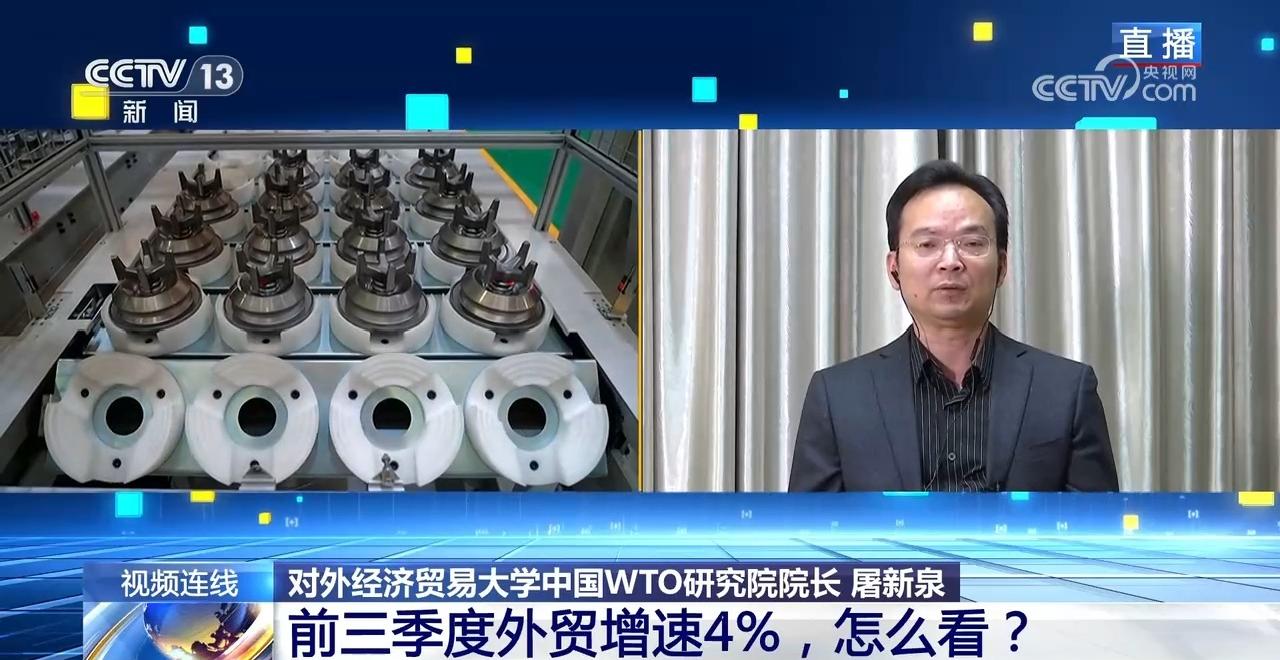
新闻1+1丨前三季度外贸增速4%,怎么看?
Yang Shi Xin Wen· 2025-10-15 01:54
Core Viewpoint - China's foreign trade performance in the first three quarters of the year showed a 4% year-on-year growth, reaching 33.61 trillion yuan, with a notable increase of 6% in the third quarter and 8% in September, indicating resilience amid external pressures [1][3]. Group 1: Factors Contributing to Trade Growth - The growth in foreign trade is attributed to a stable trade policy environment created by the government, particularly in light of negotiations between China and the U.S. [3]. - Support from various levels of government has been crucial for enterprises facing challenges [3]. - The improvement in the competitiveness and technological capabilities of Chinese industries, developed over decades, has played a significant role in maintaining stable trade performance [3]. Group 2: Expansion of Trade Partnerships - China's trade relationships are diversifying, with significant growth in imports and exports to Africa (19.5%) and Central Asia (16.7%), as well as to ASEAN and Latin America [4]. - The Asia-Pacific region remains a key focus, with ASEAN being China's largest trading partner and trade growth continuing at an above-average rate [5]. Group 3: Future Trade Strategies - To stabilize exports, China aims to optimize the structure of its export products, focusing on enhancing technical levels and international competitiveness [6]. - There is a need to adapt to changing market demands for personalized and customized products, which can reflect technological capabilities and command higher prices [6]. Group 4: Outlook for Fourth Quarter - The third quarter was identified as particularly challenging due to significant trade policy changes, yet strong performance was achieved, providing confidence for the fourth quarter [7]. - The manufacturing and service sectors are noted for their strong international competitiveness, and a stable policy environment is expected to support continued growth [7]. - The fourth quarter is anticipated to see robust market demand, presenting favorable conditions for exports [7]. Group 5: Long-term Trade Development - China's foreign trade is entering a phase focused on internal capabilities, relying on industrial upgrades, broad market layouts, and supportive policy frameworks to enhance openness [8].
波兰前总理:在欧洲市场,中国电动汽车或代替特斯拉
news flash· 2025-05-18 08:58
Core Viewpoint - The former Prime Minister of Poland, Marek Belka, stated that Chinese electric vehicles (EVs) are likely to replace Tesla in the European market, emphasizing the need for China to protect intellectual property and facilitate technology transfer [1] Group 1: Market Dynamics - Chinese companies are becoming significant manufacturers and exporters of technology, indicating a shift in global manufacturing power [1] - European companies are eager to enter the Chinese market, and there is mutual interest in discussing market access [1] - The diversification of markets in Europe is seen as a strategy for better development in the short term [1] Group 2: Competitive Landscape - The discussion around Chinese EVs entering the European market suggests a potential competitive threat to Tesla, which is not a European company [1] - The emphasis on the potential for Chinese EVs to take Tesla's place highlights the changing dynamics in the automotive industry within Europe [1]
