
市场风格变化

Search documents
沪指探底回升再收十字星,止跌企稳了吗?
Sou Hu Cai Jing· 2026-01-21 01:01
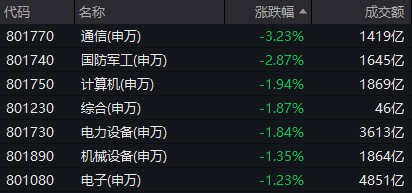
Market Overview - On January 20, the A-share market experienced adjustments, with the Shanghai Composite Index briefly falling below 4100 points before closing at 4113.65, a slight decrease of 0.01% [1] - The Shenzhen Component Index and the ChiNext Index also saw declines, closing down 0.97% and 1.79% respectively [1] Sector Performance - According to Wind data, previously strong sectors such as telecommunications, computers, and electronics led the market decline on January 20 [2] - The telecommunications sector fell by 3.23% with a trading volume of 141.9 billion, while the defense and military industry dropped by 2.87% with a volume of 164.5 billion [3] - The computer sector decreased by 1.94% with a trading volume of 186.9 billion, and the electronics sector fell by 1.23% with a volume of 485.1 billion [3] Market Dynamics - Analysts attribute the market adjustment to two main factors: the impact of counter-cyclical policy adjustments and a shift in market style [5] - Recent trading days have shown a significant decrease in trading volume, with three out of the last four days recording less than 3 trillion in trading volume [5] - The market is experiencing a "high-low switch," with funds moving towards traditional sectors as earnings forecasts for listed companies are set to peak [5] Technical Analysis - The Shanghai Composite Index formed a doji candlestick pattern, indicating potential stabilization, but the market remains cautious with a focus on defensive strategies [5] - Analysts suggest that as long as the index does not fall below 4080 points, there is a likelihood of a resumption of upward momentum [6] - The average price-to-earnings ratios for the Shanghai Composite and ChiNext are currently above their three-year median levels, indicating suitability for medium to long-term investments [6] Earnings Season Impact - As earnings forecasts enter a peak disclosure period, the correlation between stock prices and earnings is expected to increase significantly [7] - The market may undergo structural adjustments based on fundamentals, with previous hot sectors facing earnings validation while some low-priced, high-quality stocks may attract new capital [7]

我国进出口连续3个月实现双增长,港股红利ETF博时(513690)冲击5连涨,全指现金流ETF基金(563830)最新单日资金净流入1.37亿元
Xin Lang Cai Jing· 2025-09-11 03:57
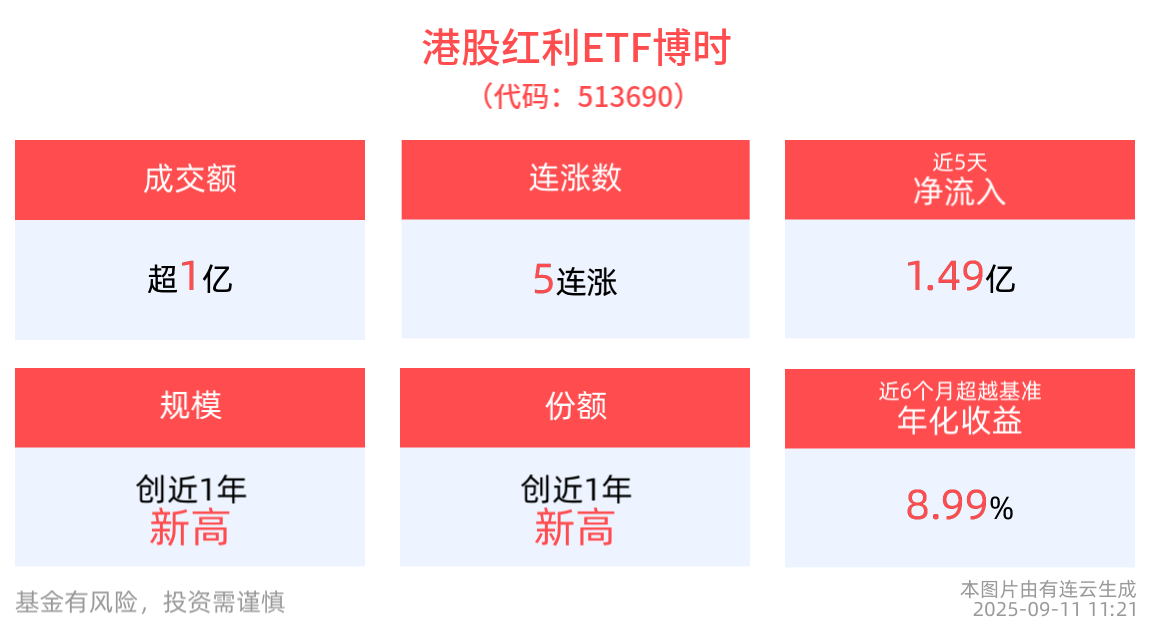
Group 1 - The Hang Seng High Dividend Yield Index increased by 0.12%, with notable gains from China Hongqiao (+3.97%), Seaspan (+2.64%), and WH Group (+2.29%) [3] - The Hang Seng Dividend ETF (513690) rose by 0.27%, marking its fifth consecutive increase, with a latest price of 1.11 yuan and a 1-week cumulative increase of 2.89% [3] - The trading volume for the Hang Seng Dividend ETF was 2.43%, with a turnover of 126 million yuan, and an average daily turnover of 220 million yuan over the past month [3] Group 2 - The CSI All Share Free Cash Flow Index rose by 0.68%, with significant increases from Xinhua Department Store (+10.03%) and Muyuan Foods (+5.92%) [6] - The All Share Cash Flow ETF (563830) showed mixed performance, with a latest price of 1.12 yuan and a 1-week cumulative increase of 0.99%, ranking 1st among comparable funds [6] - The trading volume for the All Share Cash Flow ETF was 0.3%, with a turnover of 468,600 yuan, and an average daily turnover of 3.49 million yuan over the past week [6] Group 3 - In August, China's exports decreased by 4.4% year-on-year, while imports increased by 1.3%, indicating a potential downturn in export momentum [7] - The U.S. Bureau of Labor Statistics reported a downward revision of 911,000 in non-farm employment for the past year, suggesting signs of economic weakness [9] - The August CPI fell by 0.4% year-on-year, while the PPI decreased by 2.9%, indicating ongoing challenges in consumer demand and structural pressures [9] Group 4 - The Hang Seng Dividend ETF tracks the Hang Seng High Dividend Yield Index, which currently has a dividend yield of 5.71%, with the top five sectors being Real Estate (17.6%), Banking (15.3%), and Coal (10.8%) [9][10] - The All Share Cash Flow ETF tracks the CSI Cash Flow Index, with a current dividend yield of 3.77%, and the top five sectors include Non-ferrous Metals (16.9%) and Transportation (12.7%) [10][14] - The Hang Seng Dividend ETF reached a new high in scale at 5.173 billion yuan, while the All Share Cash Flow ETF also achieved a new high at 155 million yuan [10][14]
当前市场环境下,风格表现发生了哪些变化
2025-04-15 14:30
Summary of Conference Call Records Company/Industry Involved - The discussion revolves around the investment strategies and market analysis conducted by a financial institution, specifically focusing on quantitative trading strategies and market dynamics. Core Points and Arguments 1. **Market Performance Overview** The past two weeks have shown a turbulent market environment with major indices experiencing a general decline, indicating a volatile atmosphere both domestically and internationally [1][2][3] 2. **High Volatility Asset Concerns** There is a growing concern regarding high volatility assets, with liquidity factors showing strong performance, suggesting a decline in demand for high liquidity assets [2][3] 3. **Preference for High Turnover Stocks** The market has shown a preference for stocks with high turnover rates, indicating a premium for stocks with lower liquidity [3][4] 4. **Quantitative Fund Performance** The quantitative fund managed to achieve an excess return of 1.38% over the past week and 16.55% over the past year, outperforming the market [4][5] 5. **Investment Strategy Recommendations** The institution recommends focusing on quantitative strategies and models that assess value and growth dimensions, suggesting a balanced approach leaning towards value [5][6] 6. **Value vs. Growth Style Analysis** The current model indicates a preference for value over growth, with a slight edge in investment odds for value style (1.03) compared to growth (1.01) [7][8] 7. **Market Sentiment and Expectations** The overall market sentiment is neutral, with expectations of a potential rebound in small-cap stocks and a focus on dividend and value strategies [10][11] 8. **Dynamic Classification Model** A dynamic classification model has been developed to predict market trends based on historical phase data, enhancing the ability to capture market changes effectively [17][23] 9. **Algorithm Improvements** The report highlights improvements in the algorithm, including the use of VMD (Variational Mode Decomposition) for better data decomposition compared to EMD (Empirical Mode Decomposition) [18][23] 10. **Low Turnover Strategy** The overall strategy has resulted in a low turnover rate of around 9%, indicating a stable approach to stock selection with a focus on maintaining lower trading frequencies [22][23] Other Important but Possibly Overlooked Content 1. **Quantitative Strategy Updates** The institution plans to continue updating its quantitative strategies and models, inviting investors to stay engaged for future developments [24] 2. **Methodological Enhancements** The report emphasizes the need for advanced computational power due to the complexity of the algorithms used, which may pose challenges in implementation [23] 3. **Broader Application of Models** The models discussed have potential applications across various asset classes, including domestic and international indices, as well as alternative investments like gold and fixed income [19][23]