广告规范

Search documents
【省市场监管局】陕西规范节日期间广告发布活动
Shan Xi Ri Bao· 2026-01-02 00:18
Core Viewpoint - The provincial market regulatory bureau has issued a notice to regulate advertising activities during the New Year and Spring Festival, aiming to create a fair and orderly advertising market environment while protecting consumer rights [1][2] Group 1: Advertising Regulations - Advertising content should promote traditional virtues and must not advocate excessive consumption or use misleading expressions [1] - Advertisements for seasonal goods must not deceive or mislead consumers with false content [1] - Food and health product advertisements are prohibited from mentioning disease prevention or treatment functions [1] Group 2: Specific Advertising Restrictions - Alcohol advertisements must avoid inappropriate expressions and should not encourage excessive drinking [1] - Advertisements for exam preparation and vocational training must not include any guarantees [1] - Financial investment advertisements must align with the business scope permitted by financial regulatory authorities [1] Group 3: Internet Promotion Guidelines - Influencers and bloggers must comply with relevant laws and ethical standards, avoiding false advertising and consumer fraud [1] - Promotional content must clearly label advertisements in any linked text, images, audio, or video [1] Group 4: Enforcement and Monitoring - The provincial market regulatory bureau will intensify advertising monitoring and inspections during the holiday period, focusing on key areas and media [2] - Advertising entities are required to fulfill their legal obligations and operate with integrity [2] - Consumers are encouraged to report any violations they observe [2]
德州市市场监管局发布提醒告诫书
Qi Lu Wan Bao· 2025-12-26 12:04
Group 1 - The Dezhou Market Supervision Administration issued a reminder to regulate advertising activities during the upcoming New Year and Spring Festival, aiming to create a stable and orderly festive market atmosphere [1][4] - Advertisements must be truthful and legal, adhering to the correct value orientation and promoting socialist spiritual civilization and excellent traditional Chinese culture [1][2] - Advertisements should not use national symbols or imply special supply terms, and must avoid language that promotes excessive consumption or luxury [1][2] Group 2 - Advertisements for goods must accurately present performance, origin, quality, and pricing, and any accompanying gifts must be clearly stated [2][3] - Medical and health-related advertisements require prior review by advertising regulatory authorities and must not mislead consumers regarding efficacy or safety [2][3] - Real estate advertisements must provide truthful information about properties and avoid misleading claims about investment returns [3] Group 3 - Educational advertisements must comply with national education policies and avoid making guarantees about outcomes or creating anxiety about exams [3] - Travel advertisements must not mislead consumers about destinations or pricing, and should not use deceptive marketing tactics [3][4] - Advertising operators must establish a system for reviewing and managing advertisements to ensure compliance with legal standards [3][4] Group 4 - Internet service providers must take immediate action against users posting illegal advertisements, including deletion and blocking of content [4] - The Dezhou Market Supervision Administration will enhance advertising regulation during the festive period and encourage businesses to self-check their advertising practices [4] - Consumers are advised to be vigilant and report any illegal advertisements or violations to the authorities [4]
中国官方拟规范广告中“首创”“第一”等噱头
Zhong Guo Xin Wen Wang· 2025-12-12 13:47
Core Viewpoint - The Chinese National Market Supervision Administration is drafting guidelines to regulate the use of exaggerated advertising claims such as "first" and "original" to protect consumer rights and maintain market order [1] Group 1: Regulatory Actions - The guidelines aim to address the issue of businesses using tailored research reports to create misleading advertising claims [1] - The guidelines will clarify the concepts of "advertising citation content" and "cited advertisements," along with general principles and compliance requirements [1] Group 2: Market Impact - The current advertising practices are seen as disruptive to market order and contribute to "involutionary" competition, harming consumer rights [1] - The guidelines will respond to public concerns regarding the legality of absolute terms like "sales first" and "market share first" in advertising [1] Group 3: Public Engagement - The National Market Supervision Administration is seeking public feedback on the draft guidelines for a period of one month [1]
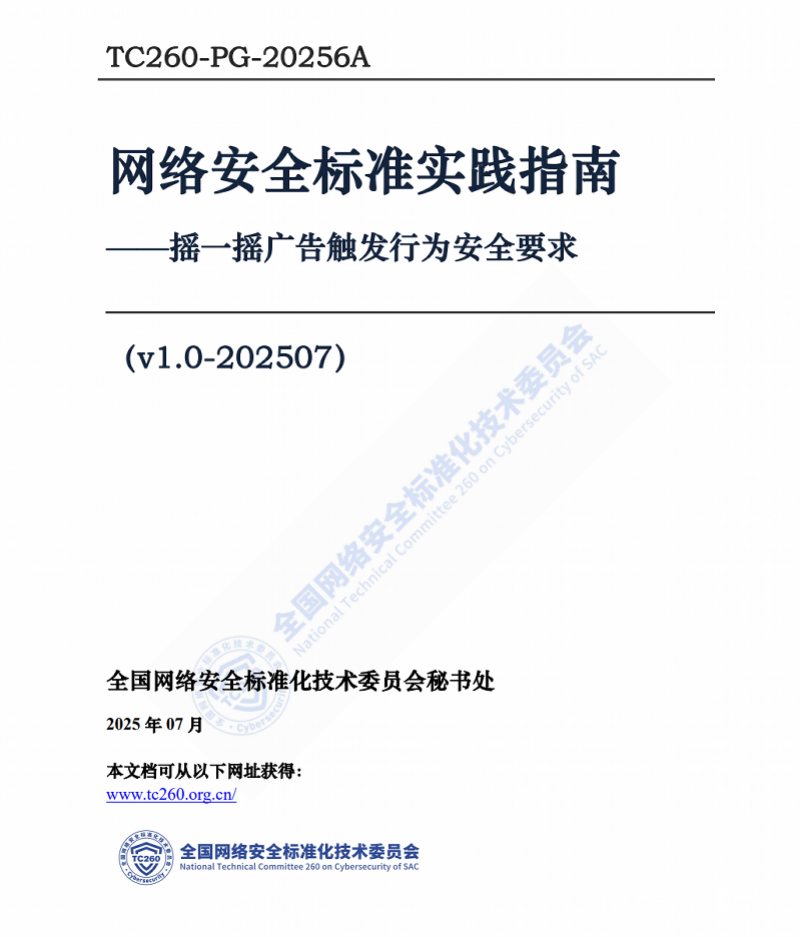
新规来了!“摇一摇”广告被要求设置醒目的“一键关闭”,记者实测多款App
21世纪经济报道· 2025-07-23 12:20
Core Viewpoint - The article discusses the newly released "Guidelines for Security Requirements of Shake-to-Trigger Advertising" aimed at regulating the shake-to-trigger advertising practice, ensuring user autonomy and transparency in the process [1][3]. Group 1: Industry Regulations - The guidelines emphasize three fundamental principles: transparency, autonomy, and personal information protection [12]. - App operators are required to provide a clear "one-click close" option for shake-to-trigger ads, allowing users to opt-out easily [11][14]. - The guidelines clarify the responsibilities of third-party advertising SDKs and app operators, mandating that SDKs must set clear triggering parameters and ensure that ads do not trigger from unintentional user actions [8][12]. Group 2: Consumer Complaints and Background - Consumer complaints regarding shake-to-trigger ads have persisted for years, with notable complaints during the 2023 Double Eleven shopping festival, where users reported frequent and unwanted ad redirects [5][6]. - The article highlights that previous regulations have been issued, but issues with shake-to-trigger ads remain prevalent, indicating a need for more stringent enforcement [7][8]. Group 3: Implementation and Compliance - The guidelines serve as a reference for regulatory enforcement and evaluation, despite not having mandatory power [3][14]. - Some apps have already implemented options to disable shake-to-trigger ads, while others have yet to comply fully, indicating a mixed response within the industry [14][16].


摇一摇广告乱跳转,规范指南发布!实测多款App可一键关闭
Nan Fang Du Shi Bao· 2025-07-23 03:05
Core Viewpoint - The release of the "Guidelines for Safe Triggering of Shake Advertising" aims to standardize practices in the industry to address the issue of unintended ad redirection caused by shake advertising, ensuring user autonomy and protection of personal information [1][2][5]. Group 1: Guidelines Overview - The "Guidelines" specify that app and SDK operators must provide easy options for users to disable shake advertising and set reasonable triggering thresholds to protect user choice [1][5]. - The guidelines are based on legal and policy standards, emphasizing the need for transparency, user autonomy, and personal information protection [2][5]. Group 2: Technical Requirements - The guidelines require that third-party SDK operators must clearly indicate the actions needed to trigger ads and provide a prominent option to close ads [6][7]. - Specific parameters for triggering sensitivity are suggested, such as an acceleration threshold of no less than 15 m/s² and a minimum operation time of 3 seconds [6][7]. Group 3: Industry Response - Several apps, including Tencent Video, Didi, and Bilibili, have already implemented features allowing users to easily enable or disable shake advertising [10][12]. - The guidelines are part of a broader initiative by regulatory bodies to address user rights and improve the advertising experience, following previous complaints and legal actions against misleading ad practices [8][10].