
广告费和业务宣传费税前扣除

Search documents
一问一答 | 自然人股东间股权转让那些事儿
蓝色柳林财税室· 2026-03-22 02:01
Group 1 - The transfer of equity between individual shareholders does not require the payment of value-added tax, but is subject to individual income tax and stamp duty [3] - According to the "Management Measures for Individual Income Tax on Equity Transfer Income (Trial)" regulations, the taxable income from equity transfer is calculated as the transfer income minus the original value of the equity and reasonable expenses, with a tax rate of 20% [3][14] - The stamp duty for equity transfer contracts is calculated at 0.05% of the amount stated in the transfer document, applicable to both the transferor and the transferee [3][6] Group 2 - The tax basis for stamp duty on equity transfer is not simply the total transfer price, but must distinguish between paid-in capital and unpaid capital [6] - Income from equity transfer must be recognized in a lump sum when certain conditions are met, such as payment being made or the transfer agreement being effective [6][18] - Penalty income received due to the transferee's failure to pay on time is considered part of the income from the equity transfer and is subject to individual income tax [6] Group 3 - The transfer of equity for investment purposes is considered a taxable event, requiring the payment of individual income tax [6] - The original value of the equity is determined based on the actual payment made and related reasonable expenses [24] - Taxpayers must submit various documents when filing for tax on equity transfer, including the transfer contract and identification of both parties [28][30]


这三类企业老板快看:这项政策延续两年
蓝色柳林财税室· 2026-02-15 02:02
Group 1 - The article discusses tax deduction policies for advertising and business promotion expenses for specific industries, including cosmetics manufacturing, beverage manufacturing (excluding alcoholic beverages), and pharmaceutical manufacturing, allowing a deduction of up to 30% of annual sales revenue from January 1, 2026, to December 31, 2027 [3][4]. - Expenses exceeding the 30% limit can be carried forward to future tax years for deduction [4]. - Related enterprises can allocate advertising and business promotion expenses through agreements, allowing one party to deduct eligible expenses while the other party can exclude these allocated expenses from their deduction limits [4].

广告费和业务宣传费支出税前扣除,你了解多少?
蓝色柳林财税室· 2026-01-30 01:49
Core Viewpoint - The article discusses the tax deduction policies for advertising and business promotion expenses for different industries, highlighting specific limits and conditions for deductions based on sales revenue [10][16]. Group 1: General Deduction Rules - For general industries, advertising and business promotion expenses can be deducted up to 15% of the annual sales revenue, with any excess allowed to be carried forward to future tax years [10][12]. - For cosmetic manufacturing or sales, pharmaceutical manufacturing, and beverage manufacturing (excluding alcoholic beverages), the deduction limit is set at 30% of the annual sales revenue, with excess amounts also eligible for carryforward [16]. Group 2: Special Cases - Tobacco companies are prohibited from deducting any advertising and business promotion expenses when calculating taxable income [16]. - In cases where related enterprises have signed a cost-sharing agreement for advertising and business promotion expenses, the expenses incurred by one party can be deducted by either party, provided they fall within the allowable limits based on their sales revenue [16]. Group 3: Calculation Basis - The calculation basis for the annual deduction limit for advertising and business promotion expenses is the company's annual sales revenue, which includes deemed sales revenue as specified in the relevant tax regulations [10][11].

铁路电子客票公司名称写错了,如何换开发票?
蓝色柳林财税室· 2026-01-30 01:49
Group 1 - The article discusses the process for railway transportation enterprises to issue red electronic invoices after confirmation from the buyer, emphasizing the importance of the confirmation document for VAT deductions [4][6][8] - It outlines the steps for buyers to obtain and exchange electronic invoices through the 12306 app, highlighting that electronic invoices can only be exchanged up to three times [8][10][12] - The article provides a reminder for users to carefully fill in invoice information to avoid errors, as incorrect information can complicate reimbursement processes [8][10] Group 2 - It mentions that general taxpayers can claim VAT deductions after obtaining the railway electronic ticket, and provides guidance on what to do if there are errors in the ticket information [6][8] - The article includes a note on the tax treatment of advertising and promotional expenses, indicating that certain limits apply based on the company's sales revenue [14][16][18] - It references specific regulations regarding the tax treatment of advertising expenses for certain industries, such as cosmetics and pharmaceuticals, allowing deductions up to 30% of annual sales revenue [16][18][20]

实用!耕地占用税申报操作指南
蓝色柳林财税室· 2026-01-29 14:34
Core Viewpoint - The article discusses the tax deduction policies for advertising and business promotion expenses for enterprises, highlighting specific regulations and limits for different industries [6][9]. Group 1: Tax Deduction Regulations - Enterprises can deduct advertising and business promotion expenses up to 15% of their annual sales revenue, with any excess allowed to be carried forward to future tax years [6]. - For cosmetics, pharmaceuticals, and non-alcoholic beverage manufacturing and sales, the deductible limit is increased to 30% of annual sales revenue [9]. - Tobacco companies are prohibited from deducting any advertising and business promotion expenses when calculating taxable income [9]. Group 2: Related Policies and Timeframe - The current policies will remain effective from January 1, 2026, to December 31, 2027, allowing continued enjoyment of the specified tax benefits [8]. - Enterprises can share advertising and business promotion expenses through agreements, allowing one party to deduct expenses within the allowable limits while the other party can also benefit from the shared deductions [9]. Group 3: Legal Basis - The regulations are based on the "Implementation Regulations of the Corporate Income Tax Law of the People's Republic of China" and other relevant announcements from the Ministry of Finance and the State Administration of Taxation [11].

近期12366热点问题解答(汇总纳税)
蓝色柳林财税室· 2026-01-08 01:33
Core Viewpoint - The article discusses the tax management methods for enterprises engaged in cross-regional operations, emphasizing the unified calculation and tiered management approach for corporate income tax [5][6]. Group 1: Tax Management for Cross-Regional Enterprises - Cross-regional enterprises are subject to a tax management method that includes "unified calculation, tiered management, local prepayment, consolidated settlement, and fiscal adjustment" [5]. - The main office calculates the total taxable income and tax amount, while branch offices are managed by local tax authorities and make monthly or quarterly prepayments [5]. - At the end of the year, the main office consolidates the annual taxable amount, offsetting prepayments, leading to either refunds or additional payments [5]. Group 2: Tax Rate for High-Tech Enterprises - If the main office is a high-tech enterprise, branch offices can also benefit from a reduced corporate income tax rate of 15% under the same unified calculation and management method [6]. - For overseas income, high-tech enterprises can apply the 15% tax rate based on total R&D expenses, total income, and sales related to both domestic and overseas operations [6]. Group 3: Advertising and Promotion Expense Deductions - Certain industries, such as cosmetics and pharmaceuticals, can deduct advertising and promotion expenses up to 30% of their annual sales revenue [14][16]. - Any expenses exceeding this limit can be carried forward to future tax years for deduction [18][19]. Group 4: Related Party Expense Allocation - Related parties can allocate advertising and promotion expenses according to a sharing agreement, allowing for tax deductions within the specified limits [20][22]. - The expenses allocated to one party do not count against the other party's deduction limits [23]. Group 5: Non-Deductible Expenses - Tobacco-related advertising and promotion expenses are not deductible when calculating taxable income [24]. Group 6: Implementation Timeline - The new regulations regarding advertising and promotion expense deductions will take effect from January 1, 2026, and will be in force until December 31, 2027 [25][26].

财政部、税务总局最新公告!
Sou Hu Cai Jing· 2025-12-29 13:30
Core Points - The announcement outlines tax deductions for advertising and promotional expenses for specific industries, including cosmetics, pharmaceuticals, and non-alcoholic beverages, allowing deductions up to 30% of annual sales revenue [1] - Companies can share advertising and promotional expenses through agreements, allowing for flexibility in tax deductions between related entities [1] - Tobacco companies are explicitly prohibited from deducting advertising and promotional expenses from taxable income [1] - The new regulations will be effective from January 1, 2026, to December 31, 2027, replacing previous guidelines [1] Summary by Category Tax Deductions - Advertising and promotional expenses for cosmetics, pharmaceuticals, and non-alcoholic beverage companies can be deducted up to 30% of annual sales revenue [1] - Any expenses exceeding this limit can be carried forward to future tax years for deduction [1] Related Party Agreements - Related companies can enter into agreements to share advertising and promotional expenses, allowing one party to deduct expenses within the allowable limit while the other can also benefit from the shared expenses [1] Tobacco Industry - Tobacco companies are not allowed to deduct any advertising and promotional expenses when calculating taxable income [1] Implementation Timeline - The new tax deduction rules will be in effect from January 1, 2026, to December 31, 2027, and will replace the previous announcement from 2020 [1]
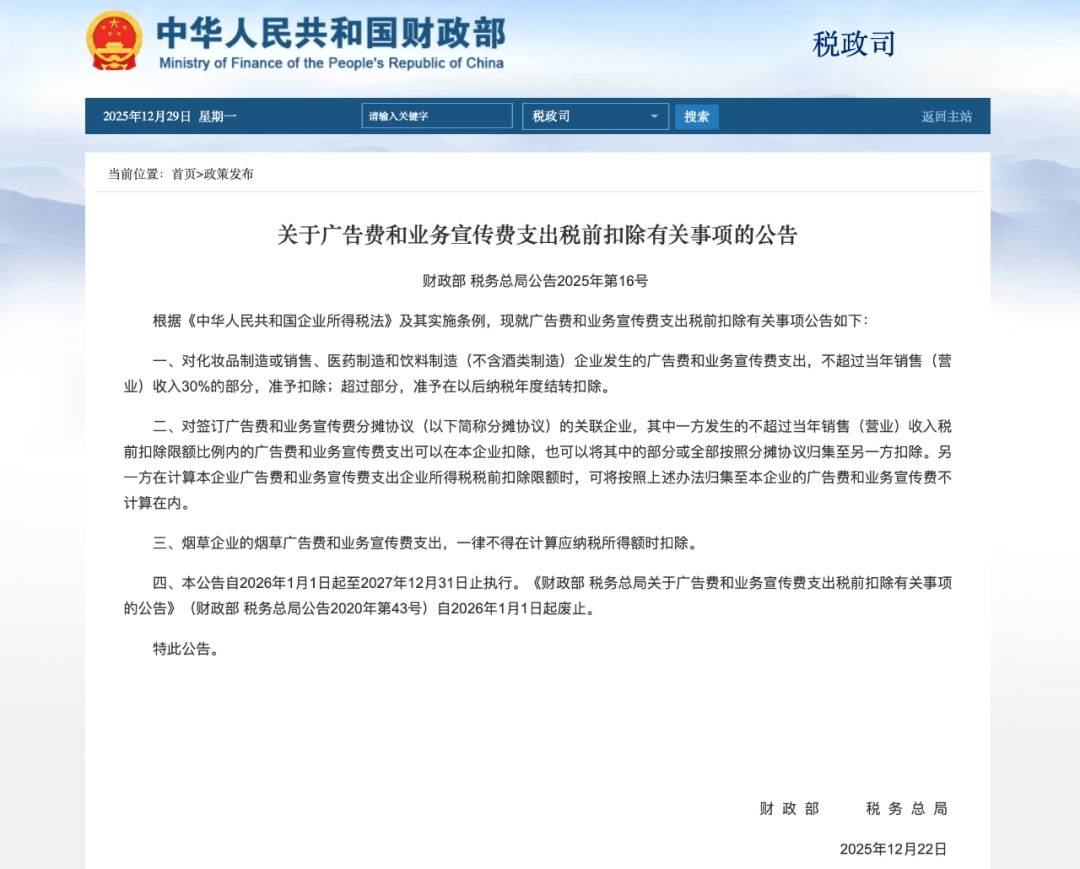
财政部、税务总局:化妆品制造或销售、医药制造和饮料制造(不含酒类制造)企业广告费和业务宣传费支出不超过当年销售收入30%的部分,准予税前扣除
Jin Rong Jie· 2025-12-29 09:16
Core Viewpoint - The announcement by the Ministry of Finance and the State Taxation Administration outlines new tax deduction rules for advertising and business promotion expenses for specific industries, effective from January 1, 2026, to December 31, 2027 [1] Group 1: Tax Deduction Rules - For cosmetics manufacturing or sales, pharmaceutical manufacturing, and beverage manufacturing (excluding alcoholic beverages), advertising and business promotion expenses are deductible up to 30% of the annual sales revenue; any excess can be carried forward to future tax years [1] - Related enterprises that sign a cost-sharing agreement can deduct advertising and business promotion expenses within the allowable limit in either party's accounts, with specific provisions for how these expenses are accounted for [1] - Tobacco companies are prohibited from deducting any advertising and business promotion expenses when calculating taxable income [1] Group 2: Implementation Period - The new rules will be in effect from January 1, 2026, to December 31, 2027, and will replace the previous announcement (Announcement No. 43 of 2020) starting January 1, 2026 [1]
两部门:烟草企业的烟草广告费和业务宣传费支出, 一律不得在计算应纳税所得额时扣除
Sou Hu Cai Jing· 2025-12-29 09:16
Core Viewpoint - The announcement by the Ministry of Finance and the State Administration of Taxation outlines new tax deduction rules for advertising and promotional expenses for specific industries, allowing deductions up to 30% of annual sales revenue, with provisions for carryover of excess amounts to future tax years [1][2]. Group 1: Tax Deduction Rules - Advertising and promotional expenses for cosmetics manufacturing or sales, pharmaceutical manufacturing, and beverage manufacturing (excluding alcoholic beverages) can be deducted up to 30% of the annual sales revenue [1]. - Any expenses exceeding the 30% threshold can be carried forward to subsequent tax years for deduction [1]. Group 2: Related Party Agreements - For related enterprises that have signed a cost-sharing agreement, advertising and promotional expenses that do not exceed the annual sales revenue deduction limit can be deducted by either party, or allocated to the other party as per the agreement [2]. - The receiving party can exclude the allocated advertising and promotional expenses from their own deduction limit calculations [2].
财政部、税务总局:烟草企业的烟草广告费和业务宣传费支出 一律不得在计算应纳税所得额时扣除
Sou Hu Cai Jing· 2025-12-29 09:16
Core Viewpoint - The announcement by the Ministry of Finance and the State Taxation Administration outlines new tax deduction rules for advertising and business promotion expenses for specific industries, effective from January 1, 2026, to December 31, 2027 [1] Group 1: Tax Deduction Rules - For cosmetics manufacturing or sales, pharmaceutical manufacturing, and beverage manufacturing (excluding alcoholic beverages), advertising and business promotion expenses are deductible up to 30% of the annual sales revenue; any excess can be carried forward to future tax years [1] - Related enterprises that sign a cost-sharing agreement can deduct advertising and business promotion expenses within the allowable limit, either in the entity that incurred the expense or allocated to another entity as per the agreement [1] - Tobacco enterprises are prohibited from deducting any advertising and business promotion expenses when calculating taxable income [1] Group 2: Implementation Period - The new rules will be in effect from January 1, 2026, to December 31, 2027, and will replace the previous announcement (Announcement No. 43 of 2020) starting from the same date [1]