开源AI生态

Search documents
黄仁勋“带货”Rubin,A股谁有望受益?
天天基金网· 2026-01-06 05:18
Core Insights - NVIDIA's CEO Jensen Huang highlighted the transformative impact of next-generation accelerated computing and AI across industries during his keynote at CES 2026 [2] - The demand for AI training and inference computing is surging, with the Rubin architecture entering full-scale production and expected to launch in the second half of 2026, offering up to a 10x reduction in token costs compared to the previous Blackwell generation [2][4][5] NVIDIA Rubin Platform - The NVIDIA Rubin platform features six new chips designed for extreme collaboration, significantly reducing training times and inference token costs [4] - The six chips include NVIDIA Vera CPU, NVIDIA Rubin GPU, NVIDIA NVLink 6 Switch, NVIDIA ConnectX-9 SuperNIC, NVIDIA BlueField-4 DPU, and NVIDIA Spectrum-6 Ethernet Switch [4] - Innovations in the Rubin platform include the latest NVIDIA NVLink interconnect technology, a Transformer engine, confidential computing, and RAS engine [4] AI Model Advancements - The Rubin platform accelerates intelligent agent AI, advanced reasoning, and large-scale mixture of experts (MoE) model inference, reducing the number of GPUs needed for training MoE models by four times compared to previous generations [5] - The platform introduces a new generation of AI-native storage architecture designed for gigascale inference context, enhancing response capabilities and throughput [5] Market Deployment and Partnerships - NVIDIA Rubin products will be available through partners like AWS, Google Cloud, Microsoft, and others in the second half of 2026 [5] - CoreWeave will collaborate with NVIDIA to leverage Rubin's advancements in inference and MoE models, while major server manufacturers like Cisco, Dell, HPE, Lenovo, and Supermicro are expected to launch Rubin-based servers [6] Physical AI and Open Source Models - Huang announced the arrival of "physical AI's ChatGPT moment," with machines beginning to understand and act upon real-world data [12][13] - NVIDIA introduced the open-source physical AI foundational model, Cosmos, which has been pre-trained on vast datasets to understand the workings of the world [13] - The Alpamayo series of open-source AI models aims to accelerate the development of safe, reasoning-based autonomous vehicles, garnering interest from industry leaders [14] Robotics and Ecosystem Development - Global robotics leaders are developing products based on NVIDIA's Isaac platform and GR00T foundational model, covering various applications from industrial to consumer robotics [15] - NVIDIA emphasizes the importance of building an open-source AI ecosystem, with models like DeepSeek R1 demonstrating rapid industry adoption and collaboration [15] Industry Implications - The introduction of the Vera Rubin platform is expected to drive demand for high-speed optical modules and CPO technology, with companies in the supply chain already preparing for this shift [9][10] - The increased power requirements of the Rubin GPU, estimated at around 1800 watts, will elevate the demands on power supply and cooling systems [10]


朱啸虎看好中国的开源AI生态
Xin Lang Cai Jing· 2025-12-11 03:26
Core Viewpoint - The gap between China and the US in AI technology is currently stable at around three to six months, with potential for narrowing in the coming years, leading to optimism about China's open-source AI ecosystem in the next three to five years [1][2]. Group 1 - The current AI technology gap between China and the US is approximately three to six months [1][2]. - The gap is not expected to widen, indicating a stable competitive landscape [1][2]. - There is optimism that the gap can be reduced in the future, which would position China's open-source AI ecosystem as a leader [1][2].
Kimi超过DeepSeek的新模型被指“套壳”Qwen?到底怎么回事儿
Hu Xiu· 2025-06-17 12:15
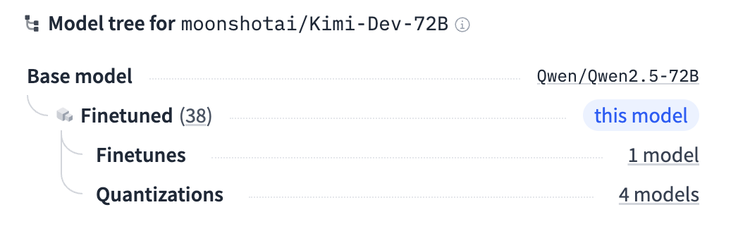
Core Viewpoint - The release of the open-source model Kimi-Dev-72B by Moonlight Dark Side has set a new record in software engineering task benchmarks, achieving a score of 60.4% on SWE-bench Verified, surpassing several competitors including DeepSeek [1][3]. Model Development - Kimi-Dev-72B is based on the Qwen/Qwen2.5-72B model, indicating it is not a completely original model but rather a fine-tuned version utilizing a large dataset of GitHub issues and PR submissions for training [2][3]. - The innovative aspect of Kimi-Dev lies in its training methodology, which employs large-scale reinforcement learning to autonomously fix real code repository issues within a Docker environment [3]. Licensing and Compliance - Kimi-Dev-72B is released under the MIT license, but it must comply with the original licensing restrictions of Qwen-2.5-72B, which is governed by the Qwen LICENSE AGREEMENT [4][5]. - The licensing controversy stems from questions about whether Moonlight Dark Side obtained special permission to use Qwen-2.5-72B, as the licensing agreement stipulates commercial licensing requirements when monthly active users exceed 100 million [6][7]. Community Response - The Qwen team clarified that they did not grant permission for the use of Qwen-2.5-72B, but later described the issue as a "legacy problem" related to their evolving licensing strategy [8][10]. - The Qwen team has transitioned to a more open licensing model with the upcoming Qwen3 series, adopting the Apache 2.0 protocol for all models, which aims to foster a more open and active AI ecosystem [12][13]. Industry Implications - The case illustrates a shift in the AI industry towards open-source collaboration, moving from restrictive licensing to more open models to encourage developer engagement and innovation [16][18]. - The rising trend of "second innovation" based on strong foundational models highlights the importance of differentiation in value creation within the open-source ecosystem [16].