
彭博商品指数再平衡

Search documents
ATFX:委内瑞拉陷权力真空 不可预测性成黄金上涨最佳燃料
Xin Lang Cai Jing· 2026-01-05 10:38
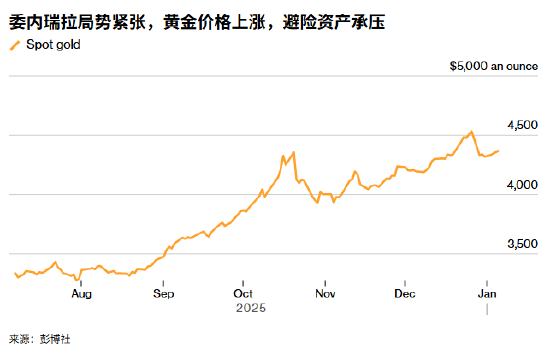
Group 1 - The article discusses the geopolitical tensions following the U.S. attack on Venezuela and the arrest of President Nicolás Maduro, leading to increased demand for safe-haven assets like gold and silver [1][5]. - Gold prices surged by 2.1%, surpassing $4,420 per ounce, while silver prices rose by 4.8% in response to the news [1][5]. - President Trump's statement about the U.S. plans to "take over" Venezuela after Maduro's regime change adds uncertainty to the future governance of the country [1][5]. Group 2 - Gold achieved its best annual performance since 1979, supported by central bank purchases and inflows into gold ETFs, with prices reaching new highs [2][8]. - The upcoming rebalancing of the Bloomberg Commodities Index may trigger significant sell-offs from passive funds, with over $5 billion in silver and approximately $6 billion in gold futures expected to be sold [2][8]. - The current geopolitical risk premium is offsetting downward pressure on precious metals, with any news regarding Venezuela's resistance or external intervention likely to further stimulate prices [2][8]. Group 3 - The arrest of Maduro has created a power vacuum, raising concerns about potential civil war or broader regional unrest, which could fuel further increases in precious metal prices [3][9]. - If U.S. military actions in Venezuela lead to long-term presence or large-scale aid, it may increase fiscal burdens and impact the credibility of the U.S. dollar, providing deeper support for gold in the long run [3][9]. - Conversely, a rapid and smooth regime change could lead to profit-taking in safe-haven assets, resulting in a sharp correction in gold prices [3][9].

多重利多支撑 黄金中长期仍有上涨空间
Sou Hu Cai Jing· 2025-12-17 23:57
Core Viewpoint - The recent increase in gold prices is primarily driven by concerns over a weakening U.S. labor market, expectations of Federal Reserve rate cuts and balance sheet expansion, global fiscal expansion, and continued central bank gold purchases [1][2][3][4]. Group 1: Federal Reserve Actions - The Federal Reserve plans to purchase $40 billion in Treasury bonds monthly starting December 12, indicating a significant liquidity injection into the financial system [2] - Predictions suggest that the Fed will buy approximately $500 billion in short-term Treasury bonds by 2026, signaling aggressive liquidity measures [2] Group 2: Global Fiscal Expansion - The U.S. government has increased its debt ceiling by $5 trillion, with projected fiscal deficits rising by $3.4 trillion over the next decade [3] - Japan has approved a ¥21.3 trillion (approximately $135.4 billion) economic stimulus package, reflecting a trend of fiscal expansion [3] - The UK's fiscal buffer has expanded to £22 billion, with net public sector borrowing projected to be £138.3 billion for the 2025-2026 fiscal year, higher than previous estimates [3] Group 3: Japanese Monetary Policy - The Bank of Japan is expected to announce a 25 basis point interest rate hike on December 19, which may lead to a reversal of the "carry trade" that has historically benefited from low interest rates [4] - As Japanese institutions begin to repatriate funds from U.S. and overseas bonds, demand for U.S. Treasuries may decrease, conflicting with the U.S. Treasury's need to issue new debt [4] Group 4: Market Implications - The ongoing central bank gold purchases, geopolitical risks, and expectations of Federal Reserve rate cuts and global fiscal policy easing are likely to support gold prices in the medium to long term [4] - However, short-term risks include potential reversals in Japanese "carry trades" and technical sell-offs in gold and silver markets due to rebalancing in the Bloomberg Commodity Index [4]