征信体系建设

Search documents
千万人受益 详解信用修复政策
Bei Jing Shang Bao· 2025-12-22 15:39
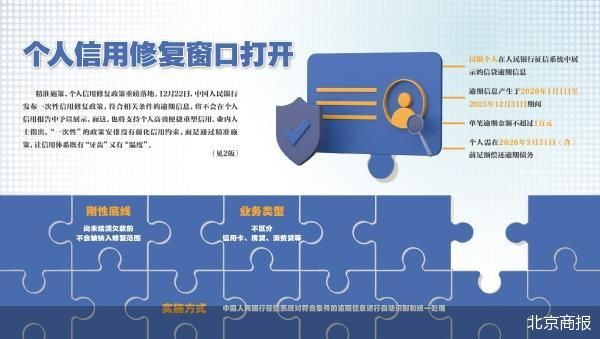
Core Viewpoint - The People's Bank of China has introduced a one-time credit repair policy that allows eligible overdue information to be excluded from personal credit reports, effective from January 1, 2026, aiming to facilitate the rebuilding of personal credit [1][3]. Group 1: Policy Details - The policy applies to overdue information from January 1, 2020, to December 31, 2025, with specific conditions: the overdue amount must be less than or equal to 10,000 yuan, and the debt must be settled by March 31, 2026 [3][4]. - The policy is designed to support individuals who experienced financial difficulties due to the pandemic, distinguishing between small, unintentional defaults and larger, intentional defaults [4][10]. - The credit repair process is automatic, requiring no application or documentation from individuals, thereby minimizing administrative burdens [7][14]. Group 2: Expected Impact - The policy is expected to benefit millions, particularly those who faced small overdue amounts due to income loss during the pandemic, including young professionals and small business owners [10][11]. - It aims to improve credit accessibility for consumers, thereby enhancing their financial stability and boosting overall consumption, which is crucial for economic recovery [10][11]. - Financial institutions will benefit from improved credit assessment capabilities, leading to better resource allocation and risk management [5][11]. Group 3: Future Directions - The policy may evolve from a one-time relief measure to a long-term mechanism, focusing on diverse credit products and enhanced consumer rights protection [11][12]. - The People's Bank of China plans to strengthen the regulatory framework around credit information collection and usage, aiming to combat illegal practices in credit repair [12][13].

农行上海市分行开展征信主题宣传系列活动
Zhong Guo Jin Rong Xin Xi Wang· 2025-06-16 08:05
Group 1 - The People's Bank of China Shanghai Headquarters, in collaboration with local financial institutions, held a credit awareness event themed "Protecting Credit, Winning the Future" on June 14 [1] - Agricultural Bank of China Shanghai Branch actively participated in the event, promoting credit knowledge to the public through various interactive activities [1] - The bank utilized its extensive network of service outlets to display promotional materials and engage customers in credit knowledge dissemination [1] Group 2 - Agricultural Bank of China Shanghai Branch developed online channels for credit report self-querying, allowing citizens to access their credit reports conveniently [2] - The bank promoted platforms for sharing credit information and financial data, enhancing the financial service coverage for small and micro enterprises [2]

年省11亿!企业个人迎征信服务降费大礼包
第一财经· 2025-06-05 03:16
Core Viewpoint - The recent notification from the National Development and Reform Commission aims to reduce credit service fees, effective from July 1, 2025, to lower operational costs for businesses, optimize the business environment, and promote the development of the real economy and social credit system [1][4]. Group 1: Fee Reduction Details - The service fee for querying corporate credit reports will decrease from 20 yuan to 9 yuan, while the fee for personal credit reports will drop from 2 yuan to 1 yuan [4]. - Various financial institutions, including rural commercial banks and consumer finance companies, will continue to enjoy preferential fee standards, with personal internet queries remaining free [4]. - The annual fee for accounts receivable pledge registration will be reduced from 30 yuan to 15 yuan, and the fees for change and dispute registrations will decrease from 10 yuan to 5 yuan [4]. Group 2: Impact on Financial Institutions - The reduction in credit service costs is expected to save users approximately 1.1 billion yuan annually [2]. - Lowering credit costs will alleviate the operational burden on banks, facilitating financing for the real economy, and will also reduce the financial burden on individuals seeking credit information [4]. - The adjustment is particularly beneficial for small financial institutions, as they often face higher credit costs due to the volume of small transactions [4]. Group 3: Broader Financial Context - In the context of increasing pressure on bank interest margins, reducing non-interest costs like credit service fees is crucial for lowering overall financing costs in society [6][7]. - The People's Bank of China has made significant progress in building a comprehensive credit information system, which is now the largest in the world in terms of population coverage and data collection [7]. - The dual approach of "government + market" in developing the credit system aims to enhance service quality and efficiency, thereby improving the matching of financial resources with real demand [7]. Group 4: Potential Issues - The reduction in query costs may lead to excessive information queries, raising concerns about consumer rights and the need for transparency in the querying process [8]. - A robust social credit system is essential for the stable development of consumer finance, and there are suggestions to grant consumer finance companies access to the same data as banks to improve their service capabilities [8].