微类星体

Search documents
【中国青年报】在地球上寻找宇宙线的源头
Zhong Guo Qing Nian Bao· 2025-11-24 03:07
Core Insights - The recent findings from the LHAASO (High Altitude Cosmic Ray Observatory) reveal that black holes, particularly microquasars, are significant sources of high-energy cosmic rays, challenging traditional views of black holes as mere absorbers of matter [6][9][10] - The research indicates that microquasars can accelerate protons to the PeV energy range, contributing to the understanding of cosmic ray origins and the mechanisms behind high-energy particle acceleration [10][12] Group 1: Discoveries Related to Black Holes - The LHAASO has identified microquasars as powerful particle accelerators within the Milky Way, capable of accelerating protons to energies exceeding 1 PeV [9][10] - The study highlights that the cosmic ray proton energy spectrum shows unexpected high-energy components, suggesting black holes as potential sources [10][11] - The findings provide a new perspective on black holes, revealing their role in producing high-energy particles rather than solely consuming surrounding matter [9][10] Group 2: Methodology and Observations - LHAASO utilized advanced ground-based observational techniques to measure cosmic ray spectra, achieving precision comparable to satellite experiments [12][14] - The observatory's design allows for the detection of both cosmic ray sources and the precise measurement of cosmic ray particles, linking the observed high-energy emissions to specific astrophysical phenomena [14][15] - The research successfully correlates the knee structure in cosmic ray energy distribution with specific types of celestial bodies, particularly black hole jet systems [15][16] Group 3: Implications for Future Research - The discoveries pave the way for further exploration of cosmic ray origins, with expectations of identifying additional black holes contributing to high-energy cosmic rays [15][16] - The findings may inspire new approaches in high-energy physics, potentially leading to experimental simulations of cosmic processes in laboratory settings [16][17] - The research emphasizes the importance of continued observation and theoretical development to understand the universe's high-energy phenomena [16][17]

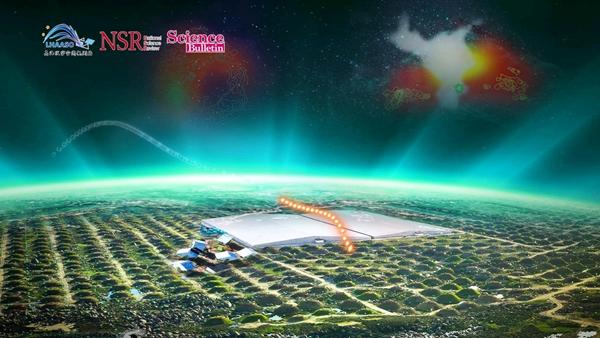
“拉索”重大发现颠覆黑洞传统认知
Ke Ji Ri Bao· 2025-11-17 02:41
Core Insights - The discovery by China's LHAASO challenges the long-held belief that black holes are merely "consumers" of matter, revealing them as sources of ultra-high-energy cosmic rays [1][2] - The research published in "National Science Review" and "Science Bulletin" provides insights into the formation of cosmic rays and identifies black holes as "super particle accelerators" [1][3] Group 1: Cosmic Rays and Black Holes - Cosmic rays are high-energy charged particles from space, primarily composed of protons and atomic nuclei, carrying significant information about the universe's origins and evolution [1] - The study identifies five micro-quasars, including SS 433 and V4641 Sgr, as sources of ultra-high-energy gamma rays, with SS 433's energy peak exceeding 1 PeV [2][3] - The energy output from these black holes is likened to the release of energy equivalent to four hundred trillion hydrogen bombs [2] Group 2: The "Knee" Phenomenon - The "knee" in cosmic ray energy distribution, observed at around 3 PeV, has puzzled scientists for nearly 70 years, with previous theories suggesting a limit to the acceleration capabilities of cosmic ray sources [3] - LHAASO's measurements have provided a breakthrough, revealing that the proton energy spectrum at the "knee" is not a simple bend but shows a new high-energy component [3] - This discovery indicates the presence of multiple types of acceleration sources within the Milky Way, each with unique acceleration capabilities and energy ranges [3]
破解宇宙线“膝”区之谜,证实黑洞为超高能“粒子加速器” “拉索”重大发现颠覆黑洞传统认知
Ke Ji Ri Bao· 2025-11-16 23:38
Core Insights - The discovery by China's LHAASO observatory challenges the long-held belief that black holes are merely destructive entities, revealing them as sources of ultra-high-energy cosmic rays [1][2] - The research published in "National Science Review" and "Science Bulletin" provides insights into the formation of cosmic rays and identifies black holes as "super particle accelerators" [1][3] Group 1: Findings on Cosmic Rays - Cosmic rays are high-energy charged particles from space, primarily composed of protons and atomic nuclei, carrying significant information about the universe's origins and evolution [1] - The LHAASO observatory identified five micro-quasars, including SS 433 and V4641 Sgr, as sources of ultra-high-energy gamma rays, with SS 433's energy peak exceeding 1 PeV [2] - The energy output from these black holes is immense, with SS 433's energy comparable to the release of four hundred trillion hydrogen bombs [2] Group 2: Understanding the "Knee" Phenomenon - The "knee" in cosmic ray energy distribution, observed at around 3 PeV, has puzzled scientists for nearly 70 years, with previous theories suggesting a limit to the acceleration capabilities of cosmic ray sources [3] - LHAASO's advanced detection capabilities allowed for precise measurement of proton spectra in the "knee" region, revealing a new high-energy component rather than a simple bend [3] - This breakthrough indicates the presence of multiple types of acceleration sources within the Milky Way, each with unique acceleration capabilities and energy ranges, providing a new understanding of cosmic ray origins [3]
拉索发布新成果,发现黑洞在宇宙线起源中的作用
Xin Jing Bao· 2025-11-16 22:49
Core Insights - The latest findings from the High Altitude Cosmic Ray Observatory (LHAASO) indicate that cosmic ray protons in the PeV energy range primarily originate from microquasars, providing significant observational evidence for understanding the role of black holes in the origin of cosmic rays [1][2] Group 1: Cosmic Rays and Their Sources - Cosmic rays are high-energy particle streams from space that carry information about their astrophysical environments [1] - A critical turning point in the energy distribution of cosmic rays occurs around 3 PeV, where the number of cosmic rays sharply decreases, referred to as the "knee" [1] - Previous beliefs attributed cosmic rays to supernova remnants, but it has been found that they struggle to accelerate particles to energies above the "knee" [1] Group 2: Role of Microquasars - Microquasars, formed when black holes in binary systems accrete material from companion stars, are identified as significant PeV particle accelerators [2] - LHAASO has systematically detected ultra-high-energy gamma rays from five microquasars, highlighting their importance in the Milky Way [2] Group 3: LHAASO's Contributions - The High Altitude Cosmic Ray Observatory is designed, constructed, and operated by Chinese scientists, achieving globally impactful breakthroughs in gamma-ray astronomy and cosmic ray measurements [2] - The recent discoveries enhance the understanding of black holes' contributions to the origin of cosmic rays [2]
首次发现高能宇宙线新来源!“拉索”成果又上新
Xin Hua She· 2025-11-16 09:57
Core Insights - The LHAASO (Large High Altitude Air Shower Observatory) has made a significant discovery regarding microquasars, which are powerful particle accelerators formed by the interaction of black holes and companion stars, capable of accelerating cosmic rays to energies above the "knee" threshold, providing crucial observational evidence for the role of black holes in the origin of cosmic rays [1] Group 1: Cosmic Rays - Cosmic rays are charged particles from outer space, primarily composed of various atomic nuclei, and are considered messengers of cosmic events. The origin of high-energy cosmic rays remains a mystery [5] - There is a critical turning point in the energy spectrum of cosmic rays, around 30 trillion electron volts, where the number of cosmic rays sharply decreases, referred to as the "knee" [5] Group 2: Research Findings - The LHAASO has identified signals of ultra-high-energy gamma rays from five microquasars, indicating that these systems can accelerate particles to energies in the "knee" region of the cosmic ray spectrum [7] - This discovery suggests that microquasars serve as new sources of high-energy cosmic rays, surpassing the acceleration limits of supernova remnants [7] - The findings link the "knee" structure of cosmic rays to specific celestial bodies, namely black hole jet systems, thus opening new avenues for understanding extreme physical processes in the universe [7] Group 3: Scientific Impact - The LHAASO continues to contribute to scientific endeavors, expanding the boundaries of human knowledge and delivering globally impactful breakthroughs [8]

新华鲜报丨首次发现高能宇宙线新来源!“拉索”成果又上新
Xin Hua She· 2025-11-16 09:43
Core Insights - The LHAASO (Large High Altitude Air Shower Observatory) has made a significant discovery regarding microquasars, which are powerful particle accelerators formed by the interaction of black holes and companion stars, capable of accelerating cosmic rays to energies above the "knee" threshold, providing crucial observational evidence for understanding the role of black holes in the origin of cosmic rays [1] Group 1: Cosmic Rays - Cosmic rays are charged particles from outer space, primarily composed of various atomic nuclei, and are considered messengers of cosmic events. The origin of high-energy cosmic rays has been a longstanding mystery [5] - There is a critical turning point in the energy spectrum of cosmic rays, around 30 trillion electron volts, where the number of cosmic rays suddenly decreases, referred to as the "knee" due to its shape resembling a human knee [5] Group 2: Research Findings - The LHAASO has identified a specific type of cosmic system known as microquasars, where black holes in binary systems consume material from companion stars, ejecting some material in the form of jets. This study marks the first detection of ultra-high-energy gamma-ray signals from five microquasars [7] - The research indicates that microquasars have a significantly higher acceleration limit than supernova remnants, reaching the energy threshold of the "knee," thus establishing them as a new source of high-energy cosmic rays [7] - This discovery not only addresses the long-standing mystery of the formation of the cosmic ray "knee" but also links the "knee" structure to specific celestial bodies, namely black hole jet systems, paving a new path for understanding extreme physical processes in the universe [7]
新华鲜报|首次发现高能宇宙线新来源!“拉索”成果又上新
Xin Hua She· 2025-11-16 06:31
Core Insights - The LHAASO (Large High Altitude Air Shower Observatory) has made a significant discovery regarding microquasars, which are powerful particle accelerators formed by the interaction of black holes and companion stars, capable of accelerating cosmic rays to energies above the "knee" threshold, providing crucial observational evidence for understanding the role of black holes in the origin of cosmic rays [1][6]. Group 1: Cosmic Rays - Cosmic rays are charged particles from outer space, primarily composed of various atomic nuclei, and are considered "messengers" of cosmic events. The origin of high-energy cosmic rays remains a mystery, particularly around the energy spectrum's critical knee point, where the number of cosmic rays sharply decreases at approximately 30 trillion electron volts [4]. - Previous theories suggested that cosmic rays originated from supernova remnants, but observations indicate that these remnants struggle to accelerate particles to energies above the knee [4]. Group 2: Research Methodology - Due to the charged nature of cosmic ray particles, their paths are influenced by magnetic fields, making it challenging to trace their origins directly. However, high-energy gamma rays produced when cosmic rays collide with interstellar matter can travel in straight lines, providing indirect evidence of cosmic ray sources [5]. Group 3: LHAASO's Findings - LHAASO's recent findings point to microquasars as a new class of cosmic ray sources. These systems consist of black holes in binary systems that consume material from companion stars, ejecting some of it as jets. LHAASO detected ultra-high-energy gamma-ray signals from five microquasars, revealing that the particle energies are located in the knee region of the cosmic ray spectrum [6]. - This discovery indicates that there are multiple types of particle accelerators in the Milky Way, with microquasars having a significantly higher acceleration limit than supernova remnants, thus becoming a new source of high-energy cosmic rays [6]. - LHAASO's findings not only address the long-standing mystery of the cosmic ray knee but also establish a connection between the knee structure and specific celestial bodies, such as black hole jet systems, paving the way for a deeper understanding of extreme physical processes in the universe [6].

新华鲜报|首次发现高能宇宙线新来源!“拉索”成果又上新
Xin Hua She· 2025-11-16 06:12
Core Insights - The LHAASO (Large High Altitude Air Shower Observatory) has made a significant discovery regarding microquasars, which are powerful particle accelerators formed by the interaction of black holes and companion stars, capable of accelerating cosmic rays to energies above the "knee" threshold, providing crucial observational evidence for the role of black holes in the origin of cosmic rays [1][6]. Group 1: Discovery and Research Findings - The latest research led by the Institute of High Energy Physics of the Chinese Academy of Sciences has been published in international academic journals, indicating that microquasars can accelerate cosmic rays to high energies [1][2]. - LHAASO has captured ultra-high-energy gamma-ray signals from five microquasars, revealing that the particle energies producing these gamma rays are located in the "knee" region of the cosmic ray energy spectrum [6][4]. - This discovery suggests that there are multiple types of particle accelerators in the Milky Way, with microquasars having a significantly higher acceleration limit than supernova remnants, thus becoming a new source of high-energy cosmic rays [6][4]. Group 2: Understanding Cosmic Rays - Cosmic rays are charged particles from outer space, primarily composed of various atomic nuclei, and are considered messengers of cosmic events [4]. - The energy spectrum of cosmic rays shows a critical turning point at approximately 30 trillion electron volts, where the number of cosmic rays suddenly decreases, referred to as the "knee" [4]. - Previous theories suggested that cosmic rays originated from supernova remnants, but observations indicate that these remnants struggle to accelerate particles to energies above the "knee" [4][6]. Group 3: Implications of the Findings - The findings from LHAASO not only address the long-standing mystery of the formation of the cosmic ray "knee" but also link this structure to specific celestial bodies, namely black hole jet systems, opening new avenues for understanding extreme physical processes in the universe [6][7]. - LHAASO continues to contribute to scientific endeavors, expanding the boundaries of human knowledge with globally impactful breakthroughs [7].