德国工业复苏

Search documents
德国工业:11月产出连增三月,财政刺激初显效
Sou Hu Cai Jing· 2026-01-09 08:17
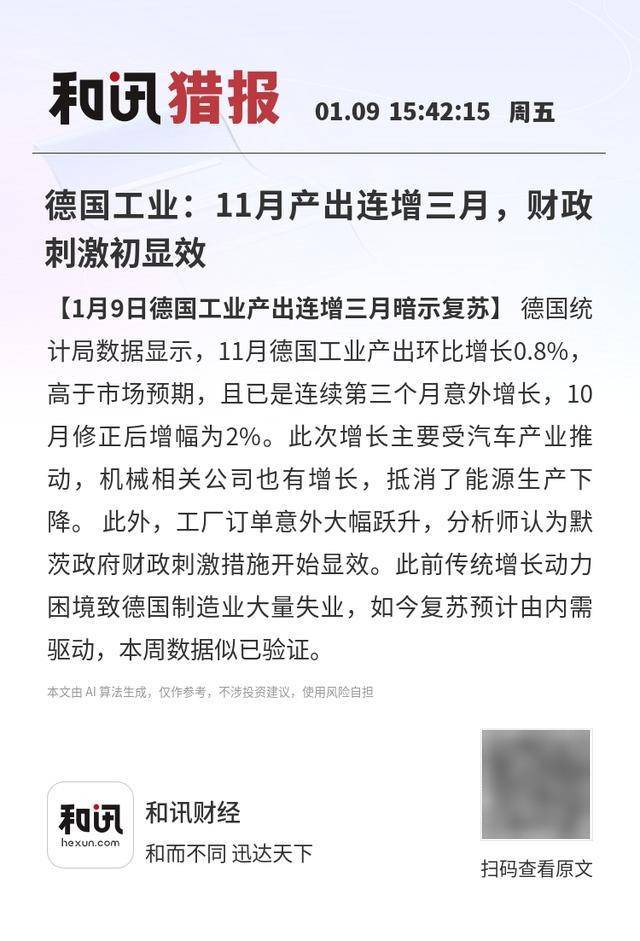
德国工业:11月产出连增三月,财政 刺激初显效 【1月9日德国工业产出连增三月暗示复苏】德国统计局数据显示,11月德国工业产出环比增长0.8%, 高于市场预期,且已是连续第三个月意外增长,10月修正后增幅为2%。此次增长主要受汽车产业推 动,机械相关公司也有增长,抵消了能源生产下降。此外,工厂订单意外大幅跃升,分析师认为默茨政 府财政刺激措施开始显效。此前传统增长动力困境致德国制造业大量失业,如今复苏预计由内需驱动, 本周数据似已验证。 本文由 AI 算法生成,仅作参考,不涉投资建议,使用风险自担 和讯猎报 01.09 15:42:15 周五 和讯财经 和而不同 迅达天下 扫码查看原文 【1月9日德国工业产出连增三月暗示复苏】 德国统 计局数据显示,11月德国工业产出环比增长0.8%, 高于市场预期,且已是连续第三个月意外增长,10 月修正后增幅为2%。此次增长主要受汽车产业推 动,机械相关公司也有增长,抵消了能源生产下 降。此外,工厂订单意外大幅跃升,分析师认为默 茨政府财政刺激措施开始显效。此前传统增长动力 困境致德国制造业大量失业,如今复苏预计由内需 驱动,本周数据似已验证。 本文由 Al 算法生成,仅 ...

德国工业走向复兴之路?
Hua Er Jie Jian Wen· 2025-07-08 00:54
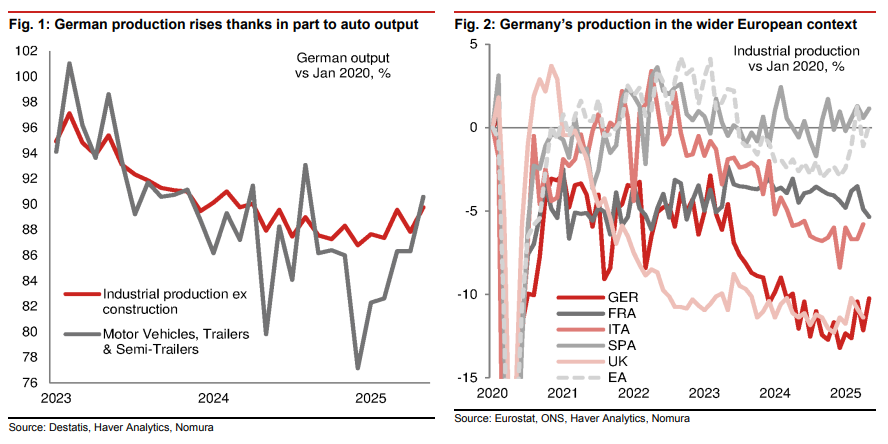
Core Viewpoint - Germany's industrial production is showing signs of recovery after a prolonged slump, driven primarily by strong performance in the automotive sector, although challenges such as tariff uncertainties and a strong euro pose risks to this recovery [1][4]. Group 1: Industrial Production Data - In May, Germany's industrial output increased by 1.2% month-on-month, reversing a 1.6% decline in April and marking a 3.4% recovery from the low in December of the previous year [1]. - Capital goods production contributed significantly to this growth, with an increase of nearly 6%, while the transportation equipment sector saw a remarkable growth of nearly 14%, and automotive production surged by approximately 17.5% [1]. Group 2: Short-term Challenges - The upcoming tariff deadline on July 9 creates uncertainty for German export companies, while a strong euro is putting pressure on export competitiveness [4]. - Despite warnings from several European Central Bank members regarding exchange rate risks, the German central bank's president stated that the euro is not at an "abnormally high level" [4]. Group 3: Long-term Opportunities - Over the next 12 years, Germany's infrastructure sector is set to receive annual fiscal investments equivalent to 1% of GDP, and defense spending is planned to increase from 2% in 2024 to 3.5% by 2029, which are viewed as key positive factors for industrial recovery [4]. - As the largest manufacturing country in the Eurozone, Germany accounts for approximately 36% of the Eurozone's total industrial production, and its commitment to fiscal support is expected to make it a key driver of economic growth in the coming years [10]. Group 4: Eurozone Industrial Performance - As of July 7, about 60% of the Eurozone's industrial production data has been reported, with a weighted average increase of 1.3% across major economies including Germany, France, and Spain [5]. - The recovery within the Eurozone is uneven, with smaller economies like Belgium, Austria, Finland, and Greece showing strong rebounds, while Germany and the UK still lag behind pre-pandemic production levels [5]. Group 5: Sentiment Indicators - The July Sentix survey indicates a rise in Germany's current situation index to a two-year high, although caution is advised as this survey primarily reflects market participants' sentiment and has a historical correlation coefficient of only 0.4 with economic growth [8].