财政刺激

Search documents
国泰君安期货商品研究晨报:贵金属及基本金属-20260401
Guo Tai Jun An Qi Huo· 2026-04-01 02:51
1. Report Industry Investment Ratings The report does not provide specific industry investment ratings. 2. Core Views of the Report - Gold: Geopolitical tensions ease [2][4] - Silver: Drops from the oscillation platform [2][4] - Copper: Risk sentiment rebounds, and prices rise [2][7] - Zinc: Shows a relatively strong performance [2][10] - Lead: Decrease in overseas inventories supports prices [2][14] - Tin: Oscillates with a slight upward trend [2][17] - Aluminum: Supply pressure persists [2][21] - Alumina: The oversupply situation remains unchanged [2][21] - Cast aluminum alloy: Follows the trend of electrolytic aluminum [2][21] - Platinum: The situation reverses, and prices rebound [2][24] - Palladium: Rebounds upward [2][25] - Nickel: The marginal increase in inventory slows down, and the cost of pyrometallurgy is pushed up by the ore end [2][29] - Stainless steel: The steel price oscillates due to the game between demand and cost [2][30] 3. Summaries by Relevant Catalogs Gold and Silver - **Fundamental Data**: The prices of Shanghai gold and silver futures and spot have increased to varying degrees, with trading volumes and positions showing different changes. ETF holdings have decreased, and inventory changes vary. Price spreads also show different trends [4]. - **Macro and Industry News**: Powell said the Fed's interest rates are in a "favorable position," and the White House and Iran have different stances on the negotiation [4][6]. Copper - **Fundamental Data**: The price of Shanghai copper futures decreased during the day but increased at night, and the price of LME copper increased. Trading volumes and positions changed, and inventory decreased. Price spreads also showed different trends [7]. - **Macro and Industry News**: Trump said he would end the Iran war in "two to three weeks," and China's central bank will strengthen monetary policy regulation. China's refined copper production increased, and Peru's copper production also increased. Codelco expects production costs to rise [7][9]. Zinc - **Fundamental Data**: The price of Shanghai zinc futures decreased slightly, while the price of LME zinc increased. Trading volumes and positions changed, and inventory decreased. Price spreads also showed different trends [10]. - **News**: Trump's "exit roadmap" emerged, and the euro - zone inflation rate soared, increasing the expectation of interest rate hikes [11]. Lead - **Fundamental Data**: The price of Shanghai lead futures increased slightly, and the price of LME lead also increased. Trading volumes and positions changed, and overseas inventory decreased. Price spreads also showed different trends [14]. - **News**: Trump said he would end the Iran war in "two to three weeks," and China's central bank will strengthen monetary policy regulation [15]. Tin - **Fundamental Data**: The price of Shanghai tin futures increased, and the price of LME tin also increased. Trading volumes and positions decreased, and inventory changed. Price spreads also showed different trends [18]. - **Macro and Industry News**: The Iranian president expressed the willingness to end the war, Trump said he would end the Iran war in "two to three weeks," China's central bank will strengthen monetary policy regulation, and the euro - zone inflation rate soared [20]. Aluminum, Alumina, and Cast Aluminum Alloy - **Fundamental Data**: The prices of aluminum, alumina, and cast aluminum alloy futures and spot showed different trends, with trading volumes, positions, and inventory changing. Price spreads also showed different trends [21]. - **Comprehensive News**: The ECB president questioned the US Treasury Secretary's view on the impact of the Iran war, and the decoupling of US Treasury bonds and oil prices became a key signal [23]. Platinum and Palladium - **Fundamental Data**: The prices of platinum and palladium futures and spot showed different trends, with trading volumes, positions, and inventory changing. Price spreads also showed different trends [25]. - **Macro and Industry News**: OPEC's production in March hit a new low since the peak of the COVID - 19 pandemic, and there were various news about the Iran situation [28]. Nickel and Stainless Steel - **Fundamental Data**: The prices of nickel and stainless steel futures showed different trends, with trading volumes, positions, and inventory changing. Price spreads also showed different trends [30]. - **Macro and Industry News**: Indonesia plans to adjust the benchmark price of nickel ore, a Swiss company plans to restart its nickel mine in Guatemala, and there are various news about nickel production and sanctions in Indonesia [30][31][34]. - **Inventory Tracking**: The inventory of refined nickel, new energy, and nickel - iron stainless steel showed different trends [36].
黄金:地缘政治局势缓解白银:跌落震荡平台铜:风险情绪回升,价格上涨
Guo Tai Jun An Qi Huo· 2026-04-01 01:52
1. Report Industry Investment Ratings The document does not provide an overall industry investment rating. 2. Core Views of the Report - The report provides a comprehensive analysis of various commodities in the futures market, including precious metals, base metals, energy, agricultural products, etc., and gives corresponding trend forecasts and analysis of influencing factors for each commodity [1][2]. 3. Summary by Commodity Category Precious Metals - **Gold**: Geopolitical tensions ease, and the trend strength is 0 [2][5]. - **Silver**: Drops from the trading range, and the trend strength is 0 [2][5]. - **Platinum**: The situation reverses and rebounds, with a trend strength of 1 [2][25]. - **Palladium**: Rebounds upwards, with a trend strength of 1 [2][25]. Base Metals - **Copper**: Risk sentiment improves, and prices rise. The trend strength is 1 [2][8]. - **Zinc**: Runs strongly, with a trend strength of 1 [2][11]. - **Lead**: Overseas inventories decline, supporting prices. The trend strength is 0 [2][14]. - **Tin**: Oscillates strongly, with a trend strength of 1 [2][18]. - **Aluminum**: Supply pressure persists. The trend strength is 1 [2][21]. - **Alumina**: The oversupply situation remains unchanged. The trend strength is -1 [2][21]. - **Cast Aluminum Alloy**: Follows the trend of electrolytic aluminum. The trend strength is 1 [2][21]. - **Nickel**: Inventory accumulation slows down marginally, and the ore end supports the upward shift of the pyrometallurgical cost. The trend strength is 0 [2][30]. - **Stainless Steel**: The price oscillates due to the game between demand and cost. The trend strength is 0 [2][30]. Energy and Chemicals - **Crude Oil**: The document does not directly cover crude oil, but it mentions the impact of geopolitical factors on energy prices [68][69]. - **Methanol**: Oscillates at a high level. The trend strength is 0 [2][101]. - **Urea**: Oscillates in the short - term. The trend strength is 0 [2][107]. - **Benzene**: Oscillates strongly. The trend strength is 0 [2][110]. - **PTA**: In a short - term oscillatory market. The trend strength is -1 [2][68]. - **MEG**: In a short - term oscillatory market. The trend strength is -1 [2][68]. - **Rubber**: Widely oscillates. The trend strength is 0 [2][76]. - **Synthetic Rubber**: Widely oscillates within the day. The trend strength is 0 [2][79]. - **LLDPE**: Supply contraction continues, and the structure is differentiated. The trend strength is 1 [2][83]. - **PP**: The supply is strongly supported by increased cracking and PDH maintenance in April. The trend strength is 1 [2][84]. - **Caustic Soda**: The valuation is at a low level. The trend strength is 1 [2][89]. - **Paper Pulp**: Oscillates. The trend strength is 0 [2][93]. - **Glass**: The price of the original sheet is stable. The trend strength is 0 [2][98]. - **Soda Ash**: The spot market changes little. The trend strength is 0 [2][116]. - **LPG**: Geopolitical risks remain, and supply disruptions occur frequently. The trend strength is 1 [2][121]. - **Propylene**: The fundamentals are supportive, and the trend remains strong. The trend strength is 1 [2][122]. - **PVC**: Widely oscillates. The trend strength is 0 [2][130]. - **Fuel Oil**: Drops at the night session and remains high in the short - term. The trend strength is 0 [2][133]. - **Low - Sulfur Fuel Oil**: Relatively stronger than high - sulfur fuel oil, and the spot price spread between high - and low - sulfur fuel oil rebounds overseas. The trend strength is 0 [2][133]. Agricultural Products - **Palm Oil**: Stimulated by B50 news, it shows a short - term strong performance. The trend strength is 1 [2][161]. - **Soybean Oil**: The sown area is lower than expected, boosting the sentiment of the soybean sector. The trend strength is 0 [2][161]. - **Soybean Meal**: The USDA area report is bullish, and the market may rebound. The trend strength is 1 [2][170]. - **Soybean**: The spot price is stable, and the market rebounds and oscillates. The trend strength is 0 [2][170]. - **Corn**: Oscillates. The trend strength is 0 [2][173]. - **Sugar**: Oscillates within a range. The trend strength is 0 [2][177]. - **Cotton**: Attention should be paid to the new domestic crop planting. The trend strength is 0 [2][181]. - **Eggs**: Wait for opportunities to short at high prices in the far - month contracts. The trend strength is 0 [2][185]. - **Hogs**: The L - bottom expectation is recognized, and the central price continues to decline. The trend strength is -1 [2][188]. - **Peanuts**: Pay attention to the purchases of oil mills. The trend strength is 0 [2][192]. Others - **Iron Ore**: The resumption of hot metal production is slow, and ore prices are under pressure. The trend strength is -1 [2][48]. - **Rebar**: The market sentiment is weak, and the price oscillates repeatedly. The trend strength is 0 [2][52]. - **Hot - Rolled Coil**: The market sentiment is weak, and the price oscillates repeatedly. The trend strength is 0 [2][52]. - **Silicon Ferrosilicon**: The market trading sentiment fluctuates, and the futures price oscillates weakly. The trend strength is -1 [2][57]. - **Manganese Silicide**: The expected demand from the ore end tightens, and the futures price oscillates weakly. The trend strength is -1 [2][57]. - **Coke**: Oscillates weakly. The trend strength is -1 [2][60]. - **Coking Coal**: Oscillates weakly. The trend strength is -1 [2][60]. - **Log**: The demand improves, and the price oscillates at a high level. The trend strength is 0 [2][64]. - **Container Freight Index (European Line)**: The spot loading is under pressure. The 04 contract oscillates and consolidates, and the far - month contracts fluctuate with geopolitical factors. The trend strength is 0 [2][135]. - **Short - Fiber**: Oscillates at a high level. The trend strength is 0 [2][148]. - **Bottle Chip**: Oscillates at a high level. The trend strength is 0 [2][148]. - **Offset Printing Paper**: Adopt a wait - and - see approach. The trend strength is 0 [2][151].
永安期货晨会纪要-20260320
Xin Yong An Guo Ji Zheng Quan· 2026-03-20 05:37
Group 1: Market Overview - The A-share market experienced a significant decline, with the Shanghai Composite Index dropping by 1.39% to 4006.55 points, and the Shenzhen Component Index falling by 2.02% [1] - The Hang Seng Index also saw a sharp drop of 2.02%, closing at 25500.58 points, while the Hang Seng Technology Index decreased by 2.19% [1][5] - In the external market, major European indices closed lower, and the US indices also saw slight declines, with the Dow Jones down by 0.44% to 46021.43 points [1][5] Group 2: Central Bank Actions - The European Central Bank (ECB) maintained interest rates, with President Christine Lagarde stating that the bank is prepared to respond to the risks posed by the ongoing war [8][14] - The ECB warned that the conflict in the Middle East is accelerating inflation and slowing economic growth, indicating a commitment to stabilize inflation around the 2% target [14] - The ECB's projections suggest that inflation could peak at 6.3% in 2027 under severe scenarios related to the conflict [14] Group 3: Geopolitical Developments - Israeli Prime Minister Benjamin Netanyahu announced that Israel would no longer target Iranian energy facilities and would assist the US in attempting to reopen the Strait of Hormuz [8][14] - Netanyahu claimed that Iran is no longer capable of uranium enrichment or missile manufacturing, suggesting that the war would end sooner than expected [8][14] Group 4: Economic Indicators - China's fiscal expenditure in January-February recorded the fastest growth since 2022, with a year-on-year increase of 6%, while total fiscal revenue fell by 1.4%, leading to a deficit exceeding 1 trillion yuan [8][14] - The increase in fiscal spending is seen as a measure to support the economy amid rising external uncertainties [14]

1750亿美元“关税退款”!对美股是“财政刺激” 对美债是“增加债务” 对金银是“不确定性重来”
智通财经网· 2026-02-21 07:42
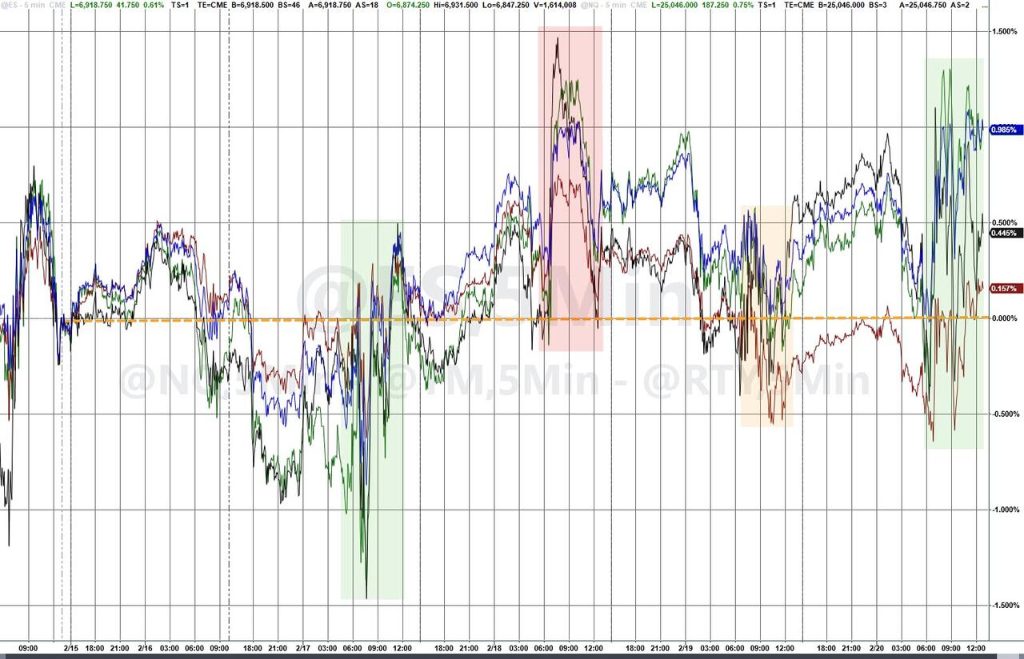
Core Viewpoint - The U.S. Supreme Court's ruling against Trump's tariff authority has led to a temporary rise in U.S. stocks, but it has also heightened concerns about the government's fiscal situation and potential economic uncertainty ahead [1][3]. Market Reactions - Following the Supreme Court's decision, U.S. stocks experienced a brief rally, with the S&P 500 index rising by 0.7%, marking its best weekly performance since January 9, with a total weekly gain of 1.07% [1]. - The ruling has intensified worries among bond investors regarding the rising U.S. debt, as the yield on the benchmark 10-year Treasury note surpassed 4.10% [3]. Impact on Tariffs and Trade - In response to the ruling, Trump indicated plans to impose a 10% global tariff, suggesting that future tariffs could be significantly higher [6]. - The uncertainty surrounding tariff policies and potential tax refund issues is expected to create multiple market reactions, affecting debt pressure, policy uncertainty, and asset price volatility in the coming months [6]. Short-term Fiscal Stimulus - The potential $175 billion in tax refunds is viewed as a short-term fiscal stimulus for U.S. stocks, particularly benefiting retail and consumer companies with high import reliance [7]. - Analysts from Jefferies highlighted that companies like Abercrombie & Fitch, Victoria's Secret, Gap, and Birkenstock Holding are likely to benefit in the short term due to their import dependence [7]. Long-term Retail Sales Impact - Emarketer's chief analyst anticipates that the Supreme Court's decision will provide a moderate boost to retail sales starting this year, although the benefits are expected to diminish by 2028 [8]. Debt Market Concerns - The Supreme Court's ruling could add over $2 trillion to the existing $38.7 trillion national debt if the anticipated tariff revenues do not materialize [10]. - Analysts warn that if Trump cannot secure sufficient revenue through alternative tariffs or if new tariffs lead to greater economic turmoil, the U.S. debt market may face increased selling pressure [11]. Political and Economic Uncertainty - The ruling has sparked a renewed demand for safe-haven assets like gold, as ongoing trade conflicts and political resistance to tariff policies create a fertile ground for such investments [13][14]. - Analysts suggest that the potential for prolonged legal battles over tariffs will maintain a low-interest-rate environment, which is generally favorable for gold [14]. Global Uncertainty and Gold Demand - Recent U.S. actions regarding Iran are contributing to global uncertainty, further enhancing the appeal of gold and other safe-haven assets [15].

1750亿美元“关税退款”!对美股是“财政刺激”,对美债是“增加债务”,对金银是“不确定性重来”
Hua Er Jie Jian Wen· 2026-02-21 03:31
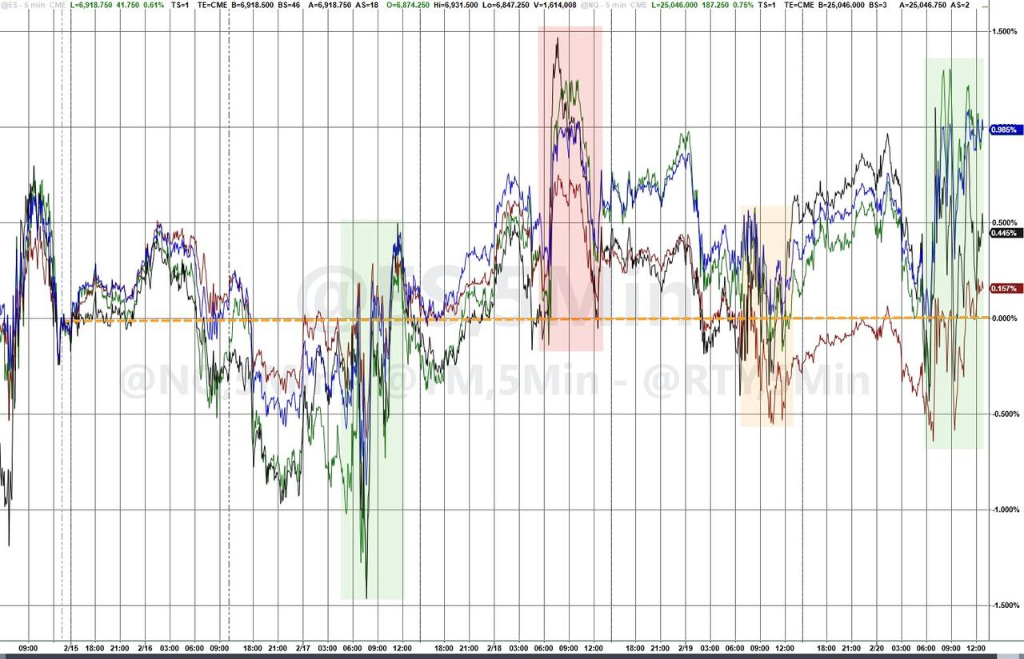
Core Viewpoint - The U.S. Supreme Court's ruling against Trump's tariff authority has led to a temporary rise in U.S. stocks, but it has also heightened concerns about the government's fiscal situation and potential economic uncertainty ahead [1][2]. Market Reactions - Following the Supreme Court's decision, U.S. stocks experienced a brief rally, with the S&P 500 index rising by 0.7% and achieving its best weekly performance since January 9, with a total weekly gain of 1.07% [1]. - The ruling has intensified worries among bond investors regarding the rising U.S. debt, as the yield on the benchmark 10-year Treasury note surpassed 4.10% [2]. Tariff Policy Implications - In response to the ruling, Trump indicated plans to impose a 10% global tariff, suggesting that future tariffs could be significantly higher, which may lead to market volatility and increased compliance costs for importers [3][4]. - Analysts predict that the chaotic tariff policies and subsequent tax refund issues will continue to impact market reactions, debt pressures, and asset price fluctuations in the coming months [4]. Short-term Fiscal Stimulus - The potential $175 billion in tax refunds is viewed as a short-term fiscal stimulus that could directly benefit corporate profits, particularly for retail and consumer companies with high import reliance [5]. - Companies such as Abercrombie & Fitch, Victoria's Secret, Gap, and Birkenstock Holding are expected to benefit in the short term due to their high dependency on imports [5]. Long-term Retail Sales Impact - Emarketer's chief analyst forecasts that the Supreme Court's decision will provide a moderate boost to retail sales starting this year, but the benefits are expected to diminish by 2028 [6]. - Over 1,500 companies, including Costco, have filed lawsuits for tariff refunds, indicating ongoing trade policy uncertainties that retailers and brands will face [6]. U.S. Debt Market Concerns - The Supreme Court's ruling could add over $2 trillion to the existing $38.7 trillion national debt if tariff revenues cannot be replaced, raising concerns about potential selling pressure in the U.S. debt market [7]. - The Trump administration is expected to invoke alternative legal powers to maintain tariff revenues, with estimates suggesting that these measures could keep tariff income relatively stable through 2026 [7]. Safe-Haven Assets - The Supreme Court's ruling may reignite demand for safe-haven assets like gold, as ongoing trade conflicts are anticipated [8]. - Analysts note that the political and economic uncertainties surrounding tariff policies create a favorable environment for gold and other safe-haven assets [8][9]. - The potential for continued low interest rates due to fiscal measures is also seen as beneficial for gold, as it typically performs well in such environments [9]. Geopolitical Factors - Recent U.S. actions regarding Iran are contributing to global uncertainty, further enhancing the appeal of gold and other safe-haven assets [10]. - Central banks remain keen on increasing gold holdings as a hedge against geopolitical and financial risks, which continues to drive gold price increases [10].
美联储博斯蒂克:如果通胀走势“走错方向”并开始上升,美联储将不得不把加息选项摆到台面上
Sou Hu Cai Jing· 2026-02-21 01:45
Group 1 - The core viewpoint is that the Federal Reserve's neutral interest rate may be 0.25 to 0.5 percentage points lower than the current policy rate, indicating potential for future interest rate hikes if inflation trends upward [1] - The projected GDP growth for the United States is 2.4% in 2026, 2.1% in 2027, and a return to trend levels in 2028, suggesting a gradual economic recovery [1] - Significant fiscal stimulus is expected to have an expansionary effect on the economy, but it may also exert upward pressure on inflation [1]
博斯蒂克:中性利率或较目前政策利率低0.25到0.5个百分点
Xin Lang Cai Jing· 2026-02-20 16:32
Group 1 - The core viewpoint is that the neutral interest rate may be 0.25 to 0.5 percentage points lower than the current policy rate [1] - The Federal Reserve's Bostic forecasts U.S. GDP growth of 2.4% in 2026 and 2.1% in 2027, with a return to trend levels in 2028 [1] - Significant fiscal stimulus is expected to arrive, which will have an expansionary effect on the economy but may also exert pressure on inflation [1]
美联储博斯蒂克:如果通胀走势“走错方向”并开始上升 美联储将不得不把加息选项摆到台面上
Sou Hu Cai Jing· 2026-02-20 15:53
Core Viewpoint - The Federal Reserve's Bostic indicated that the neutral interest rate may be 0.25 to 0.5 percentage points lower than the current policy rate, suggesting that if inflation trends "go awry" and begins to rise, the Fed will have to consider raising interest rates [1] Economic Growth Projections - The projected GDP growth for the United States is 2.4% in 2026, 2.1% in 2027, and a return to trend levels in 2028 [1] Fiscal Stimulus Impact - A significant amount of fiscal stimulus is expected to arrive, which will have an expansionary effect on the economy but may also exert pressure on inflation [1]
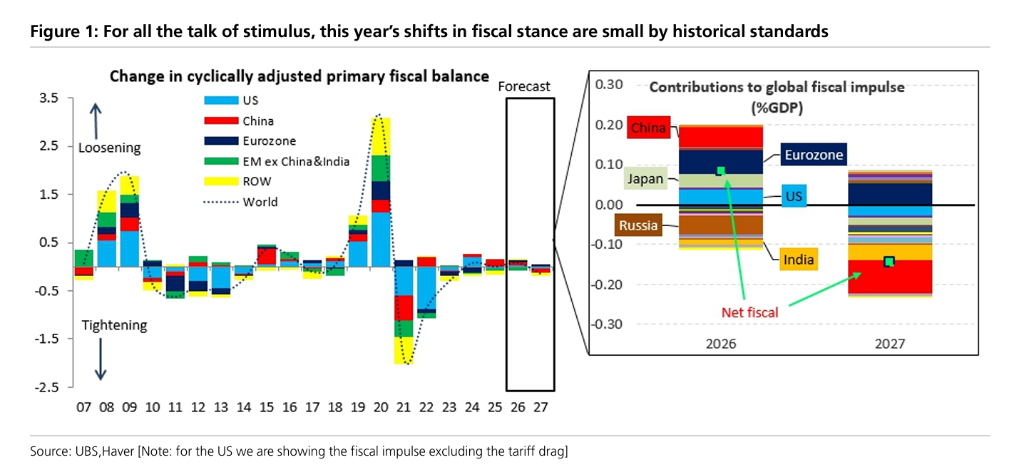
全球财政刺激“雷声大雨点小”?瑞银预计仅为2026年GDP增长贡献8个基点
Hua Er Jie Jian Wen· 2026-02-19 09:12
Core Insights - Despite fiscal stimulus measures from major economies like the US, Japan, and Germany, the global impact is expected to be much lower than market expectations, with UBS projecting a contribution of only 8 basis points to global GDP growth in 2026 and a potential drag of 14 basis points in 2027 [1][5][8] Group 1: Global Fiscal Position - UBS's analysis indicates that the global fiscal stance is only slightly better than neutral, with the predicted fiscal shock for 2026 and 2027 being close to zero [5][6] - Historical data shows that the fiscal stance has fluctuated significantly over the past 20 years, but the predicted values for 2026 and 2027 are relatively mild compared to past years [5][6] Group 2: US Fiscal Stimulus - The US "Big Beautiful" plan is estimated to contribute approximately 45 basis points to economic growth, but after accounting for tariff impacts and state and local government drag, the net fiscal shock is around 30 basis points [6][7] - Historical context reveals that in the past 20 years, there have been nine years of fiscal stimulus in the US, all exceeding the predicted level for 2026, indicating that the current stimulus is not particularly remarkable [6][7] Group 3: Japan and Europe - Japan's fiscal stance has only loosened by 0.9 percentage points of GDP so far, which is insufficient to significantly boost global economic growth [7][8] - Germany's fiscal stimulus is now expected to be about 1 percentage point of GDP, which constitutes roughly two-thirds of the total stimulus in the Eurozone, but this is still below market expectations [7][8]

高市早苗胜选打消“财政赤字”恐慌,日元有望创2024年来最佳单周表现
Hua Er Jie Jian Wen· 2026-02-13 02:51
Core Viewpoint - The market anticipates that Prime Minister Fumio Kishida's victory will enable him to expand fiscal stimulus while maintaining confidence in financial markets, leading to a potential significant weekly appreciation of the yen since November 2024 [1]. Group 1: Yen Appreciation - The yen rose over 0.3% on Thursday, marking its fourth consecutive day of gains, with a cumulative appreciation of approximately 2.8% for the week [1]. - The demand for safe-haven assets, amid ongoing sell-offs in risk assets, has also supported the yen [1]. Group 2: Political Stability and Fiscal Policy - Analysts interpret Kishida's victory as a reduction in political uncertainty and a decrease in the worst-case fiscal scenario risks, contributing to the yen's strength and a decline in Japanese government bond yields from recent highs [3]. - Kishida acknowledged market concerns regarding a two-year food consumption tax cut plan and reiterated that this measure would not be financed through bond issuance, alleviating fears of fiscal deterioration [4]. - Following the overwhelming victory of the Liberal Democratic Party, the easing of fiscal concerns and expectations of a Bank of Japan interest rate hike have driven the yen's strengthening trend, with a 78% probability of a rate hike in April indicated by overnight index swaps [4]. Group 3: Market Speculation on Government Intervention - The heightened vigilance of Japan's top currency official regarding foreign exchange trends has sustained market speculation about potential government intervention, which in turn limits the yen's downside [5]. - On January 23, the yen experienced a maximum intraday increase of approximately 1.75%, the largest since August of the previous year, prompting widespread speculation about possible government intervention in the currency market [5]. Group 4: International Relations and Currency Policy - U.S. Treasury Secretary Janet Yellen stated that the U.S. maintains a strong dollar policy and will "absolutely not" intervene in the currency market to support the yen, while Japan's Finance Minister Katsunobu Kato emphasized close communication with Yellen regarding their shared responsibility to maintain stability in the USD/JPY exchange rate [7]. - Morgan Stanley's forex strategist noted that Yellen's comments do not rule out additional verbal or actual intervention, but emphasized the importance of establishing the correct fundamentals for the foreign exchange market in the long term [7]. Group 5: Upcoming Economic Indicators - Investors are expected to focus on the remarks of Bank of Japan's hawkish board member Naoki Tamura and U.S. CPI data to assess the outlook for the interest rate differential between the U.S. and Japan, as well as the direction of the yen [8].