
德国经济增长

Search documents
结束连续两年萎缩 德国经济2025年略有增长
Jing Ji Guan Cha Wang· 2026-01-15 09:45
经济观察网 据央视新闻客户端消息,当地时间1月15日,德国联邦统计局公布的初步统计数据显示, 2025年德国国内生产总值(GDP)比上年增长了0.2%。在经历了连续两年的萎缩后,德国经济于2025 年首次恢复增长。 ...
【环球财经】德国工商大会预计明年德国经济仅增长0.7%
Xin Hua Cai Jing· 2025-11-06 13:39
Core Insights - The German economy is projected to grow by only 0.7% in 2024, significantly lower than previous government and economic institution forecasts [1] - Market sentiment has worsened since summer, with only 15% of businesses expecting economic improvement in the next 12 months, while a quarter anticipate deterioration [1] - The German economy is expected to stagnate this year, with a slight growth of 0.7% anticipated in 2026, indicating a lack of sustained growth momentum [1] Economic Outlook - The German Chamber of Commerce's report indicates that the economy has not improved since summer, and the confidence index remains in a pessimistic range [1] - The German government has identified issues affecting the economy but lacks effective measures for improvement, leading to a continued low sentiment among businesses [1] Previous Predictions - In October, the German Ministry of Economic Affairs and Energy noted signs of slight recovery in the economy by autumn 2025, with a projected growth of 1.3% in 2026 [1] - The German Banking Association also forecasts a better economic outlook for 2026, predicting a growth of 1.4% [1]
【环球财经】德国权威机构预测2025年德经济小幅增长0.2%
Xin Hua She· 2025-09-25 13:57
Core Insights - The joint economic forecast report from five major German economic research institutions predicts that Germany's economy will only grow by 0.2% in 2025 due to ongoing impacts from U.S. tariff policies and other factors [1] - The report indicates that while the German economy is gradually emerging from a downturn, the recovery in the manufacturing sector remains weak, with strong growth observed in the service sector [1] - Structural weaknesses, including high energy and labor costs, a shortage of skilled workers, and declining competitiveness, are constraining growth prospects [1] Economic Growth Projections - The report forecasts that Germany's economic growth will primarily rely on domestic expansionary fiscal policies over the next two years [1] - Expected growth rates for Germany's economy are projected at 1.3% in 2026 and 1.4% in 2027 [1] Risks and Challenges - The German economy is described as being in an "unstable" state, with significant downward risks primarily stemming from trade disputes between the U.S. and the EU [1] - An escalation in trade disputes could impose heavy burdens on both economies, further complicating Germany's recovery [1] Report Significance - The joint economic forecast report is published biannually and serves as an important reference for the German federal government in formulating economic policies [1]
德权威机构预测2025年德国经济将微增0.2%
Zhong Guo Xin Wen Wang· 2025-09-25 12:15
Core Insights - The German economy is projected to grow by only 0.2% in 2025, with subsequent growth rates of 1.3% in 2026 and 1.4% in 2027, following two consecutive years of recession in 2023 and 2024 [1][2] - The report emphasizes the need for comprehensive structural reforms by the federal government to enhance economic competitiveness, as underlying structural weaknesses persist despite anticipated recovery [1] - Key factors affecting long-term economic growth include high energy and labor costs, a shortage of skilled labor, and the impact of high U.S. tariffs on German exports [1] Economic Sector Analysis - The service sector is expected to experience robust growth in the coming two years, particularly in the public sector, while the recovery in manufacturing (including mining and construction) is anticipated to be more moderate [1]
德国权威机构预测2025年德经济小幅增长0.2%
Xin Hua Wang· 2025-09-25 12:07
Core Viewpoint - The joint economic forecast report from five major German economic research institutions predicts that Germany's economy will only grow by 0.2% in 2025, primarily due to the ongoing impact of U.S. tariff policies and other factors [1]. Economic Growth Outlook - The report indicates that while Germany's economy is gradually emerging from a downturn, the service sector is experiencing strong growth, whereas the manufacturing sector is struggling to recover [1]. - The growth outlook is constrained by high energy and labor costs, a shortage of skilled workers, and declining competitiveness due to a lack of structural reforms [1]. Export and Domestic Policy - The report highlights that U.S. tariffs have severely impacted the global economy, leading to weakened overseas demand for German goods, which hampers the potential for exports to drive economic recovery [1]. - In the next two years, Germany's economic growth is expected to rely mainly on domestic expansionary fiscal policies [1]. Future Projections - Economic growth in Germany is projected to be 1.3% in 2026 and 1.4% in 2027, indicating a gradual recovery despite existing structural weaknesses [1]. Risks and Trade Disputes - The report warns of significant downside risks to the German economy, primarily stemming from trade disputes between the U.S. and the EU, which could impose heavy burdens on both economies if tensions escalate [1]. Importance of the Report - The joint economic forecast report is published biannually and serves as an important reference for the German federal government in formulating economic policies [1].
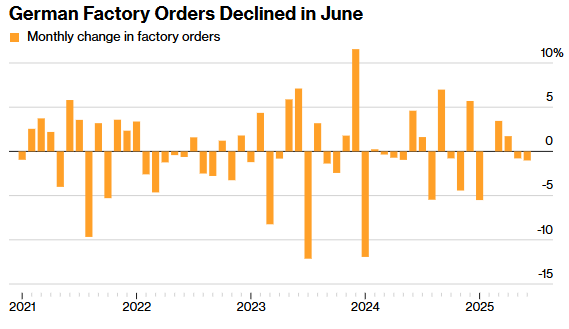
美欧贸易协议不确定性拖累 德国6月工业订单意外环比下滑
智通财经网· 2025-08-06 08:24
Group 1 - Germany's industrial orders declined for the second consecutive month in June, with a month-on-month decrease of 1%, falling short of the market expectation of a 1.1% increase [1][3] - The decline in orders is attributed to ongoing uncertainties surrounding US-EU trade agreements, with a significant increase in tariffs on US imports from the EU announced by President Trump [3] - Despite the decline, domestic demand in Germany remained stable, and orders from the Eurozone increased, particularly in the machinery manufacturing sector, indicating a shift in focus away from the US market [3] Group 2 - The German government has made fiscal commitments, and major companies are planning to invest at least €100 billion, which brings hope for economic growth acceleration [3] - Economists predict that Germany's GDP growth will remain stable in the third quarter due to increased infrastructure and defense spending, with an expected growth rate of 0.3% for the year and 1.0% by 2026 [3] - The German central bank anticipates a recovery in growth momentum, projecting a growth rate of 0.7% for 2026 and an acceleration to 1.2% in 2027 [3]

德国智库IFO:预计德国经济预计将在2026年增长1.5%,高于之前预估的0.8%。
news flash· 2025-06-12 08:33
Core Insights - The IFO Institute forecasts that the German economy will grow by 1.5% in 2026, an increase from the previous estimate of 0.8% [1] Economic Outlook - The revised growth forecast indicates a more optimistic view of the German economy's recovery trajectory [1]
德国智库IFO:预计德国经济今年预计将增长0.3%,高于之前预估的0.2%。
news flash· 2025-06-12 08:33
Group 1 - The core viewpoint of the article is that the German economic growth forecast for this year has been revised to 0.3%, an increase from the previous estimate of 0.2% [1] Group 2 - The IFO Institute, a German think tank, is responsible for the updated economic forecast [1] - The revision indicates a slight improvement in the economic outlook for Germany amidst ongoing economic challenges [1] - This growth forecast reflects a cautious optimism regarding the recovery of the German economy [1]
欧洲央行管委内格尔:德国第一季度的经济增长可能会出现超预期的上行惊喜,但第二季度情况将会恶化,预计到2026年,德国经济有望实现超过1%的增长。
news flash· 2025-05-21 21:33
Core Insights - The European Central Bank's Governing Council member, Nagel, suggests that Germany's economic growth in the first quarter may exceed expectations, but the situation is expected to worsen in the second quarter [1] - It is projected that Germany's economy could achieve growth of over 1% by 2026 [1] Economic Outlook - First quarter growth in Germany may present an upside surprise [1] - The second quarter is anticipated to show a decline in economic performance [1] - Long-term projections indicate a positive growth trajectory for Germany's economy, with expectations of over 1% growth by 2026 [1]
德国财政部长:通过我们的改革,德国的经济增长将会增加,这对欧洲来说是好消息。
news flash· 2025-05-12 12:40
Core Viewpoint - The German Finance Minister stated that the reforms implemented will lead to increased economic growth in Germany, which is positive news for Europe [1] Group 1 - The reforms are expected to enhance Germany's economic performance [1] - The positive impact on Germany's economy is anticipated to benefit the broader European economy [1]