美国关税政策

Search documents
美国关税政策变化及影响
Minmetals Securities· 2026-03-05 06:27
Policy Changes - The U.S. tariff policy has shifted from "emergency state tariffs" to "temporary additional tariffs" with a maximum rate of 15% and a duration of 150 days, requiring Congressional approval for extension[7][10]. - The Supreme Court's ruling has limited the President's ability to impose broad tariffs under the IEEPA, prompting a reliance on Section 122 of the Trade Act of 1974 as a transitional tool[1][9]. Future Tariff Structure - The U.S. tariff system is expected to evolve into a "three-layer parallel" structure: Section 122 as a short-term tool, Section 232 (national security) and Section 301 (unfair trade) as mid-term channels, and Congressional legislation for tariffs and subsidies as a supportive framework[2][3]. - Section 301 investigations against China are still active, indicating ongoing targeted tariff measures despite the general tariff increase[2][14]. Impact on China - The immediate impact on China includes fluctuations in external demand, profit compression in industries, and disruptions in order allocation, rather than a complete loss of competitiveness[3][18]. - China's comparative advantages may be highlighted in sectors where supply chain integrity and cost efficiency remain strong, potentially benefiting domestic manufacturing[3][19]. Long-term Considerations - The temporary nature of Section 122 suggests it is not a long-term solution, and future tariffs may increasingly rely on targeted measures under Sections 301 and 232, which focus on specific industries and national security concerns[13][24]. - The potential for a dual approach combining tariffs and non-tariff measures (e.g., stricter customs enforcement, investment reviews) indicates a shift towards more complex trade friction rather than simple tariff increases[15][24].
大宗商品综述:原油震荡走低 伦铜微跌 金价小幅走高
Xin Lang Cai Jing· 2026-02-26 21:33
Oil Market - Oil prices experienced a slight decline, with WTI down 0.3% closing above $65 per barrel and Brent below $71 per barrel [3][20] - The third round of nuclear talks between the US and Iran concluded in Geneva, with reports of "positive" progress from US officials and Iranian Foreign Minister Zarif [4][18] - A key indicator showed Brent crude oil signaling oversupply for the first time since 2024, with the price spread between Brent and WTI widening to $5.89 per barrel [5][19] Copper Market - Copper prices saw a minor decrease, with futures down 0.1%, ending a two-day upward trend [10][22] - LME copper closed at $13,304.5 per ton, reflecting a lack of bullish drivers in the industrial metals market [10][22] Precious Metals - Gold prices rose slightly, influenced by geopolitical tensions in the Middle East and US tariff policies, with a cumulative increase of nearly 6% over the past six trading days [14][27] - The new 10% global tariffs imposed by the Trump administration have heightened trade tensions, impacting market sentiment [27] - As of 4:09 PM New York time, spot silver fell 0.33% to $88.9338 per ounce, while spot gold increased by 0.67% to $5,199.33 per ounce [15][27]
狠话 威胁伊朗 谎言 粉饰经济
Xin Lang Cai Jing· 2026-02-25 18:57
Core Points - Trump's State of the Union address lasted over 1 hour and 40 minutes, setting a record for the longest such speech [3] - He threatened Iran, stating that the U.S. would never allow Iran to possess nuclear weapons and claimed Iran was developing missiles capable of reaching the U.S. [3][5] - Trump criticized the Biden administration, claiming he inherited a country in crisis but has achieved unprecedented changes [3] - His approval ratings have dropped, prompting him to portray a narrative of a "historic turnaround" in the address [3] Economic Claims - Trump claimed to have secured over $18 trillion in investment commitments globally within 12 months, but this figure is disputed as the actual reported investment is $9.7 trillion [5][6] - He stated that gasoline prices in most states were below $2.30 per gallon, which contradicts data showing no state had an average price below $2.37 [6] - The economic burden of tariffs imposed during his term primarily fell on U.S. businesses and consumers, contrary to his claims that other countries were paying these tariffs [6]

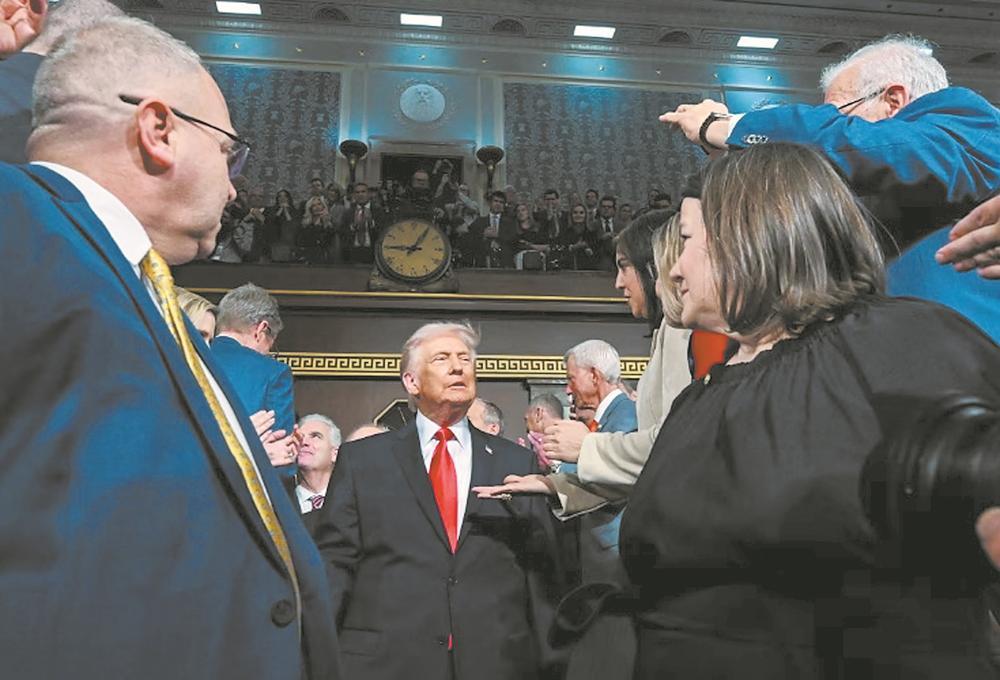
记者手记|执政“年度总结”与关税终裁尴尬
Xin Hua She· 2026-02-25 15:13
Group 1 - The U.S. Supreme Court ruled that the International Emergency Economic Powers Act does not authorize the president to impose large-scale tariffs, marking a significant setback for the Trump administration's tariff policy [1][2] - Trump's claims that tariffs would reduce income tax burdens on Americans are contradicted by studies showing that U.S. businesses and consumers bear most of the additional tariff costs, disproportionately affecting low- and middle-income households [2] - Public opinion reflects dissatisfaction with the government's handling of the economy and tariffs, with only 39% of U.S. adults approving of Trump's economic management and 64% disapproving of the tariff policy [2] Group 2 - The annual summary from The Wall Street Journal highlighted troubling data, including that only 181,000 jobs were added by U.S. employers in 2025, a significant drop compared to 2024, marking the lowest level in over 20 years outside of economic recessions [3] - The trade deficit continued to expand, reaching a record $1.24 trillion in 2025, indicating that tariffs did not significantly reduce the trade imbalance [3] - Manufacturing employment declined for eight consecutive months in 2025, with tariffs contributing to uncertainty and increased production costs [3]
2月25日上期所沪金期货仓单较上一日持平
Jin Tou Wang· 2026-02-25 08:04
Group 1 - The total amount of gold futures at the Shanghai Futures Exchange is 105,072 kilograms, with no change from the previous day [1][2] - The main gold futures contract opened at 1,144.80 yuan per gram, reaching a high of 1,154.98 yuan and a low of 1,134.00 yuan, currently trading at 1,151.06 yuan, down 0.04% [1] - Trading volume for the day is 198,537 contracts, with open interest at 155,075 contracts, showing a decrease of 2,336 contracts in daily open interest [1] Group 2 - COMEX gold prices experienced a slight decline after reaching a high of 5,280 USD per ounce, currently fluctuating around 5,180 USD per ounce [2] - Key short-term support for gold prices is influenced by rising uncertainty regarding U.S. tariff policies, ongoing U.S.-Iran negotiations, and heightened tensions in the Middle East [2] - Following a Supreme Court ruling on February 20 regarding tariffs, President Trump announced a temporary 10% tariff increase on a global scale, with plans to raise tariffs on multiple countries to 15% effective February 24 [2] - Gold prices are also facing pressure from mixed U.S. economic data and delayed expectations for the Federal Reserve's first interest rate cut of the year [2] - Upcoming events to monitor include the U.S.-Iran negotiations on February 26, the release of January PPI data on February 27, and the non-farm payroll report next week, along with developments in U.S.-China relations [2]
美指震荡上行逼近四周高位
Jin Tou Wang· 2026-02-25 02:30
Group 1 - The core viewpoint of the articles indicates that the US dollar index is experiencing a short-term upward trend, influenced by the Federal Reserve's cautious stance on interest rate cuts, changes in US tariff policies, and global risk aversion sentiment [1][2] - The Federal Reserve's interest rate cut expectations have cooled, with the January meeting minutes reinforcing a "wait and see" signal, and the inflation target of 2% being a key factor for any potential rate cuts [1] - The recent Supreme Court ruling regarding tariffs may lead to a reduction in tariffs by 5 percentage points and a potential tax refund of $175 billion, although former President Trump has indicated plans to maintain existing tariffs, which creates policy uncertainty and boosts demand for the dollar as a safe-haven asset [1] Group 2 - Technically, the dollar index has shown a rebound from 95.56 to 97.95 since mid-February, with short-term support at 97.80 and resistance around 98.00-98.05, although it remains in a long-term downtrend with targets around 80-85 [2] - The outlook for the dollar remains strong in the short term, influenced by Federal Reserve policies, tariff implementations, and inflation data, but long-term pressures from fiscal deficits, interest rate cut cycles, trade deficits, and de-dollarization persist [2] - Investors are advised to monitor inflation, official statements, and tariff developments closely, as these factors could lead to potential pullback risks [2]
期市节后首日金属板块普涨 白银期货涨超10%
Xin Lang Cai Jing· 2026-02-24 22:51
Core Viewpoint - The domestic futures market showed a trend of more gains than losses on the first trading day after the Spring Festival, with significant performance in the metal sector, particularly in precious metals like silver, which saw a daily increase of over 10% [1][4]. Group 1: Market Performance - The agricultural sector performed relatively weakly, while the energy and chemical sectors saw slight gains, and the metal sector experienced a broad increase [1][4]. - Precious metals, especially silver, showed the strongest performance, with the main contract opening significantly higher and maintaining a daily increase of over 10% [1][4]. Group 2: Influencing Factors - Market analyst Wang Wei indicated that changes in U.S. tariff policies during the Spring Festival heightened market risk aversion, coupled with a current inventory replenishment phase for non-ferrous metals, providing clear price support [1][4]. - Three main factors are expected to sustain copper prices as the leader in the non-ferrous metal sector: ongoing supply tightness, increased geopolitical risks leading to higher strategic resource reserve demands, and a decline in U.S. dollar credibility enhancing the financial attributes of non-ferrous metals [1][4]. Group 3: Precious Metals Insights - Researcher from Huishang Futures noted that international gold and silver prices initially weakened but later strengthened due to rising market risk aversion, geopolitical risks, and expectations of U.S. Federal Reserve rate cuts [2][5]. - The silver price is expected to have greater elasticity than gold due to its wide industrial applications [2][5]. - On the first trading day after the Spring Festival, precious metals performed well, driven by international silver prices and tight domestic supply, indicating a strong basis for silver price increases [2][5]. Group 4: Capital Flow - On February 24, the commodity futures market saw a net inflow of nearly 45 billion yuan, with significant capital inflows into varieties such as Shanghai gold, silver, copper, and lithium carbonate [2][5]. - Specifically, nearly 10 billion yuan flowed into Shanghai silver and around 8 billion yuan into Shanghai gold, with total funds in Shanghai gold reaching 154.87 billion yuan and in Shanghai silver exceeding 90 billion yuan, ranking them among the top in commodity futures [2][5].
全球媒体聚焦 | 美媒:政策混乱叠加退款无期 美国关税乱局难平
Yang Shi Xin Wen· 2026-02-24 12:59
Core Viewpoint - The U.S. Supreme Court ruled that the President does not have the authority to impose tariffs under the International Emergency Economic Powers Act (IEEPA), leading to significant discussions regarding the fate of billions in tariffs already collected and how to compensate affected businesses and consumers [1]. Group 1 - The IEEPA does not mention the term "tariff," indicating that imposing tariffs under this law lacks legal grounding [1]. - The technical process of refunding illegally collected tariffs is straightforward, but the likelihood of the government proactively issuing refunds is low, as indicated by recent statements from the White House and the Treasury [1][2]. - Approximately $175 billion in tariffs and interest could potentially be refunded to businesses if the government acknowledges its defeat in court [1]. Group 2 - Thousands of companies have already filed lawsuits with the U.S. International Trade Court, and more are expected to join, highlighting the ongoing legal disputes over tariff refunds [2]. - Many small and medium-sized enterprises among the 600,000 importers in the U.S. lack the legal resources to pursue their claims effectively [2]. - The costs of tariffs have already been passed down through the supply chain to consumers, making it nearly impossible for them to recover the costs incurred from "illegal tariffs" [2].
未知机构:华创家电周观点20260223板块涨跌幅春节前一周上证指数上涨04-20260224
未知机构· 2026-02-24 02:40
Summary of Key Points from the Conference Call Industry Overview - The report focuses on the home appliance sector, particularly the performance of leading companies in the Hong Kong stock market during the Spring Festival period from February 16 to February 23, 2026 [1][2]. Market Performance - The Shanghai Composite Index increased by 0.4% in the week leading up to the Spring Festival, while the home appliance index (Shenwan) rose by 0.2% - The white goods sector experienced a decline of 0.7%, the kitchen appliance sector fell by 2.6%, the black goods sector increased by 3.5%, and the small appliances sector decreased by 1.2% [1]. Stock Performance of Leading Companies - Notable stock performances during the Spring Festival period include: - Midea Group: +3.6% - Haier Smart Home: +2.8% - Hisense Home Appliances: +2.6% - Aux Electric: -11.6% - TCL Electronics: +1.3% - Sanhua Intelligent Control: +6.2% - Yadea Holdings: +4.4% - Techtronic Industries: +4.5% - JS Global Lifestyle: -2.2% - The Hang Seng Index rose by 1.9% and the Hang Seng Composite Index increased by 1.7% during the same period [2]. Valuation Insights - Current price premiums for A-shares compared to H-shares are as follows: - Midea Group: -4.8% - Haier Smart Home: +4.0% - Hisense Home Appliances: +9.7% - Sanhua Intelligent Control: +57.1% - Midea Group is viewed as having stable operations, with high absolute return levels due to dividends and buybacks. The influx of insurance capital and the appreciation of the RMB against the USD, along with easing tariffs, enhance its attractiveness to foreign investors, suggesting potential upward movement in stock price [2].



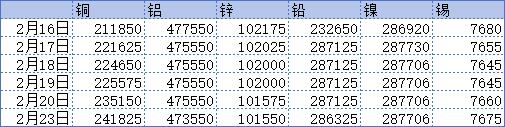
需求担忧笼罩 有色走势谨慎【春节外盘综述】
Wen Hua Cai Jing· 2026-02-24 02:16
Group 1 - The overall performance of the overseas non-ferrous metal sector showed initial decline followed by recovery during the holiday period, with reduced volatility [1] - Concerns over US tariffs have eased, leading to a rebound in non-ferrous metals as the US dollar index retreated from its highs [2] - The US Supreme Court ruled that the Trump administration's large-scale tariff measures lacked clear legal authorization, contributing to a decrease in average tariff rates [2] Group 2 - Domestic demand for copper is weak, leading to a significant accumulation of global copper inventories, with COMEX copper prices experiencing narrowing premiums [3] - The increase in copper inventories is evident, with the Shanghai Futures Exchange copper stock rising over 20,000 tons, reaching a 1.5-year high [3] - The LME copper inventory has also shown a notable increase, rising from around 200,000 tons before the holiday to over 240,000 tons [3] Group 3 - During the holiday, LME copper prices fluctuated due to a strong US dollar and increasing inventories, with trading volumes being low due to the Chinese New Year [5] - The LME copper price saw a brief recovery on February 18, but faced downward pressure again due to rising inventories and reduced demand from China [5] - Following the Supreme Court's ruling on February 20, LME copper and aluminum prices increased, but later retreated as inventory levels continued to rise [6]