心智占领

Search documents
为什么真正的出海,一定要先学会亏损?| 卓立出海谈
吴晓波频道· 2025-12-24 00:31
Core Viewpoint - The article discusses the overseas expansion strategy of the company, focusing on its current losses as a strategic choice to capture market share rather than immediate profitability [2][4][5]. Group 1: Long-term Value through Overseas Expansion - The company aims to replicate its domestic success internationally, with a target of creating a $20 billion overseas business, currently at about $1 billion [4]. - The CEO acknowledges that the overseas business is in a phase of strategic losses, which are seen as necessary for future growth and market dominance [5][8]. - The strategy emphasizes rapid market penetration and establishing a leading position, even at the cost of increased losses [6][10]. Group 2: Strategic Partnerships for Market Entry - The company initially entered the overseas market in 2017, motivated by a successful trial in South Korea, which boosted confidence for further expansion [13][14]. - Collaborations with local strong companies are a key strategy, allowing the company to leverage existing market presence and expertise [15]. - This approach is likened to "borrowing a boat to go to sea," facilitating smoother entry into new markets [15]. Group 3: Challenges of Localization - The company faces significant challenges in localizing its advertising strategies, as understanding local consumer preferences is crucial [16][18]. - The CEO believes that while the company can sell advertising space, it has yet to reach the level of providing comprehensive brand strategy support as it does in China [17][18]. - The use of AI tools is being explored to assist overseas teams in generating localized advertising content, although there are still hurdles to overcome [19][20]. Group 4: Brand and Market Positioning - The article highlights that brand recognition and consumer perception are critical barriers for Chinese brands entering foreign markets [22][23]. - The first brand to establish itself in a new market often gains a significant competitive advantage, making early entry essential [24]. - The CEO emphasizes that deep distribution capabilities and quick responses to local needs will determine success in overseas markets [23][25].



超级符号炼金术:顶级企业家的个人IP打造
Sou Hu Cai Jing· 2025-09-01 07:05
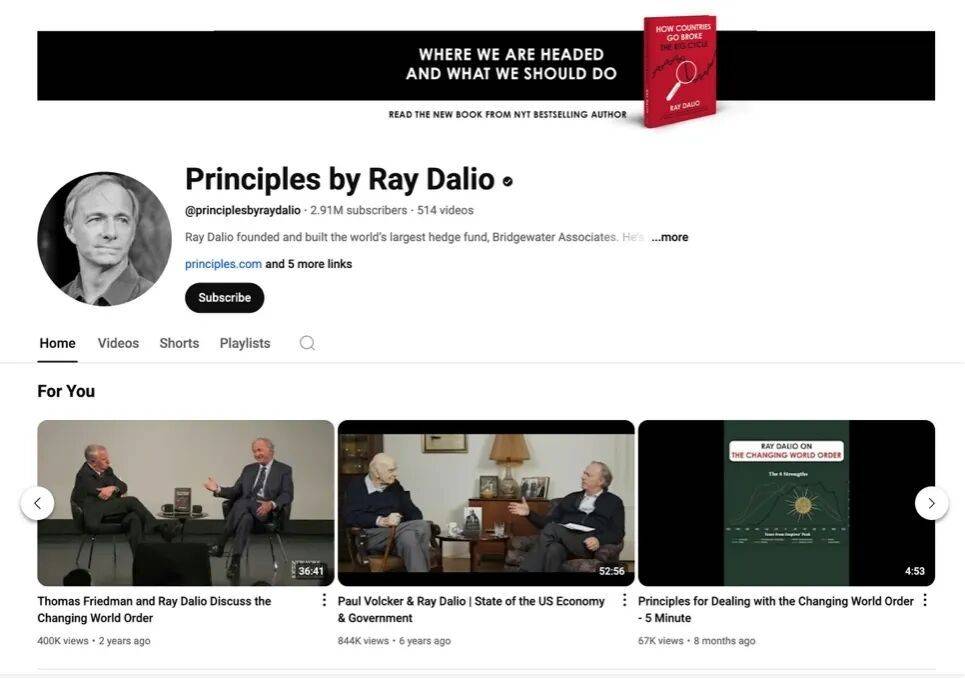
Group 1 - Ray Dalio, founder of Bridgewater Associates, sold his last stake in the company in August 2025 and stepped down from the board, marking his retreat from the public eye while his personal brand continues to benefit the firm [1] - The phenomenon of entrepreneurs building personal brands through diverse media reflects both a pursuit of sharing experiences and a strategic consideration for extending business value [1] - In the traditional media era, entrepreneurs relied on book publishing and television interviews to convey their value, whereas today, they utilize various media forms to enhance personal influence and corporate growth [5] Group 2 - The concept of "cognitive load reduction" is essential for entrepreneurs in the video era, allowing complex information to be simplified and made accessible to a broader audience [7] - Dalio's 2022 YouTube video, "Principles: Navigating a Changing World Order," exemplifies how visual metaphors can make complex economic concepts understandable for those without an economics background [9] - Bill Gates uses visual storytelling in his YouTube content to lower the public's understanding barrier regarding health and education topics, effectively building public support for his foundation's initiatives [9] Group 3 - Emotional resonance is crucial for building and disseminating an entrepreneur's personal brand, with storytelling often surpassing mere content explanation [11] - Dalio shares personal experiences, such as his bankruptcy in 1982, to create empathy and connect with audiences, reinforcing his theories on economic cycles [13] - Gates employs nostalgic storytelling techniques to make his image relatable, enhancing audience engagement and support for his philanthropic efforts [14] Group 4 - Chinese entrepreneurs excel in emotional storytelling, often using short videos and live streams to connect with users on a personal level [16] - Lei Jun, founder of Xiaomi, effectively uses humor and relatability in his online presence to enhance his brand image and connect with consumers [16] - Liu Qiangdong's narrative style, characterized by a "big brother" persona, resonates with audiences through relatable stories of struggle and success [18] Group 5 - The repetition of key symbols and phrases is vital for establishing a strong brand impression in the minds of consumers [21] - Dalio's concepts of "principles" and "cycles" have become central to his brand, allowing for extensive content distribution with minimal marginal costs [22] - The strategy of maximizing content reuse across various formats helps dominate vocabulary definitions and establish industry standards, making it difficult for competitors to challenge [22] Group 6 - The competition among entrepreneurs extends beyond products to every aspect of their public persona, including emotional narratives and branding strategies [26] - Chinese entrepreneurs face the challenge of balancing relatable storytelling with high-level value propositions while managing public sentiment and potential risks [26]