思政教育一体化

Search documents
运河文化成长共同体成立,首批51家单位打造运河思政教育新生态
Xin Jing Bao· 2025-10-27 01:12
Core Points - The establishment of the "Canal Culture Growth Community" aims to integrate resources from families, schools, and society to create a new ecosystem for ideological and political education based on the Grand Canal culture [1][2] - The community consists of 51 units, including universities, primary and secondary schools, and cultural resource institutions, forming a diverse system that promotes educational collaboration along the canal [2] - Four action plans for the 2025-2026 period were announced, focusing on international youth dialogue, teacher training, digital mapping of canal culture, and interactive exhibitions [3][4] Group 1 - The "Canal Culture Growth Community" will serve as a "pool of resources" for sharing educational materials and integrating various cultural resources [2] - The community aims to be a "source of wisdom" by organizing dialogues to address challenges in the integration of ideological education across different educational stages [2] - The "Canal Culture Digital Map" project will create a virtual representation of educational bases along the canal, enhancing learning experiences [3] Group 2 - The "Youth Canal Speech" international plan will involve collaboration with global organizations to promote youth engagement through competitions and dialogues [3] - The "Canal Ideological Seed Teacher" empowerment plan will train teachers to effectively integrate canal culture into their teaching practices [3] - The "Flowing Cultural Context" exhibition will collect stories and create a digital archive to promote cultural exchange and cooperation [4] Group 3 - Experts and educators discussed the integration of artificial intelligence in cultural transmission and the collaboration between families, schools, and society in ideological education [5] - The Beijing School has gained practical experience in promoting canal culture and aims to enhance cooperation among schools along the canal [6] - The Beijing education system has been actively incorporating canal cultural resources into ideological education, fostering a new generation committed to national rejuvenation [6]
潮州市构建“三师三课三段”育人“潮州模式”
Zhong Guo Fa Zhan Wang· 2025-10-20 08:08
Core Viewpoint - Chaozhou City is developing an integrated ideological and political education model that combines local cultural resources with educational practices, aiming to create a replicable and promotable "Chaozhou Plan" for ideological education in basic education across the province and the nation [1][2]. Group 1: Theoretical Framework - The city has established a theoretical framework called "1+3" focusing on "cultural immersion," which includes collaborative governance, curriculum connection, and progressive development [1]. - The framework aims to address challenges such as the lack of external ideological education bases and the underutilization of local red culture and intangible cultural heritage [1]. Group 2: Implementation Strategies - Chaozhou is implementing a "Three Beams and Four Pillars" strategy to activate a new ecosystem for ideological education, emphasizing collaboration among universities, primary and secondary schools, and the community [2]. - The "Three Teachers Collaboration" approach aims to break down barriers between educational institutions and society, enhancing the teaching force through dual hiring and training mechanisms [2]. - The "Three Courses Integration" focuses on transforming local resources into active teaching materials, integrating national, local, and practical courses [2]. - The "Three Stages Connection" promotes a systematic approach to ideological education based on students' cognitive development, with specific goals for each educational stage [2]. Group 3: Achievements - After six years of exploration, Chaozhou has seen significant improvements in students' ideological qualities, with recognition rates of local culture rising from 35% to 82% [3]. - Teachers have enhanced their teaching capabilities, winning multiple provincial and national teaching awards [3]. - Several schools have been recognized for their quality in ideological education, receiving titles such as National Civilized Campus and National Defense Education Characteristic School [3]. - The "Chaozhou Model" has been recognized as an excellent case at the provincial level and has been widely reported in the media as a successful example of integrating local culture with ideological education [3].
杭州有多吸引“青”? 高校新生在钱塘江边上思政课!
Hang Zhou Ri Bao· 2025-09-22 02:11
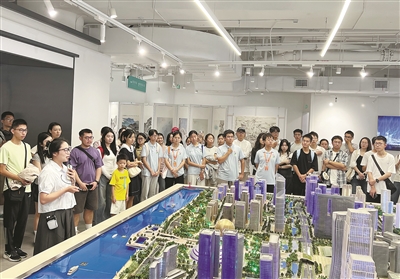
Core Viewpoint - The "Walking Hangzhou" series of ideological and political education activities aims to enhance students' understanding of the city's development and cultural heritage through practical experiences outside the classroom [3][4]. Group 1: Event Overview - Over 100 freshmen from nine municipal universities in Hangzhou participated in the first event of the "Walking Hangzhou" series, which took place along the Qiantang River [3]. - The event included visits to urban balconies, community service centers, and urban planning exhibition halls, providing a hands-on learning experience [3]. Group 2: Student Engagement - Students expressed excitement and surprise at gaining a deep understanding of Hangzhou, with many visiting the city for the first time [3]. - A graduate student in archaeology noted that the experience helped bridge the past and future of Hangzhou, motivating them to contribute to the city's historical narrative [3]. Group 3: Educational Impact - The initiative is part of a broader effort to integrate ideological education across all levels of education in Hangzhou, emphasizing the importance of practical learning [4]. - The program aims to instill a sense of belonging and commitment to the city among young people, encouraging them to stay and contribute to its development [4].

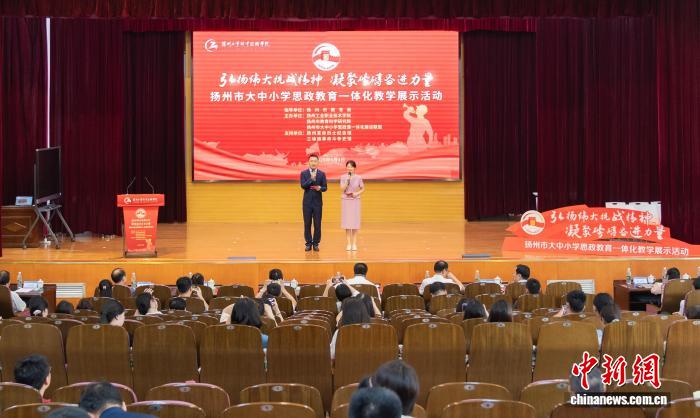
江苏扬州大中小学思政课“开学第一课”:让抗战精神薪火相传
Zhong Guo Xin Wen Wang· 2025-09-04 12:47
Core Viewpoint - The article highlights the integration of patriotic education in Jiangsu Yangzhou's primary, secondary, and higher education through a themed lesson on the "Battle of Sanjiao Kou" to instill national spirit and historical awareness among students [1][3]. Group 1: Event Overview - The integrated teaching demonstration event took place on September 4 at Yangzhou Industrial Vocational and Technical College, showcasing a patriotic education lesson that combines historical exploration, spiritual understanding, and mission inheritance [1][3]. - Five teachers from different educational levels designed their lessons around the same core theme, adapting to the cognitive development of students at various stages [3]. Group 2: Teaching Methodology - The teaching approach was structured in a progressive manner, with elementary classes focusing on "Stories Warm the Heart," middle school classes on "Tracing the Footsteps of War," high school classes on "Bloodlines Forge Monuments," and university classes on "New Journey of the Silk Road" [3]. - This method aims to create a resonance between small classrooms and the larger historical context, enhancing students' understanding of national pride and sacrifice [3]. Group 3: Institutional Role - Yangzhou Industrial Vocational and Technical College, as the leading unit of the integrated ideological and political education alliance, plays a pivotal role in innovating the teaching model, which includes "One Main, Two Wings, Three Transformations, and Four Chains" [3]. - The college promotes various practical teaching activities such as "Red Path Research," "Canal Ideology," and "Political Education in Museums," aiming to blend classroom learning with real-world experiences [3].