情境感知能力

Search documents
Token售卖已无溢价、大模型公司转型“系统商”?记忆张量 CTO 李志宇:智能体能力会拉开差距,长期记忆与状态管理成竞争核心
AI前线· 2026-01-12 11:04
Core Insights - The article discusses the evolution of AI companies and technologies, emphasizing the shift from merely scaling models to developing sustainable systems that incorporate memory and state management capabilities [2][4][17]. Group 1: Industry Trends - In 2025, notable companies like MiniMax and Zhipu have emerged, aiming for IPOs, but face challenges such as severe losses and production ratios [4]. - The pressure on tech companies has intensified, with a focus on system efficiency and sustainable technology accumulation rather than just chasing model parameters [5]. - The competition landscape is shifting from a focus on individual model capabilities to a broader emphasis on system-level capabilities, including memory management and reasoning [17]. Group 2: Technological Developments - The trend of using large-scale synthetic data is growing, but it is not expected to completely replace human-annotated data; high-quality synthetic data must be carefully constructed [9]. - Significant advancements in model capabilities have been observed, particularly in complex instruction understanding and multi-step reasoning stability [10]. - The introduction of Mixture of Experts (MoE) architecture has become mainstream due to its cost-effectiveness, balancing parameter efficiency and inference costs [12]. Group 3: Future Directions - The next major leap in AI models is anticipated to come from advancements in memory management, transitioning from static parameter storage to dynamic memory systems that support long-term tasks [18]. - The competition in AI is expected to focus on the development of intelligent agents, with a need for models to enhance reasoning, state understanding, and collaboration with tools [15]. - Companies are likely to explore value-added services beyond just selling model tokens to maintain profitability amid increasing price competition [16].


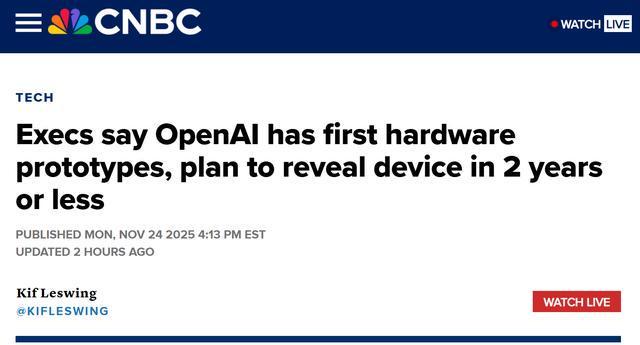
奥特曼:OpenAI首款 AI 硬件原型已落地,两年内将投产
Huan Qiu Wang Zi Xun· 2025-11-25 03:57
Core Insights - The collaboration between former Apple Chief Designer Jony Ive and OpenAI CEO Sam Altman has successfully developed a prototype of a mysterious AI hardware, expected to enter production within two years [1][2] - The project aims to fundamentally change how people use computers, creating a serene user experience akin to "sitting by a lakeside cabin" to help users focus on what truly matters [1] Design Philosophy - The device embodies a philosophy of "naive simplicity," combining a highly intelligent and complex core with an approachable design that invites interaction [2] - Jony Ive emphasized the importance of aesthetic appeal, suggesting that the device may utilize ceramic materials to achieve a premium feel and visual expression [2] Functional Advantages - The AI device is designed to possess strong contextual awareness, acting as a proactive participant in users' lives by understanding their thoughts and activities to provide non-intrusive assistance and information filtering [2] - This capability aims to alleviate information overload, enabling users to manage tasks more efficiently and maintain focus [2] Product Form - While specific details about the product's form factor remain undisclosed, the prototype has reportedly performed impressively [3] - Market speculation suggests it could be a screenless "AI phone," a third core device between a MacBook and an iPhone, or a pocket-sized device that utilizes microphones and cameras for environmental awareness, excluding traditional wearable devices like glasses, watches, or headphones [3]
23岁天才被OpenAI解雇后,又凭AI狂揽15亿美元
3 6 Ke· 2025-09-01 09:09
Core Insights - Leopold Aschenbrenner, a 23-year-old former OpenAI researcher, has founded an AI hedge fund named Situational Awareness, managing over $1.5 billion in assets and achieving a 47% return in the first half of 2025, significantly outperforming Wall Street peers [3][5][8] Group 1: Fund Overview - The Situational Awareness fund focuses on companies benefiting from AI advancements and prominent AI startups, employing a long-short strategy to mitigate risks by going long on AI sectors and shorting traditional industries likely to be disrupted [5][8] - Aschenbrenner's fund is positioned as a leading think tank in the AI field, with a notable investor base including Stripe co-founders and other prominent figures in the tech industry [7][8] Group 2: Investment Strategy and Performance - The fund's performance has been exceptional, with a 47% return after management fees in the first half of 2025, compared to a 6% increase in the S&P 500 and a 7% average return for tech hedge fund indices [5][8] - The fund's concentrated holdings reflect the limited number of publicly traded AI companies, with significant investments in companies like Vistra, which supplies power to AI data centers [9] Group 3: Background and Research - Aschenbrenner gained attention with his 165-page paper titled "Situational Awareness," predicting the arrival of Artificial General Intelligence (AGI) by 2027 and advocating for an "AI Manhattan Project" [3][11] - His research highlights the rapid advancements in AI capabilities, suggesting that by 2027, AI models will be capable of performing tasks traditionally reserved for human researchers and engineers [19][20]