战略防御

Search documents
POS机快刷爆了,200亿、50亿、10亿,黄仁勋用美金“爆买”一切
3 6 Ke· 2025-12-25 08:17
Core Insights - Nvidia is aggressively expanding its influence in the AI sector through strategic acquisitions and investments, including a $20 billion licensing agreement with Groq, which allows Nvidia to integrate Groq's core team and technology while Groq maintains operational independence [1][3][5] - The acquisition of Groq is seen as a strategic defense and capability enhancement, as Groq's LPU architecture poses a significant threat to Nvidia's dominance in AI inference markets [5][6] - Nvidia's investments in companies like Intel and Nokia, along with its commitment to OpenAI, illustrate a comprehensive strategy to control key nodes in the AI computing value chain [10][13][17] Group 1: Strategic Acquisitions - The $20 billion deal with Groq not only secures key technology but also eliminates a major competitor in the AI inference space [3][5] - Nvidia's investment in Synopsys for $2 billion aims to embed its accelerated computing capabilities into future chip design tools, shortening design cycles across various applications [10][12] - The $5 billion investment in Intel is intended to create a strategic alliance, allowing Nvidia to integrate its GPU technology into Intel's next-generation chips [13][15] Group 2: Financial Strength and Investment Strategy - Nvidia's cash reserves have surged to $606 billion, a 4.5-fold increase from early 2023, enabling significant strategic investments [24] - The company is expected to generate $968.5 billion in free cash flow in 2025, with total cash flow over the next three years potentially exceeding $5.76 trillion [24] - Nvidia prioritizes strategic investments over stock buybacks, viewing them as essential for building competitive barriers and securing key partnerships [24] Group 3: Long-term Vision and Ecosystem Development - Nvidia's investment strategy is designed to create a comprehensive network across the AI industry, ensuring that its hardware and software are integral to future AI applications [18][19] - The company is focusing on high-potential areas such as autonomous driving, robotics, and fusion energy, aiming to embed its standards and software ecosystem in these sectors [21][22] - Nvidia's approach reflects a shift from open ecosystems to internal capabilities that can be controlled and accumulated over time [8][18]



巴基斯坦与沙特阿拉伯签军事协议,多国受震动
Huan Qiu Shi Bao· 2025-09-18 22:22
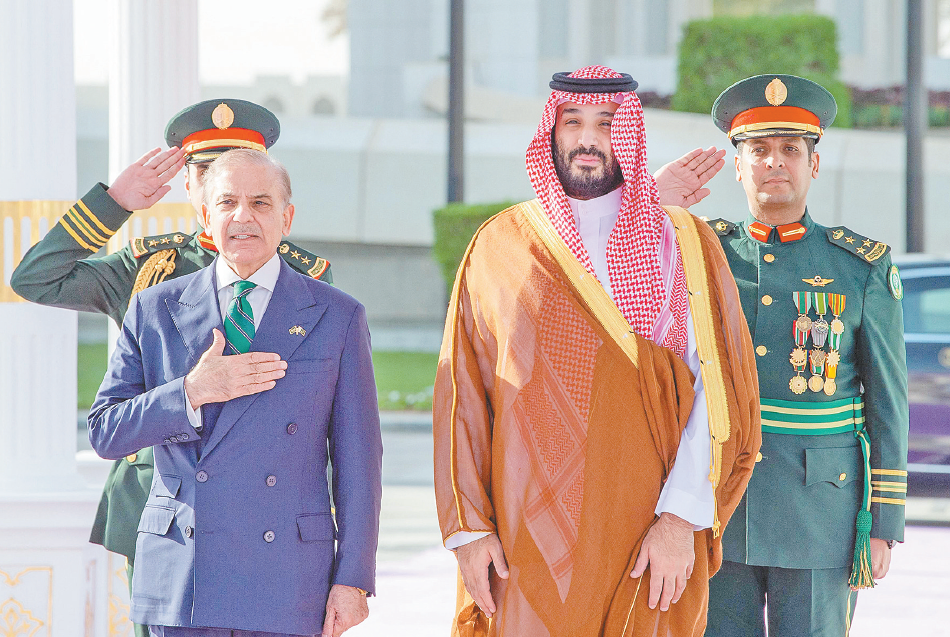
Core Viewpoint - The signing of a strategic defense agreement between Saudi Arabia and Pakistan is seen as a significant development that may impact regional security dynamics beyond the Middle East, particularly in light of recent tensions involving Israel and the Gulf states [1][7]. Group 1: Agreement Details - The strategic defense agreement was signed by Saudi Crown Prince Mohammed bin Salman and Pakistani Prime Minister Shehbaz Sharif, reflecting a commitment to enhance national security and regional peace [2]. - The agreement states that any attack on either country by a third party will be considered an aggression against both, aiming to develop comprehensive defense cooperation [2][4]. - A senior Saudi official indicated that the agreement is a comprehensive defense pact covering all military means, although specifics regarding nuclear protection were not disclosed [4][6]. Group 2: Regional Reactions - India's Ministry of External Affairs expressed concern over the agreement, indicating it will closely monitor its implications for national security and regional stability [5]. - Indian media suggested that the agreement could be perceived by Pakistan as a strategic deterrent against India, raising questions about potential Saudi intervention in future conflicts [5]. Group 3: Broader Implications - The agreement signals Saudi Arabia's growing skepticism about the reliability of U.S. defense commitments in the region, prompting a diversification of security partnerships [7][8]. - Analysts suggest that this development could lead to a domino effect in the region, with other Arab nations potentially seeking similar agreements with Pakistan [7]. - The timing of the agreement reflects the increasingly complex security environment, highlighting Saudi Arabia's desire for greater autonomy in its security policy despite existing U.S. assurances [8].