房企存货管理

Search documents
每周精读 | 2025H1房企偿债能力、盈利能力、存货管理专题;《2025H1阿联酋住宅市场趋势报告》发布(9.22-9.26)
克而瑞地产研究· 2025-09-27 00:39
Core Insights - The article focuses on the real estate industry, highlighting the ongoing challenges and strategies of listed companies in managing inventory and financial performance amid a shrinking scale and risk mitigation [5][6][7]. Group 1: Inventory Management - A study of 50 typical listed real estate companies reveals that impairment provisions are still being made, indicating a continued focus on inventory management as companies navigate through "scale contraction" and "risk mitigation" [5]. - The report indicates that during the first half of 2025, these companies recognized inventory impairment losses amounting to 49.4 billion, contributing to a net profit loss of 90.2 billion [6]. Group 2: Profitability and Debt Management - The gross profit margin for the industry has recovered to 10.87%, yet net profits remain in the red, highlighting ongoing profitability challenges [6]. - The cash-to-short-term debt ratio continues to decline, with the cash holdings of the 50 companies at 1,186.7 billion, a decrease of 9.49% from the beginning of the period, indicating a need for improved debt management [7]. Group 3: Community Operations and Market Trends - Leading real estate companies are increasingly focusing on community operations, with firms like China Resources and Huafa establishing group IPs, reflecting a growing trend in the industry [9]. - The article discusses the demand for construction management in urban renewal, emphasizing the importance of understanding policies and balancing various stakeholder interests for companies looking to enter this market [10]. Group 4: Land Transactions and Policy Developments - In a recent land auction in Xiamen, four residential plots were sold for a total of 8.125 billion, all acquired by local state-owned enterprises, indicating a trend in land acquisition strategies [12]. - The article notes that the land supply has continued to decline, with a significant drop in the monitored land supply area by 25%, while the transaction area surged by 261%, reflecting a complex market dynamic [15]. Group 5: International Market Opportunities - The UAE residential market is experiencing growth driven by policy incentives, economic restructuring, and continuous population influx, presenting differentiated investment opportunities in core and emerging areas [18]. - The "2025 Middle East Real Estate Investment Summit" highlighted the potential for investment in the UAE, with discussions on the importance of regional partnerships and understanding local market dynamics [19][20].


克而瑞地产:房企存货总量连续四年下滑 竣工存货短期收缩
智通财经网· 2025-09-22 09:46
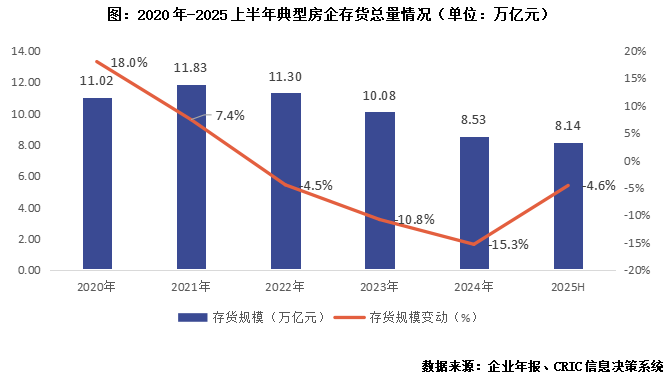
Core Viewpoint - The real estate industry is experiencing a continuous decline in inventory levels, with a total inventory value of 8.14 trillion yuan as of mid-2025, representing a 4.6% decrease from the end of 2024, marking the fourth consecutive year of negative growth in inventory levels [1][25]. Group 1: Inventory Trends - The total inventory value has decreased from 8.53 trillion yuan at the end of 2024 to 8.14 trillion yuan in mid-2025, indicating a slight deceleration in the rate of decline compared to the 5.1% drop observed in the first half of 2024 [1]. - Among different tiers of real estate companies, the largest decline in inventory was seen in the TOP31-50 and TOP51-100 companies, with a drop of over 7%, while the TOP10 companies experienced a smaller decline of 2.3% [3]. - As of mid-2025, the inventory of completed projects reached 1.77 trillion yuan, down 3.4% from the beginning of the year, which is an improvement compared to a 2.6% increase in the same period last year [9]. Group 2: Inventory Structure - The proportion of completed inventory reached a new high of 26.9% in mid-2025, reflecting a 0.5 percentage point increase from the beginning of the year, although the growth rate has slowed compared to previous years [11][13]. - The inventory of ongoing projects totaled 4.61 trillion yuan, down 7.0% from the beginning of the year, maintaining a consistent negative growth trend since 2022 [5]. - The inventory turnover rate for the 50 typical real estate companies was 0.28 times per year, an increase of 0.03 times compared to the previous year, although it remains lower than the annual turnover efficiency of the previous year [25]. Group 3: Impairment and Valuation - The balance of inventory impairment provisions for 19 A-share companies was 159.8 billion yuan at the end of the first half of 2025, a decrease of 0.8% from the beginning of the year, indicating ongoing pressure for inventory impairment despite a slight decline [15]. - The inventory impairment ratio for the sample companies was 4.67% at mid-2025, up 0.25 percentage points from the beginning of the year, reflecting a higher level of impairment pressure compared to the previous year [15][26]. - Private real estate companies have the highest inventory impairment ratio at 13.12%, significantly above the average level of other tiers, indicating a growing trend of impairment among private firms [19][21]. Group 4: Strategic Adjustments - The real estate industry is shifting from a scale-oriented approach to prioritizing liquidity, with companies reducing investments and accelerating inventory turnover to manage liquidity pressures [23]. - Companies are increasingly focusing on core urban areas for land acquisition while managing existing inventory through strategies such as price reductions and impairment provisions to facilitate quicker sales [27]. - The overall strategy involves a concerted effort to optimize inventory structures and reduce excess stock, with a focus on maintaining cash flow and profitability in a challenging market environment [27].
专题 | 2024年房企存货管理专题——典型房企现房库存占比接近3成
克而瑞地产研究· 2025-05-25 01:47
Core Viewpoint - The article analyzes the inventory status and development trends of typical real estate companies in 2024, focusing on inventory scale, structure, and investment intensity, highlighting a significant decline in total inventory and an increase in the proportion of completed housing inventory [1][3]. Group 1: Inventory Trends - Total inventory of typical real estate companies decreased by 15% compared to the beginning of the year, marking a continuous decline for three years [4][5]. - Among 50 typical listed companies, the total inventory value reached 7.98 trillion yuan, down from 9.4 trillion yuan at the end of 2023 [5]. - The decline in inventory is most pronounced among companies ranked 51-100, with a drop of 22.3%, while the top 10 companies experienced a smaller decline of 12.4% [7]. - Completed inventory accounted for 27% of total inventory, reaching a five-year high, with a 5.6 percentage point increase from the beginning of the year [10][12]. Group 2: Current Housing Inventory - The scale of completed housing inventory grew by 7% compared to the beginning of the year, with state-owned enterprises showing the highest increase of 22.7% [14][16]. - Nearly 60% of real estate companies reported an increase in completed inventory, indicating persistent pressure on current housing inventory [21]. - The inventory impairment ratio rose to 4.42%, reflecting ongoing challenges in the market [22][25]. Group 3: Investment and Inventory Management - The proportion of inventory to total assets decreased to 47.5%, with 86% of companies experiencing a decline in this ratio [26][28]. - The weighted average inventory turnover rate for 50 typical companies was 0.35 times per year, slightly down from the beginning of the year [26][28]. - Companies are focusing on high-quality investments and strategies to quickly liquidate completed inventory to alleviate pressure [27][28].