
房地产企业转型

Search documents
可研智库:从“空间建造者”向“城市运营综合服务商” 地产企业转型在即
Zhong Zheng Wang· 2026-01-20 07:40
Group 1 - The core viewpoint is that the transformation from "space builders" to "comprehensive urban operation service providers" is essential for survival in the real estate industry [1] - The key to success lies in the reconstruction of four core capabilities: transitioning from scale to quality, from development to service, from incremental to stock, and from traditional to technology [1] - Companies need to establish refined R&D, digital user management, precise marketing, and robust cash flow management capabilities [1] Group 2 - The first judgment on the future of the real estate industry is that the transformation is irreversible, with single development and sales models expected to exit within 3-5 years [2] - The focus will shift to high-energy cities, where only products and services that match their development capabilities will ensure survival [2] - The integration of urban renewal and operation will create a trillion-level market during the "14th Five-Year Plan" period, providing historic opportunities for companies with integrated capabilities in investment, planning, construction, and operation [2]
中国房企可能如何发展?
Ge Long Hui· 2026-01-09 02:21
Core Viewpoint - The real estate industry is undergoing a transformation towards asset management, driven by financial deepening and the need for high-quality development in housing business and operational real estate [1][2][3] Group 1: Overseas Market Insights - The transition of real estate companies to asset management firms has been primarily driven by financial deepening over the past 40 years, with Western economies progressing faster than Asian markets [2] - The real estate sector's contribution to GDP in developed countries has shown an upward trend when including virtual rent in calculations, despite a downward trend in housing development investment's share of GDP [5][6] - Financial deepening has led to a stabilization of supply-demand cycles in real estate, with more fluctuations arising from capital flows and asset prices [7][8] Group 2: China's Market Outlook - China is at a dual turning point of urbanization and financial market development, making the exploration of asset management by real estate companies an inevitable direction [3][41] - The "14th Five-Year Plan" period is expected to be crucial for institutional development in asset management, with a need for policy support to address challenges in market structure and organizational capabilities [3][41] - The transition from traditional development to asset management is recognized, but significant challenges remain, including reliance on policy guidance and the need for further market cultivation [3][41] Group 3: Structural Changes and Opportunities - The post-urbanization era presents structural growth opportunities in the real estate sector, with a focus on professional deepening and business segmentation as key trends [10][19] - The evolution of asset management companies has been marked by the rise of REITs and alternative asset management firms, which have significantly increased their scale and market presence [25][26] - The diversity of real estate business models and the changing commercial logic within various asset types highlight the industry's structural development characteristics [9][10] Group 4: Comparative Analysis of East Asia and Western Markets - There are notable differences in the development stages of real estate companies between East Asia and Western markets, with East Asian firms often exhibiting a mixed business model while Western firms tend to focus on specialization [14][15] - The marketization and competitive environment in Western economies have led to stronger overall competitiveness among their real estate firms compared to those in East Asia [15][16] - The capital dynamics and external investment strategies differ significantly, with East Asian firms generally being more conservative in their international expansion compared to their Western counterparts [16][18] Group 5: Future Development Directions - The future of China's real estate market will focus on managing existing assets and optimizing new developments, with a shift towards a more market-oriented pricing mechanism for new homes [43][44] - The ongoing process of destocking and deleveraging in the real estate sector is expected to continue, with a gradual improvement in cash flow and market stability [46][49] - The development of a securities market for operational real estate is anticipated to gain momentum, supported by policy initiatives aimed at revitalizing existing assets [47][48]
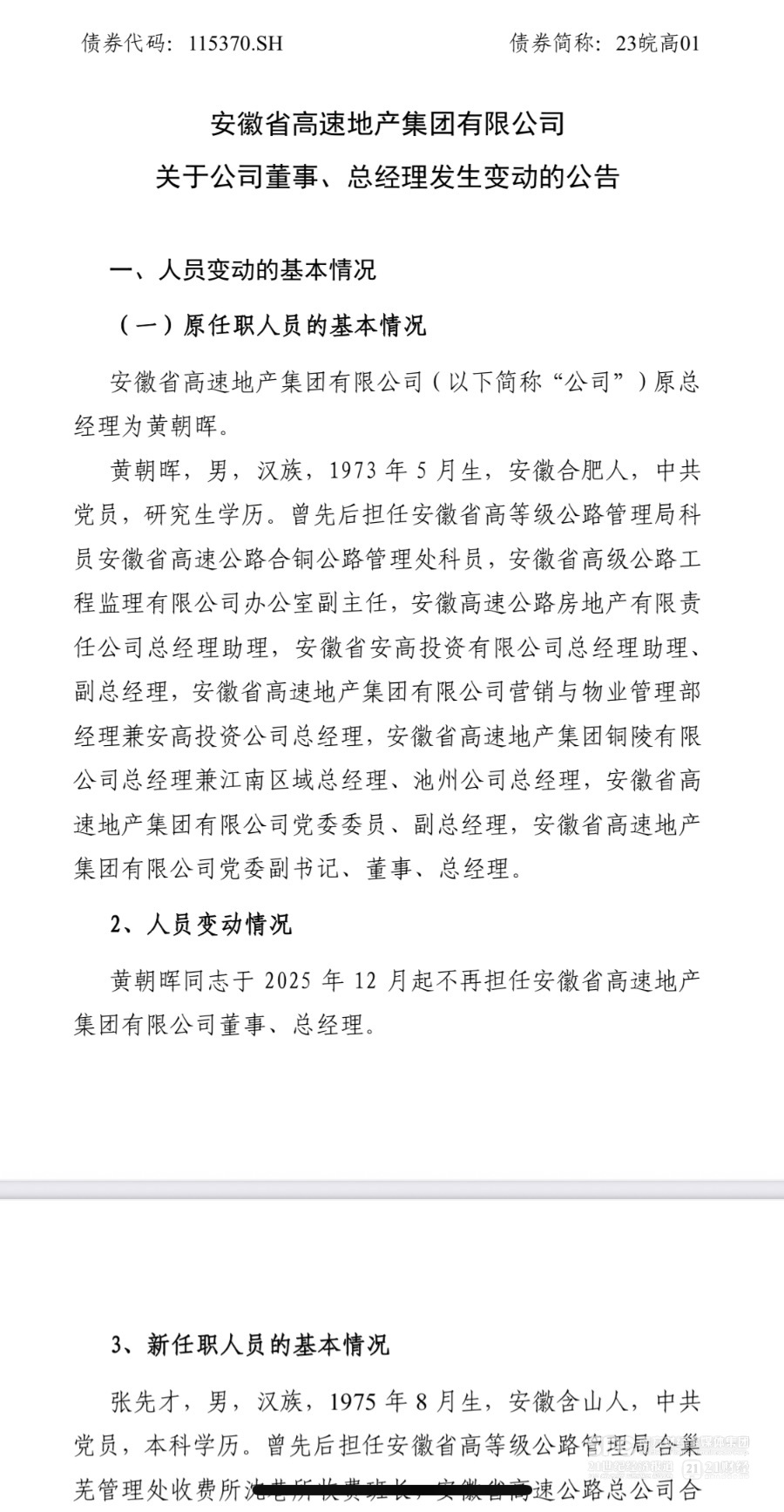
安高地产换帅:三季报业绩承压,张先才接棒能否带领上海项目破局
2 1 Shi Ji Jing Ji Bao Dao· 2025-12-23 12:20
Core Viewpoint - The personnel change at Anhui Gaodao Real Estate Group is a strategic move to address the company's operational challenges and improve management capabilities in response to declining performance and market pressures [5][10]. Financial Performance - As of the end of Q3 2025, Anhui Gaodao's total assets reached 49.303 billion, with liabilities climbing to 39.077 billion, resulting in a high debt-to-asset ratio of 79.26% [6]. - The company reported a loss of 1.98 billion in the first half of 2025, followed by an additional loss of 1.43 billion in Q3, indicating a worsening financial situation [6]. - The net operating cash flow was -0.871 billion as of Q3 2025, highlighting significant short-term liquidity pressures [6]. Market Challenges - The company faces multiple challenges in the Shanghai market, including pressure to sell properties, brand crises, and management issues [10]. - Quality issues have emerged in previously sold projects, which could erode brand trust and affect future sales [10][11]. Strategic Shift - The leadership change from Huang Zhaohui to Zhang Xiancai reflects a shift from aggressive expansion to a focus on operational efficiency and quality control [12]. - Zhang Xiancai's experience in managing core cities in the Yangtze River Delta positions him to address current operational needs, including resolving existing disputes and ensuring project quality [13]. Project Development - The upcoming launch of the An Gao Haiyin Huating project in Shanghai is seen as critical for alleviating cash flow pressures, with a planned offering of 68 apartments at an average price of 82,590 per square meter [8]. - The project's pricing strategy, which is significantly lower than the land acquisition cost, suggests limited profit margins [8]. Future Outlook - The primary tasks for the new management include establishing stricter quality control measures, resolving existing disputes, and optimizing land acquisition strategies to avoid high-cost land purchases [13].

百强房企10月销售总额环比增长3.7%;深铁集团同意向万科提供最多220亿元贷款 | 房产早参
Mei Ri Jing Ji Xin Wen· 2025-11-02 21:29
Group 1: Real Estate Sales Performance - In October, the total sales of the top 100 real estate companies in China increased by 3.7% month-on-month, but the total sales from January to October decreased by 16.3% year-on-year, with the decline rate widening by 4.1 percentage points compared to the previous period [1] - The strong sales performance in October was led by companies such as Greenland Holdings, Xingyao Real Estate Group, and China State Construction Intelligence [1] - Despite 48 companies experiencing month-on-month growth in October, the cumulative scale remains under pressure, particularly for lower-tier companies, which may force them to accelerate product upgrades and promotional sales [1] Group 2: Financing and Corporate Governance Changes - Shenzhen Metro Group agreed to provide Vanke with a loan of up to 22 billion yuan, which will help alleviate the company's debt repayment pressure and strengthen market expectations for risk mitigation [2] - Zhuhai Investment Group plans to convert a debt of 5.122 billion yuan owed to Gree Real Estate into capital reserves, improving Gree Real Estate's asset-liability structure and enhancing its risk resistance capabilities [3] - Xu Rong has been appointed as the new chairman of China Resources Land, aligning with the company's transformation strategy and enhancing its ability to integrate policy resources [4] - Lin Junjie has taken over as chairman and general manager of Midea Real Estate, which coincides with the company's focus on light asset transformation, leveraging his extensive experience to support the company's strategic direction [5]
