二手房交易服务

Search documents
贝壳-W(02423):净收入稳健增长,非房业务经营提质
Guolian Minsheng Securities· 2026-03-21 08:47
Investment Rating - The report maintains a "Buy" rating for the company [3] Core Insights - The company achieved a net revenue of 94.6 billion RMB in 2025, reflecting a year-on-year growth of 1.2%. However, net profit decreased by 26.7% to 2.99 billion RMB, and adjusted net profit fell by 30.4% to 5.02 billion RMB [2][9] - The total transaction volume (GTV) for 2025 was 3.1833 trillion RMB, down 5.0% year-on-year. The decline in revenue from existing and new housing was offset by growth in non-housing business [9] - The company has improved operational efficiency, with operating expenses as a percentage of net revenue decreasing by 1.4 percentage points year-on-year. The company also returned approximately 12 billion RMB to shareholders through stock buybacks and dividends, an increase of over 9% year-on-year [9] Financial Forecasts - Revenue projections for 2026-2028 are as follows: 103.98 billion RMB in 2026 (growth of 9.9%), 115.24 billion RMB in 2027 (growth of 10.8%), and 127.07 billion RMB in 2028 (growth of 10.3%) [3] - The forecasted net profit for 2026-2028 is 3.50 billion RMB (growth of 16.8%), 4.10 billion RMB (growth of 17.3%), and 4.92 billion RMB (growth of 20.0%) respectively [3][9] - The company’s earnings per share (EPS) is projected to increase from 0.85 RMB in 2025 to 1.40 RMB in 2028, with corresponding price-to-earnings (P/E) ratios decreasing from 44x to 27x over the same period [3][9] Business Performance - The company’s second-hand housing transaction volume reached a historical high in 2025, increasing by 11.2% year-on-year. The GTV for existing housing was 2.1515 trillion RMB, down 4.2%, with net income of 25 billion RMB, a decline of 11.3% [9] - The new housing GTV was 890.9 billion RMB, down 8.2%, with net income of 30.6 billion RMB, a decrease of 9.1%, outperforming the overall industry decline of 12.6% [9] - Non-housing business segments, such as home decoration and rental services, showed improved profitability, with home decoration net income at 15.4 billion RMB (up 4.4%) and rental services net income at 21.9 billion RMB (up 52.8%) [9]
【贝壳(2423.HK)】着眼效率,修炼内功——2025年年报点评(付天姿/孙伟风/鲁俊)
光大证券研究· 2026-03-18 23:05
Core Viewpoint - The company reported its 2025 annual performance, showing a revenue of 94.6 billion yuan, net profit of 2.99 billion yuan, and Non-GAAP net profit of 5.02 billion yuan, with year-on-year changes of +1.2%, -26.7%, and -30.4% respectively [4] Group 1: Business Performance - In Q4, the company's revenue decreased by 28.7% year-on-year, primarily due to a high base from the previous year and ongoing market pressures [5] - The second-hand housing segment reported a GTV of 48.2 billion yuan and revenue of 5.4 billion yuan in Q4, with year-on-year declines of 35.3% and 39% respectively. The GTV performance was better than revenue due to a decrease in the proportion of Lianjia's GTV from 42% in Q4 2024 to 37% in Q4 2025 [5] - The new housing segment saw a GTV of 20.7 billion yuan and revenue of 7.3 billion yuan in Q4, with year-on-year declines of 41.7% and 44.5% respectively. The revenue underperformed GTV mainly due to the high base effect from the previous year [5] Group 2: Home Decoration Business - The home decoration business achieved a revenue of 3.6 billion yuan in Q4, marking a 12% year-on-year decline, the first quarterly revenue drop, attributed to adjustments in channel structure and business pace [6] - The contribution profit margin for the home decoration business was 28.8%, down 0.9 percentage points year-on-year, mainly due to provisions for potential maintenance costs on orders still under warranty [6] - Excluding this impact, the improvement in procurement ratios led to a reduction in material costs, indicating a trend of improving core cost structure [6] Group 3: Rental Business - The rental business generated a revenue of 5.4 billion yuan in Q4, reflecting an 18.1% year-on-year increase, driven by a continuous growth in managed housing sources, which exceeded 700,000 units by the end of 2025, a 62% year-on-year increase [7] - The contribution profit margin for the rental business was 10.4%, up 5.9 percentage points year-on-year, attributed to a shift towards a lighter product model and operational efficiency improvements [7] Group 4: Operational Efficiency - The company significantly enhanced the efficiency of core service providers and asset management managers through process restructuring and specialized division of labor, leading to notable improvements in labor costs [8] - The integration of AI technology into the entire operational chain of the rental business has laid a foundation for scalable expansion and sustained profitability [8]


贝壳-W(02423):着眼效率,修炼内功
EBSCN· 2026-03-18 09:48
Investment Rating - The report maintains a "Buy" rating for the company, indicating a positive outlook for future investment returns [4][6]. Core Insights - The company reported a revenue of 94.6 billion CNY for 2025, reflecting a year-on-year growth of 1.2%, while net profit decreased by 26.7% to 2.99 billion CNY [1]. - The fourth quarter (Q4) results showed a significant decline in revenue and net profit, with Q4 revenue at 22.2 billion CNY, down 28.7% year-on-year, and net profit down 85.7% to 0.8 billion CNY [1][2]. - The company is focusing on operational efficiency and optimizing its business model amidst ongoing pressures in the real estate market [4]. Summary by Relevant Sections Business Performance - The second-hand housing segment saw Q4 GTV and revenue of 482 billion CNY and 5.4 billion CNY, respectively, down 35.3% and 39% year-on-year. The monetization rate for the second-hand housing segment was 2.36% [2]. - The new housing segment reported Q4 GTV and revenue of 207 billion CNY and 7.3 billion CNY, down 41.7% and 44.5% year-on-year, with a monetization rate of 3.51% [2]. - The home decoration business experienced a revenue decline of 12% in Q4, with a profit margin of 28.8%. The company is adjusting its channel structure to improve efficiency [3]. - The rental business turned profitable in Q4, achieving a revenue of 5.4 billion CNY, up 18.1% year-on-year, with a profit margin of 10.4% [3]. Financial Forecasts - The company has adjusted its net profit forecasts for 2026 and 2027 to 4.35 billion CNY and 5.16 billion CNY, respectively, reflecting a decrease of 9% and 11% from previous estimates. A new forecast for 2028 is set at 5.74 billion CNY [4]. - Revenue growth rates are projected to be 20.2% for 2024, 1.2% for 2025, and negative growth of 8.4% for 2026 [5]. Valuation Metrics - The report provides various financial metrics, including an expected EPS of 0.85 CNY for 2025 and a P/E ratio of 45 [5][11]. - The company's return on equity (ROE) is projected to be 4.5% for 2025, with a gradual increase to 7.1% by 2028 [13].
贝壳-W(02423):2025年年报点评:着眼效率,修炼内功
EBSCN· 2026-03-18 06:00
Investment Rating - The report maintains a "Buy" rating for the company, indicating a positive outlook for future investment returns [4][6]. Core Insights - The company reported a revenue of 94.6 billion yuan for 2025, a slight increase of 1.2% year-on-year, while net profit decreased by 26.7% to 2.99 billion yuan, and Non-GAAP net profit fell by 30.4% to 5.02 billion yuan [1][4]. - In Q4, the company experienced a revenue decline of 28.7% year-on-year, primarily due to high base effects from the previous year and ongoing market pressures [2]. - The second-hand housing segment saw a GTV of 482 billion yuan and revenue of 5.4 billion yuan in Q4, reflecting a year-on-year decline of 35.3% and 39% respectively [2]. - The new housing segment reported a GTV of 207 billion yuan and revenue of 7.3 billion yuan in Q4, with year-on-year declines of 41.7% and 44.5% respectively [2]. - The home decoration business showed a revenue of 3.6 billion yuan in Q4, marking a 12% decline, attributed to adjustments in channel structure [3]. - The rental business turned profitable with Q4 revenue of 5.4 billion yuan, an increase of 18.1% year-on-year, driven by a 62% growth in managed properties [3]. Summary by Sections Revenue and Profitability - The company achieved a total revenue of 94.6 billion yuan in 2025, with a net profit of 2.99 billion yuan, reflecting a decrease in profitability [1][4]. - The revenue growth rate for 2025 is projected at 1.2%, while the net profit growth rate is expected to decline by 26.3% [5]. Business Segments - The second-hand housing segment's GTV and revenue declined significantly in Q4, with a contribution margin of 40.4% remaining stable year-on-year [2]. - The new housing segment's revenue performance was weaker than GTV due to high previous year monetization rates, with a contribution margin of 28.3% showing improvement [2]. - The home decoration segment's revenue decreased for the first time, but cost structure improvements are noted [3]. - The rental segment's profitability improved significantly, with a contribution margin of 10.4% in Q4 [3]. Future Outlook - The company is expected to benefit from a recovery in the real estate market, with significant growth potential in home decoration and rental services [4]. - The net profit forecast for 2026 and 2027 is adjusted to 4.36 billion yuan and 5.16 billion yuan respectively, with a new forecast for 2028 at 5.74 billion yuan [4][5].
BEKE(BEKE) - 2025 Q4 - Earnings Call Transcript
2026-03-16 13:00
Financial Data and Key Metrics Changes - In 2025, the company initiated a strategic pivot from sales-driven to efficiency-driven growth, resulting in stable revenue despite market fluctuations, with non-housing transaction business accounting for a record high of 41% of total revenue [5][6] - Q4 GTV reached RMB 724.1 billion, a decrease of 36.7% year-on-year, while revenue was RMB 22.2 billion, down 28.7% year-on-year [8][9] - Q4 GAAP net profit was RMB 823 million, down 85.7% year-on-year, and non-GAAP net profit was RMB 517 million, representing a year-on-year decline of 61.5% [9][20] Business Line Data and Key Metrics Changes - Existing home business GTV reached RMB 482 billion in Q4, reflecting a 35.3% decrease year-on-year, while revenue was RMB 5.4 billion, down 39% year-on-year [10][11] - New home business GTV reached RMB 207 billion in Q4, a year-on-year decrease of 45.7%, with revenue at RMB 7.3 billion, down 44.5% year-on-year [12] - Home rental services revenue reached RMB 5.4 billion in Q4, a year-on-year increase of 18.1%, driven by a 62% increase in rental units under management [14][15] Market Data and Key Metrics Changes - The existing home transaction market in China saw a historical high in 2025, with the number of transactions increasing by over 10% year-on-year [30] - The new home market is experiencing greater differentiation, with higher quality projects attracting stronger demand [25] Company Strategy and Development Direction - The company is focusing on improving operational governance and leveraging data and AI to enhance service capabilities and customer value [27][28] - The growth model is shifting from scale-driven to efficiency-driven, emphasizing decision support services and resource optimization [28][34] - The company aims to build diversified service capabilities across the residential ecosystem to meet a full range of housing needs [29] Management's Comments on Operating Environment and Future Outlook - Management noted that the overall demand for better living remains stable, with consumers seeking safe, professional, and reliable services [26] - The company plans to validate its decision support service model in 2026, focusing on improving conversion rates and unit economics [41][42] Other Important Information - Total shareholder return for 2025 was approximately $1.22 billion, significantly exceeding non-GAAP net income, representing around 170% of non-GAAP net income for the year [22][41] - The company has repurchased approximately $921 million in shares for the full year of 2025, reflecting a commitment to shareholder returns [8][21] Q&A Session Summary Question: Strategic upgrade from scale-driven expansion to efficiency-driven growth - Management emphasized that this transition is about upgrading value creation and improving community-based residential services, rather than simply cutting capacity [45][46] Question: New home business dynamics and relationship with developers - Management discussed the need to upgrade the new home business from a channel player to an integrated capability platform, focusing on enhancing online decision-making support and optimizing resource allocation [52][54] Question: Impact of AI on the real estate sector - Management highlighted that AI will reshape the division of labor and value creation in the industry, improving efficiency in standardized tasks while emphasizing the importance of human judgment and service [58][63]

北京楼市新政满月:中介平台二手房交易量提升三成
Feng Huang Wang· 2026-01-27 00:46
Core Viewpoint - The recent policy adjustments in Beijing's real estate market have led to a significant increase in transaction volumes and market activity, although disparities between regions and projects remain evident [1][2][4]. Policy Changes - The new policies include lowering social security requirements, supporting multi-child families in purchasing additional homes, eliminating distinctions between first and second home mortgage rates, reducing down payment ratios for public housing loans, and optimizing the business environment [2]. Market Performance - After one month of the new policies, the transaction volume for second-hand homes increased by 33% compared to the previous month, with new home market activity also showing signs of stabilization, as evidenced by an average of 96 daily registrations for new residential properties [2][5]. - The market's active engagement is reflected in a 14% increase in new customer inquiries and an 18% rise in property viewings [2]. Factors Influencing Market Trends - Three main factors contributing to the market's warming include improved market expectations due to recent policy announcements, concentrated signing of contracts following the policy changes, and seasonal trends that typically see a natural uptick in activity during the first quarter [3]. - The current market is primarily driven by first-time buyers, with a notable focus on entry-level housing, particularly in suburban areas and secondary centers [3]. Regional Disparities - There is a structural differentiation in market performance, with premium projects in core areas benefiting significantly from the new policies, while suburban and non-core projects show relatively flat performance [4]. - The recent decline in the number of second-hand homes listed for sale indicates a stabilization in owner expectations, suggesting early signs of market bottoming [4]. Long-term Market Outlook - The overall market is expected to continue a slow recovery, with second-hand homes dominating the market, accounting for 81% of total transactions in 2025 [5]. - The price structure is showing a downward trend for second-hand homes while new homes are becoming more expensive, indicating a growing financial barrier for "selling old to buy new" transactions [6]. - The policy environment is anticipated to remain supportive, with ongoing adjustments in purchasing qualifications and financial support, which may gradually improve market demand expectations [6].
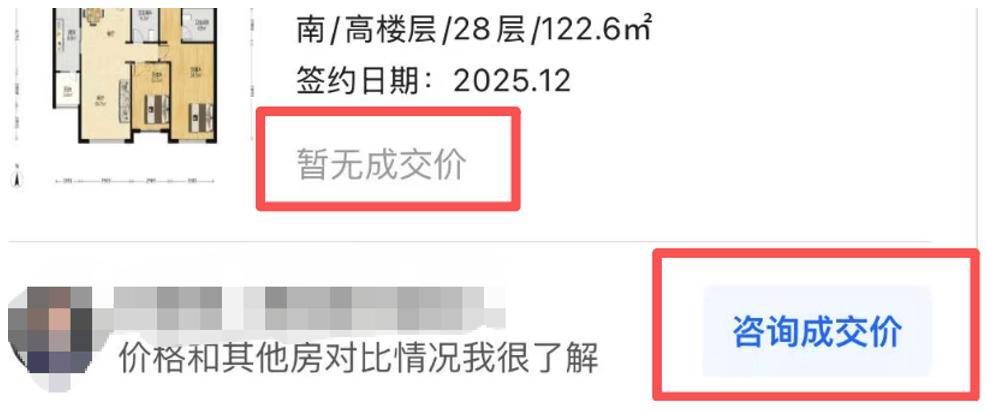
沈阳二手房成交价“隐身”!买卖双方陷入“盲猜”困局?
Sou Hu Cai Jing· 2025-12-28 06:45
Core Viewpoint - The recent decision to hide transaction prices for second-hand homes in various cities aims to stabilize market expectations and reduce panic selling, which has been exacerbated by extreme low-price transactions [3][9]. Group 1: Market Changes - The practice of concealing transaction prices began in July 2025 in major cities like Beijing, Shanghai, and Nanjing, and has now expanded to include cities like Chengdu and Suzhou, with Shenyang being one of the later adopters [3]. - The high volume of second-hand home listings and the economic environment have led to many homeowners selling at prices significantly below regional averages, creating a cycle of declining prices [3][9]. Group 2: Impact on Buyers - Buyers previously relied on public transaction records to gauge market prices, but the removal of this information increases the difficulty of making informed decisions, potentially leading to longer decision-making periods [4][6]. - Without low-price references, buyers may feel pressured to accept higher offers, which could lead to a sense of uncertainty and hesitation in the market [4][5]. Group 3: Impact on Sellers - Sellers face challenges in pricing their properties accurately, as the lack of transparent transaction data shifts pricing from being data-driven to relying on personal judgment [5][6]. - The adjustment in pricing strategies may lead to difficulties in selling homes, as sellers must navigate the balance between setting a competitive price and avoiding losses [5][6]. Group 4: Industry Implications - The change in transaction price visibility is seen as a potential opportunity for real estate agents, as it may increase client inquiries and communication opportunities [9]. - However, the industry faces the challenge of maintaining credibility; agents must provide professional pricing advice and transparent services to build trust in a market where information is less accessible [9]. - The high inventory of 245,000 second-hand homes in Shenyang, with some properties taking up to 18 months to sell, indicates a need for stability in the market, which the price concealment aims to address [9].
郑州二手房市场变革在即:手拉手房产网引领透明交易新风尚,地产或迎重磅支持
Sou Hu Cai Jing· 2025-11-22 07:17
Core Viewpoint - The recent supportive policies across the country are injecting strong momentum into the second-hand housing market, aiming to break down transaction barriers and activate market liquidity, thus facilitating a transition from high-speed growth to high-quality development in the industry [1][3]. Policy Impact - The policies are not limited to a single dimension of stimulus but form a "combination punch" that covers demand release, process optimization, and cost reduction [1]. - The core direction of the current policies aligns with addressing industry pain points such as information asymmetry, high transaction costs, and closed processes, thereby promoting a more transparent and efficient second-hand housing market [3][7]. Industry Transformation - The traditional "information broker" model dominated by intermediaries has created structural contradictions, leading to passive situations for both buyers and sellers [7]. - The shift in the industry is moving from "intermediary-centered" to "user-centered," emphasizing service value and transaction transparency [7][18]. - The transformation is not merely a model adjustment but a return to the essence of real estate transactions, focusing on value exchange between buyers and sellers [7]. Company Innovation - Hand-in-Hand Real Estate Network's "three-dimensional driving" model demonstrates strong adaptability and innovation, aligning with current policy directions and market demands [8]. - The model leverages technology, new media, and direct services to create a comprehensive ecosystem that supports transparent, efficient, and low-cost transactions [8][10]. Service Model - Hand-in-Hand Real Estate Network offers a differentiated fee structure based on user-selected service types, including a zero-commission model, a pure agency model, and a full-service model [11][12][13]. - The full-service model, with a total cost significantly lower than traditional intermediaries, reflects a user-centric service philosophy that aligns with policies aimed at reducing housing costs [14][15]. Future Trends - The continuous empowerment of policies and market-driven changes are pushing the Zhengzhou second-hand housing market into a new development stage, where core competitiveness will focus on professional services, transaction transparency, and reasonable costs [18]. - The trend towards transparency is irreversible, driven by policy advocacy for fair trading and user demands for security and cost control [18]. - Professional services will become a core competitive advantage, necessitating platforms to build comprehensive service systems to meet diverse user needs [18][19].
滔搏(06110.HK):卓越零售能力构建竞争壁垒,高分红回馈投资者
GOLDEN SUN SECURITIES· 2025-11-21 03:27
Core Insights - The report highlights the competitive advantage of Tabo (滔搏) in the retail sector, emphasizing its strong retail capabilities and high dividend payouts to investors [4][5] - The report projects Tabo's revenue and net profit for FY2025 to FY2027, indicating a slight decline in revenue but a recovery in net profit growth by FY2027 [4][5] Company Overview - Tabo is identified as the largest sports retail and service platform in China, collaborating with major brands such as Nike and Adidas [4] - The company experienced a revenue decline of 7% in FY2025 and a projected decline of 6% in FY2026H1, with net profit dropping by 42% and 10% respectively [4][5] Financial Projections - Revenue forecasts for Tabo are set at 946 billion, 953 billion, and 1,005 billion RMB for FY2025, FY2026, and FY2027 respectively, with year-on-year growth rates of 1.2%, 0.8%, and 5.5% [4] - The net profit estimates are 37.1 billion, 52.8 billion, and 61 billion RMB for the same years, with growth rates of -8.7%, 42.4%, and 15.5% [4] Investment Recommendations - The report maintains a "buy" rating for Tabo, citing its robust dividend payout history of 107.3% since its IPO in 2019 and a current cash position of 2.54 billion RMB [5] - The expected price-to-earnings ratio for FY2026 is 14.6, with a dividend yield of 7% [5] Industry Context - The report discusses the broader retail environment, noting challenges such as fluctuating consumer demand and the need for effective e-commerce strategies [5] - It emphasizes the importance of Tabo's strong brand partnerships and retail efficiency in maintaining its competitive edge in the market [4][5]



一份房产中介的财报,揭露了楼市最真实的现状
Sou Hu Cai Jing· 2025-11-17 23:20
Core Viewpoint - The second-hand housing market is the most accurate reflection of the real estate market's current state, and this perspective will continue to gain significance as new homes eventually become second-hand properties [1][3]. Group 1: Company Performance - Beike's Q3 financial report revealed a net profit of 747 million yuan, a year-on-year decline of 36.1%, and an adjusted net profit of 1.286 billion yuan, down 27.8% year-on-year [3]. - The total transaction volume for Beike's second-hand housing business reached 505.6 billion yuan, a year-on-year increase of 5.8%, but revenue decreased by 3.6% to approximately 6 billion yuan [3]. - Beike's new housing business saw a transaction volume of 196.3 billion yuan, a year-on-year decline of 13.7%, with revenue dropping 14.1% to 6.6 billion yuan [3][4]. Group 2: Market Trends - The second-hand housing market is experiencing a price drop, leading to increased transaction volumes as buyers find better value, although revenue is declining due to a higher proportion of transactions coming from franchise stores [6][8]. - The overall real estate market is shrinking, impacting Beike's profitability despite its market dominance [7]. - The shift towards "fourth-generation residential" projects is reducing developers' reliance on intermediaries, leading to lower commission rates for agents [8]. Group 3: Future Outlook - Beike's non-real estate business, including home decoration and rental services, is performing well, with home decoration revenue at 4.3 billion yuan and rental income growing by 45.3% to 5.7 billion yuan [8][9]. - The real estate industry is transitioning from a focus on property transactions to comprehensive residential services, indicating that Beike may expand its offerings to include furniture and appliances [10]. - Future home-buying decisions will increasingly prioritize living quality, rental yield, and property management, with older neighborhoods likely facing further depreciation [11][12].