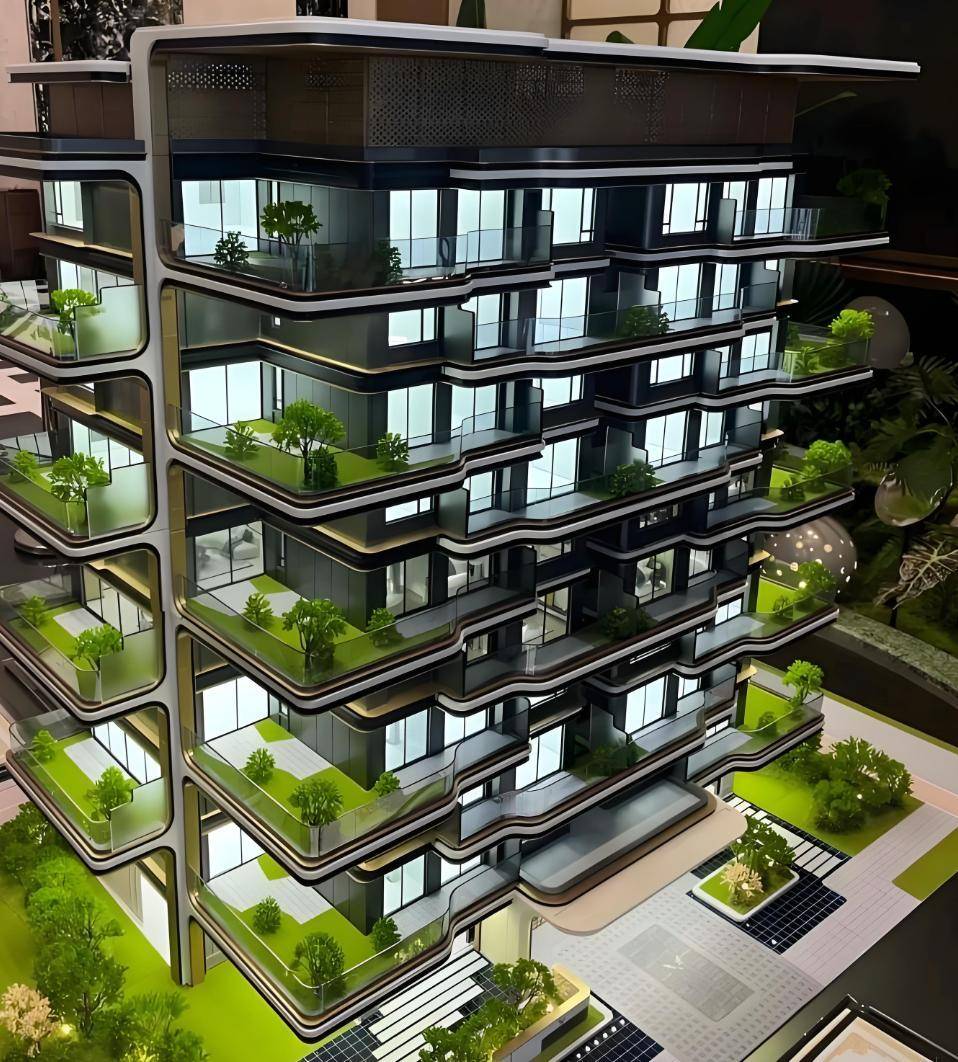
房地产市场见底

Search documents
李蓓:房地产市场很有可能两个季度内会见底,房价涨幅3年内不会很大,若干相关公司涨幅会非常巨大
Jin Rong Jie· 2026-01-23 06:58
Group 1 - The founder of Banxia Investment, Li Bei, experienced a two-week ban on her Xiaohongshu account shortly after its creation, which she attributes to a comment regarding the real estate market that was interpreted as "violating traffic rules" by the platform [1] - Li Bei expressed confusion and dissatisfaction with the platform's rules, describing the situation as a typical monopolistic behavior [1] - The real estate market's core issue over the past two years has been the significant increase in second-hand housing supply, which has recently begun to reverse, with a continuous decline in listings and a narrowing of price drops [1] Group 2 - Li Bei predicts that the real estate market may reach its bottom within the next two quarters, based on various evidence [1] - Looking ahead, Li Bei anticipates a ten-year upward cycle for the market, although the industry scale is not expected to return to historical highs, and price increases will be modest over the next three years [2] - Despite the overall modest price growth, certain related companies are expected to experience significant increases [2]

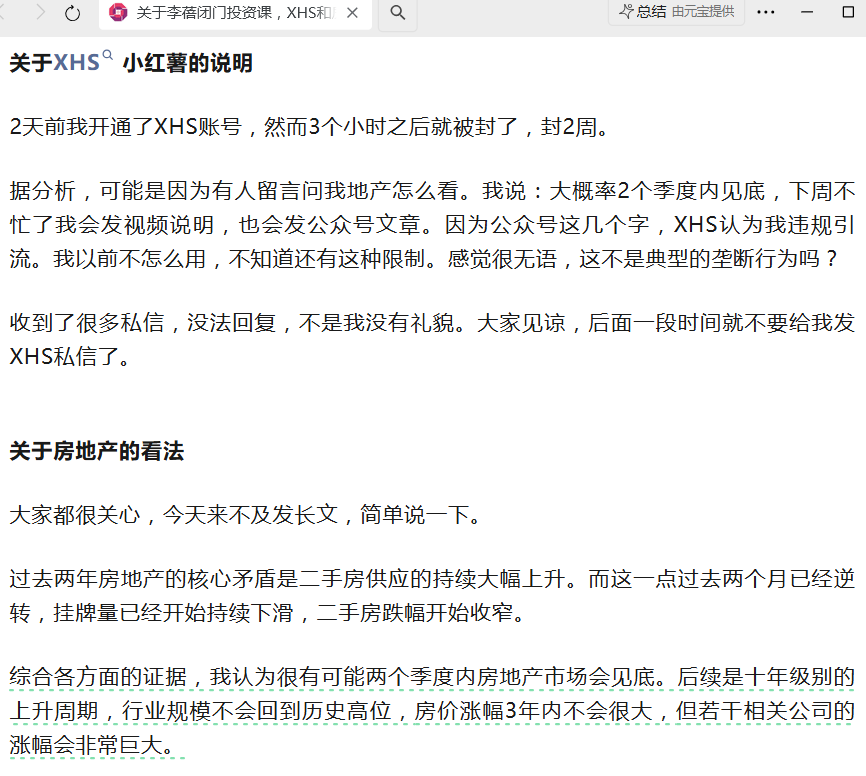
关于李蓓闭门投资课,XHS和房地产的说明
Xin Lang Cai Jing· 2026-01-23 05:26
Group 1 - The real estate market's core issue over the past two years has been the significant increase in the supply of second-hand homes, which has recently reversed with a continuous decline in listings and a narrowing of price drops [12] - It is believed that the real estate market may reach a bottom within the next two quarters, leading to a decade-long upward cycle, although the industry scale is not expected to return to historical highs and price increases will be modest over the next three years [12] - Certain related companies are anticipated to experience substantial growth despite the overall market conditions [12] Group 2 - The organizer has increased the capacity for the closed-door investment course from 200 to 350 participants due to a rise in investor interest, necessitating a change in venue to the Shanghai InterContinental Hotel [9] - There are now 20 additional spots available for the investment course due to last-minute cancellations from some participants [10] - The speaker plans to discuss the real estate market during the course and will provide further insights through articles and videos in the following week [5][13]
关于李蓓闭门投资课,XHS和房地产的说明
半夏投资· 2026-01-23 05:23
Core Viewpoint - The article discusses the upcoming closed-door investment course and provides insights into the real estate market, indicating a potential bottoming out within two quarters and a long-term upward cycle thereafter [2][4]. Group 1: Investment Course Details - The venue for the closed-door investment course has changed to Shanghai Jin Jiang InterContinental Hotel due to an increase in participants from 200 to 350 [2]. - There are now 20 additional spots available for those who previously attempted to register but were unsuccessful [2]. - The course aims to teach ordinary individuals about investment, focusing on achieving over 10% annualized returns [6][10]. Group 2: Real Estate Market Insights - The core issue in the real estate market over the past two years has been a significant increase in the supply of second-hand homes, which has recently started to decline [4]. - It is anticipated that the real estate market may reach a bottom within the next two quarters, followed by a decade-long upward cycle, although prices may not return to historical highs [4]. - The article suggests that while overall housing price increases may be limited in the next three years, certain related companies could see substantial growth [4]. Group 3: Investment Framework and Strategies - The course will cover various asset classes available for ordinary investors, their characteristics, and which to choose or avoid [7][10]. - It will also address timing in major asset classes and stock market style selection, including how to evaluate potential returns and manage asset switches [7][11]. - The course will highlight the importance of the stock market as a core investment area for ordinary people, aiming for a straightforward approach to achieving long-term returns [11].

明年中国经济的主要矛盾是什么?
2025-12-01 00:49
Summary of Key Points from Conference Call Industry Overview: Chinese Real Estate Market Current Market Conditions - The Chinese real estate market is experiencing a rapid decline, particularly in first-tier cities, with 70% of second-hand housing prices showing accelerated month-on-month declines since May 2023, marking the third such downturn since the second half of 2021 [1][4] - Beijing has seen the most significant drop in second-hand housing prices, with a consistent month-on-month decline of over 1% for five consecutive months starting from April 2023 [1][4] Market Sentiment - The market sentiment towards the real estate sector is predominantly pessimistic, with most institutions predicting a further decline of over 30% in the next three years [1][7] - Historical data suggests that first-tier cities may require a 4 to 5-year adjustment period, while second and third-tier cities may need 7 to 9 years [1][9] Rental Yield and Housing Demand - Current rental yields across major cities are approximately 2.38% to 2.4%, which is below actual mortgage rates. A 10% drop in housing prices could push rental yields above public housing loan rates, potentially stimulating home-buying demand [1][10][11] - Signs of market stabilization include renters transitioning to buyers, sellers opting to rent instead of sell, and an increase in investment buyers [1][14] Developer Challenges - Frequent crises among real estate companies, such as the Evergrande incident, may indicate the end of the current downturn cycle, as many firms have either cleared their debts or shifted their business models [1][17] - The inability of developers to reduce inventory will hinder cash flow, affecting their ability to acquire land, which in turn impacts land premiums and the Producer Price Index (PPI) [1][16] Policy Implications - The government is shifting its focus from stimulating price increases to improving housing quality, indicating a low likelihood of large-scale stimulus policies [1][18][19] - Future economic policies will emphasize reforms in the household registration system and marketization of factors, aiming to enhance public service levels and stimulate demand through improved supply [1][29] Economic Outlook - The economic policy direction for 2026 will prioritize consumer demand and investment in human capital, with a growth target of around 5% [1][21][22][23] - The government aims to balance fiscal and monetary policies to promote economic development, focusing on direct fiscal measures to increase residents' income [1][27][28] Comparative Analysis - Compared to international cities, China's real estate market remains relatively stable, with first-tier cities showing an average rental yield of 1.8% and a national average of 2.4% [1][13] Conclusion - The Chinese real estate market is currently in a challenging phase, with significant price declines and a pessimistic outlook. However, potential signs of stabilization and government policy shifts may provide a foundation for future recovery. The focus on quality over quantity in housing, along with broader economic reforms, will be crucial in shaping the market's trajectory moving forward [1][29]
一个数据告诉你:现在的房企,有多难!
Sou Hu Cai Jing· 2025-10-21 17:52
Core Viewpoint - The financing scale for real estate companies has significantly declined, indicating severe challenges in obtaining funds for development [1][5]. Group 1: Financing Challenges - The financing scale for real estate companies in the first three quarters of 2025 was only 307.2 billion, a year-on-year decrease of 30% [1]. - In the third quarter, financing reached 114.5 billion, a slight increase of 5% from the second quarter, but still down 35% compared to the same period last year [1]. - Financial institutions remain cautious, leading to a tightening of both financing and sales revenue streams for real estate companies [5][10]. Group 2: Debt and Cash Flow Issues - Real estate companies face rigid debt obligations that must be repaid, creating a risk of default if not managed properly [7]. - Many companies are resorting to selling properties at a loss to alleviate debt pressure, which is not a sustainable solution [8]. - High debt levels directly impact investment and development capabilities, further eroding buyer confidence in the market [10]. Group 3: Policy Responses - The government is implementing policies aimed at improving cash flow for real estate companies, including extending loan policies to 2026 [12]. - Despite these efforts, the effectiveness of the policies has yet to be fully realized, and pressures remain [12]. Group 4: Disparities in Financing - There is a significant disparity in financing between state-owned enterprises and private companies, with state-owned enterprises accounting for 85% of bond issuance in the first three quarters of 2025 [14]. - Private real estate companies issued only 13.4 billion in bonds, reflecting a 13% year-on-year decline, indicating higher perceived risks associated with private firms [14]. Group 5: Market Outlook - The overall survival environment for real estate companies remains challenging, with a need for more effective policy support to restore market confidence [16]. - A genuine recovery in the real estate market is anticipated to take time and requires substantial improvements in financing conditions [16].