手机轻薄化

Search documents
iPhone Air爆改eSIM卡槽?业内称很难,极致轻薄其实很小众?
Shen Zhen Shang Bao· 2026-01-29 10:41
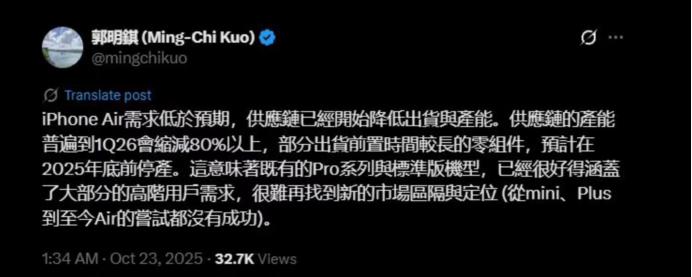
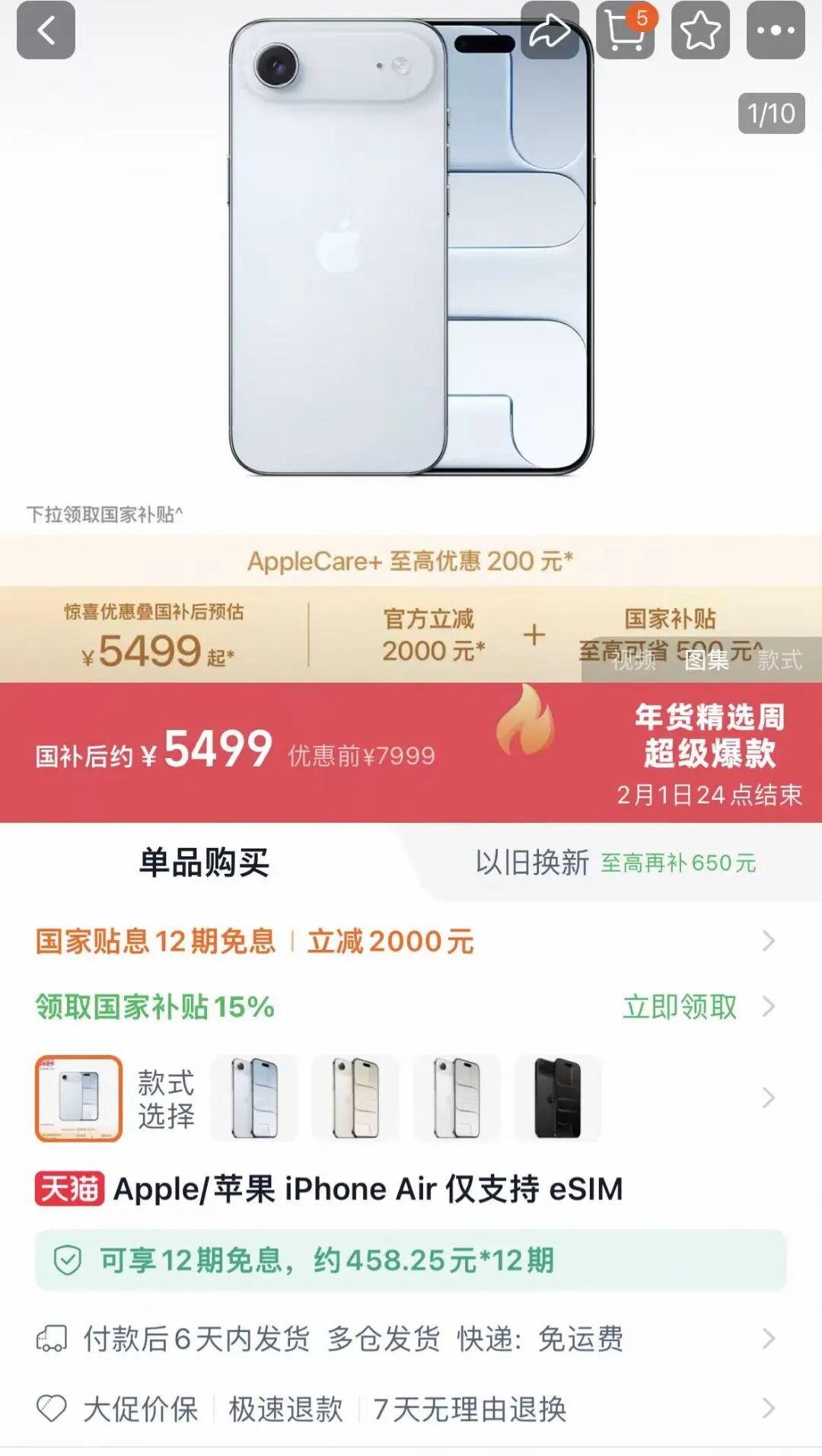
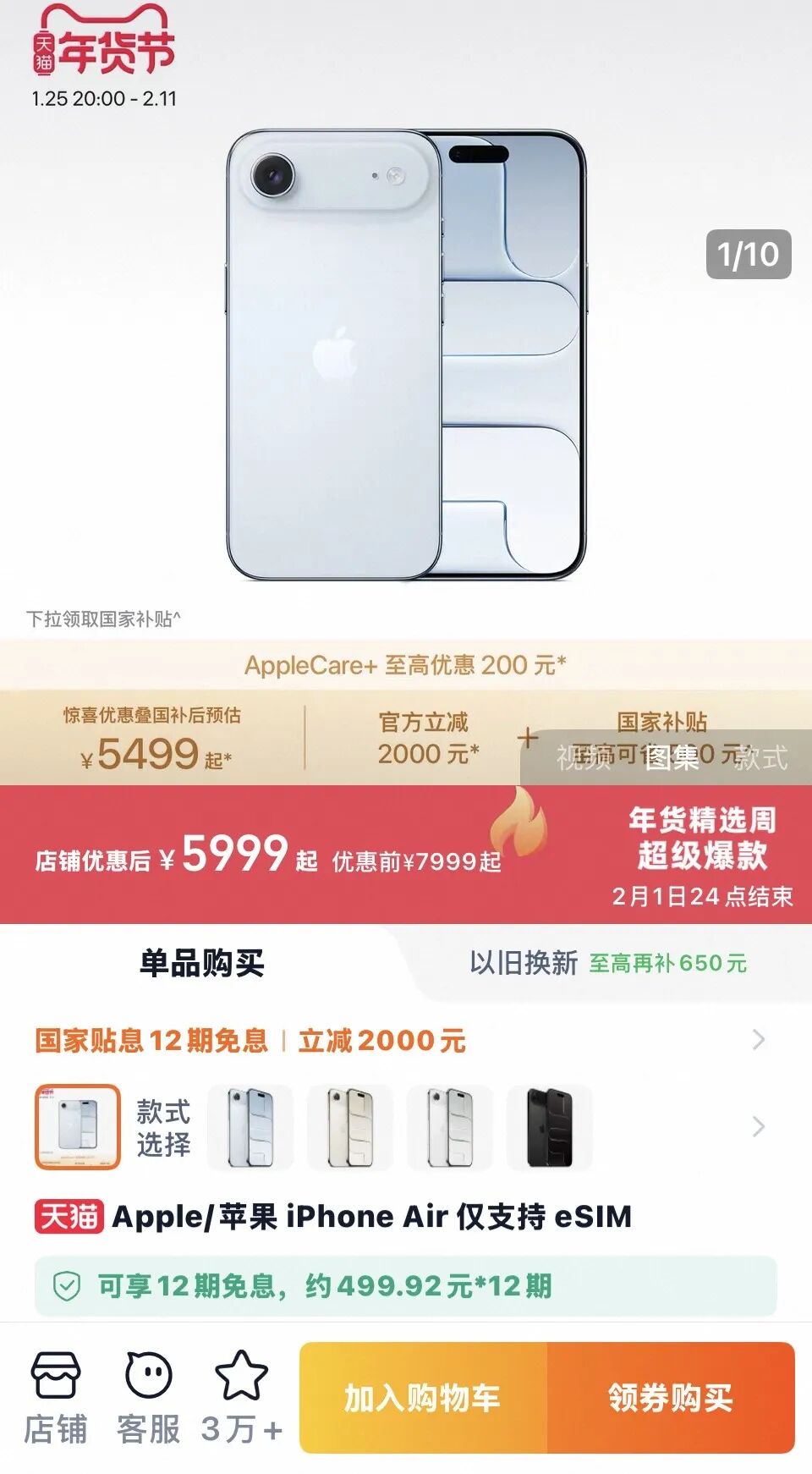
Core Viewpoint - The recent significant price drop of the Apple iPhone Air, originally priced at 7999 yuan, now starting at 5499 yuan after a reduction of 2000 yuan, highlights the product's poor sales performance since its launch just over three months ago [1][10]. Group 1: Sales Performance - The iPhone Air has seen disappointing sales, with cumulative activation numbers below 200,000 units as of January 24, 2026, which is significantly below expectations [4][10]. - Following the price cut, there are reports of stock shortages for certain models at authorized Apple stores, indicating a potential short-term increase in demand [10]. Group 2: eSIM Technology Challenges - The adoption of eSIM technology in the iPhone Air has been a major hurdle, as many users find the activation process cumbersome compared to traditional SIM cards [4][5]. - Users must visit physical stores with identification to activate eSIM services, which has led to frustration and a lack of understanding of the new technology [6][8]. - The complexity of eSIM management, especially for users accustomed to physical SIM cards, poses a significant barrier to widespread adoption [8][11]. Group 3: Market Strategy and Consumer Preferences - Analysts suggest that the iPhone Air's design and features have not sufficiently impressed consumers, making it difficult to stand out in a competitive market [10][11]. - The initial high pricing has limited market acceptance, and while the price reduction may attract some buyers, it risks damaging the brand's image and consumer confidence [10]. - The trend towards ultra-thin devices may not align with consumer preferences for battery life and usability, indicating a potential shift in Apple's future product strategy towards larger foldable screens and AI hardware [11].


iPhone降价,破纪录了
3 6 Ke· 2026-01-26 23:59
Core Viewpoint - The iPhone Air, released only three months ago, has become a focal point due to a significant price drop, with a reduction of 2000 yuan, bringing the starting price to 5499 yuan after regional subsidies [1][3]. Group 1: Market Performance and Consumer Response - The iPhone Air's market performance has been disappointing, leading to the dismantling of several production lines by Apple suppliers [3][9]. - The device has not resonated with the majority of consumers, as its lightweight design appeals to a niche market rather than the broader audience [4][10]. - The iPhone Air's initial sales were overshadowed by the iPhone 17 series, which dominated sales rankings during the same period [4][8]. Group 2: Product Features and Consumer Expectations - To achieve its slim profile of 5.6 mm and weight of 165 grams, the iPhone Air compromised on key features, including a smaller battery capacity of 3149 mAh and a single camera setup [5][7]. - Consumers are increasingly unwilling to pay flagship prices for devices that lack high-end specifications, leading to a perception of the iPhone Air as a "downgraded" option [8][9]. - The high initial price of 7999 yuan, which is comparable to other flagship models with superior specifications, has further hindered its appeal [8][9]. Group 3: Industry Trends and Competitor Actions - The smartphone market is witnessing a shift, with many manufacturers, including Xiaomi and OPPO, canceling lightweight model projects in response to consumer feedback [9][10]. - Competitors are adopting a more balanced approach, offering lightweight models with better specifications at lower price points, which has proven more successful in the market [13][19]. - The iPhone Air's lack of success does not indicate a failure in the lightweight category, as the industry continues to explore innovations in design and functionality [20][21].
“轻薄”成手机新战场:iPhone Air遇冷 华为Mate 70 Air接棒入局
Mei Ri Jing Ji Xin Wen· 2025-11-06 06:32
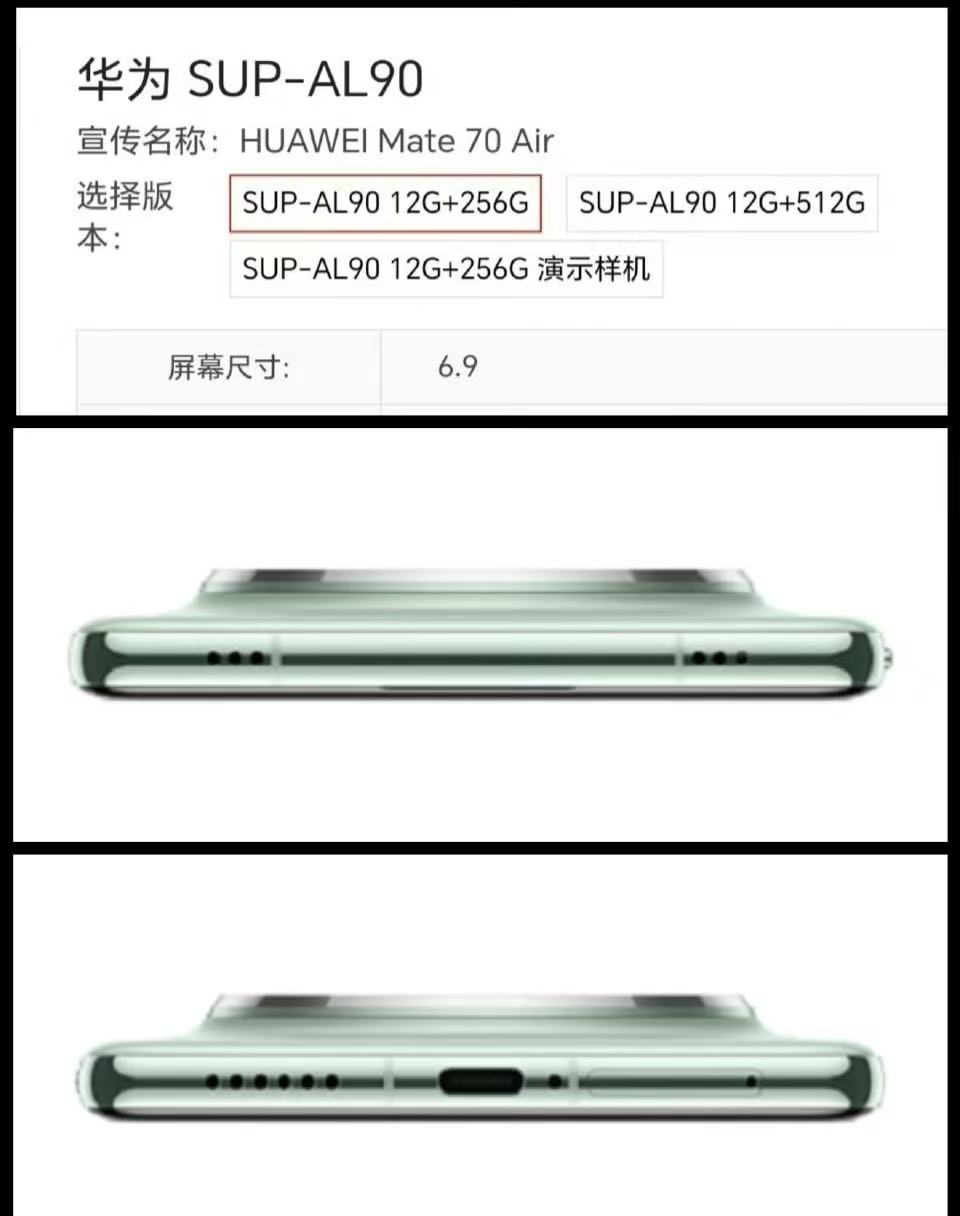
Core Viewpoint - The smartphone industry is witnessing a trend towards ultra-thin devices, with major brands like Samsung and Apple launching models with thicknesses between 5.5mm and 6mm, aiming to differentiate in a saturated market [1] Group 1: Market Trends - Huawei has launched the Mate 70 Air, which is 6.6mm thick and weighs 208g, featuring a 6500mAh silicon-carbon battery and a 7-inch screen, priced from 4199 yuan [1] - The iPhone Air initially saw strong pre-sale demand, selling out in five minutes, but has since experienced a decline in sales [1][2] Group 2: Product Challenges - Apple is reducing iPhone Air production by approximately 1 million units due to underwhelming market performance, despite the overall iPhone 17 series exceeding expectations [2] - The iPhone Air's reliance on eSIM technology has limited its appeal in the Chinese market, where traditional SIM cards are preferred [2][3] Group 3: Industry Insights - The pursuit of extreme thinness in smartphones has led to compromises in practical features, such as battery life and camera capabilities, with the iPhone Air featuring only a single 48MP main camera [2] - Samsung's Galaxy S25 Edge, another ultra-thin model, faced similar issues, leading to its discontinuation after five months due to problems like reduced battery life and overheating [3] - Innovations such as silicon-carbon batteries and advanced thermal management are being explored to balance performance, pricing, and thinness in future smartphone designs [3]
小米华为入局轻薄赛道,Air手机团战即将开启?
3 6 Ke· 2025-10-30 00:19
Core Viewpoint - The introduction of the iPhone Air has sparked a trend in the smartphone industry towards lightweight designs, despite lacking significant performance upgrades or new imaging systems [1][3][11]. Group 1: Market Response - The term "Air" has revitalized discussions around lightweight smartphones, prompting major manufacturers like Huawei, Xiaomi, OPPO, and Vivo to develop their own versions [2][3][10]. - The shift towards lightweight designs is a response to consumer preferences, with over 70% of users indicating that performance is sufficient, while weight and feel are critical factors in their purchasing decisions [4][12]. Group 2: Challenges Faced - Despite the hype, lightweight models like the iPhone Air and Samsung Galaxy S25 Edge have not met sales expectations, facing criticism for compromised features such as battery life and audio quality [7][8][14]. - The iPhone Air's design sacrifices battery capacity and speaker quality, leading to a less complete user experience, which has resulted in a delay in production for subsequent batches [7][14]. Group 3: Future Outlook - The lightweight trend is seen as a potential design revolution, with advancements in technology such as silicon-carbon batteries and titanium frames offering new solutions for achieving meaningful lightweight designs [16][18]. - The industry may see 2026 as a pivotal year for lightweight flagship models, as the goal shifts from merely achieving thinness to integrating lightweight features across all devices [18].

十年来最好的iPhone,刚上市就卖不动了
3 6 Ke· 2025-10-26 23:24
Core Insights - The iPhone Air is facing significant challenges in the market, with demand falling short of expectations, leading to a projected production capacity reduction of over 80% by Q1 2026 [1][5][6] - The iPhone 17 series has effectively met the majority of consumer needs, making it difficult for the iPhone Air to find a new market position [3][19] - Apple plans to cut production by 1 million units of the iPhone Air while increasing the iPhone 17 series production by 2 million units [5][6] Group 1 - The iPhone Air's starting price is 7999 yuan, but it is being sold at a lower price on second-hand platforms, indicating weak demand [6][12] - The iPhone Air only accounts for 3% of the overall sales of the iPhone 17 series, highlighting its poor market performance [7] - The iPhone Air has been criticized for its lack of competitive features compared to the iPhone 17 series, which offers better specifications at a lower price point [14][19] Group 2 - The iPhone Air's design sacrifices functionality for a thinner profile, which has not resonated with consumers [12][19] - The device's battery life is significantly lower than competitors, with only a 3149mAh battery compared to newer Android models [12][19] - The iPhone Air's reliance on eSIM technology complicates user experience, as the activation process is cumbersome in the current market [13][19] Group 3 - The iPhone Air's situation mirrors that of previous models like the iPhone mini and Plus series, which also struggled due to a lack of consumer demand [16][18] - Apple's focus on a single selling point has led to neglect of broader consumer needs, resulting in poor sales performance [19][20] - The extreme thinness of the iPhone Air aligns with future mobile design trends, but its value proposition remains questionable [19][20]