扩大开放合作

Search documents
将在七个重点方面“持续用力”
Xin Lang Cai Jing· 2025-12-30 20:11
Core Viewpoint - Chengdu's economic work for 2026 will focus on seven key areas to enhance effective demand, deepen the integration of technology and industry, expand open cooperation, promote coordinated development, advance urban renewal, optimize the development environment, and improve public welfare and safety [1] Group 1: Expanding Effective Demand - The emphasis will be on expanding effective demand and creating new space for domestic demand growth, integrating consumption promotion with investment expansion [2] - Specific actions include implementing special initiatives to boost consumption, enhancing the second-hand car market, and improving investment mechanisms to support high-quality economic development [2][3] Group 2: Deepening Technology-Industry Integration - The goal is to foster new productive forces through organized innovation and effective transformation, with a focus on enhancing enterprise innovation capabilities [3] - A comprehensive service system for investment will be established to support technology transfer and innovation funding [3] Group 3: Expanding Open Cooperation - The strategy includes enhancing the open economy by coordinating foreign affairs, investment, trade, and promoting the capabilities of free trade zones and cooperation parks [5] - Plans to increase international cooperation and participation in overseas exhibitions will be implemented to boost local products' global presence [5] Group 4: Promoting Coordinated Development - The focus will be on regional collaboration and urban-rural integration, with strategies to strengthen the Chengdu-Chongqing economic circle and promote urbanization [6] - Specific initiatives will include optimizing the economic layout and enhancing the capacity for population and economic growth [6] Group 5: Advancing Urban Renewal - Urban renewal will be prioritized to improve city functionality and quality, with a focus on infrastructure safety and the renovation of old neighborhoods [7][8] - The aim is to create a comprehensive urban development model that integrates various aspects of city life [8] Group 6: Optimizing Development Environment - The city will enhance its business environment to stimulate high-quality development, focusing on legal protections for market entities and efficient service delivery [9] - Collaboration with educational institutions will be emphasized to attract high-end talent and foster innovation [9] Group 7: Enhancing Public Welfare and Safety - Efforts will be made to improve public services and enhance citizens' sense of happiness and security, with a focus on sports and cultural events to drive economic activity [10][11] - Long-term goals include significant improvements in economic strength, technological capability, and overall quality of life for residents [11]
张占斌:读懂中国经济的韧性和底气
Jing Ji Ri Bao· 2025-12-18 00:08
Core Viewpoint - The article emphasizes the importance of enhancing economic resilience in the face of global uncertainties and challenges, particularly in the context of a new round of technological revolution and industrial transformation [1][2]. Group 1: Economic Resilience - Economic resilience refers to a country's ability to withstand external shocks and internal structural pressures, adapting quickly and recovering effectively [2]. - The current global supply chain restructuring highlights the need for self-sufficiency and control over critical supply chains, as geopolitical tensions rise [3]. - The concept of economic resilience is closely tied to national security, with issues like energy, food, and data security becoming integral to economic decision-making [3]. Group 2: China's Economic Transition - China's shift towards high-quality development necessitates enhanced economic resilience to mitigate the pains of transition and prevent systemic risks [4]. - The central economic work conference outlines five key imperatives, including maximizing economic potential and balancing policy support with reform innovation [4]. - The focus on technological self-reliance is crucial, particularly in overcoming "choke point" technologies in sectors like integrated circuits and core seed sources [4]. Group 3: Advantages of China's Economy - China's super-large market, with over 1.4 billion people and a significant middle-income group, provides a robust foundation for domestic demand resilience [5]. - The complete industrial system in China supports supply chain resilience, allowing for rapid response to market demands and mitigating disruptions [6]. - Strong innovation capabilities, backed by substantial R&D investments, position China to achieve self-sufficiency in critical technology areas [7]. Group 4: Governance and Institutional Strength - The centralized leadership of the Communist Party enables effective governance, which has been demonstrated in crisis management, such as during the COVID-19 pandemic [8]. - Current policies aim to enhance the business environment and ensure rapid responses to economic shocks, thereby strengthening governance resilience [8]. Group 5: Global Economic Integration - China's deep integration into the global economy, through initiatives like the Belt and Road Initiative, reduces reliance on single markets and enhances economic resilience [9]. - The focus on expanding high-standard trade agreements and optimizing free trade zones supports a dual circulation strategy, leveraging both domestic and international markets [9]. Group 6: Pathways to Enhance Economic Resilience - Strengthening supply chain resilience involves focusing on key industries and ensuring a modernized industrial system that can withstand global competition [10]. - Enhancing technological innovation requires collaboration between government, academia, and industry to foster a robust innovation ecosystem [11]. - Promoting domestic consumption and effective investment strategies is essential for sustaining economic growth and resilience [12].
与天下同利 和世界共享
Jing Ji Ri Bao· 2025-11-06 00:08
Group 1 - The China International Import Expo (CIIE) has become an important bridge connecting the Chinese economy with the global economy, successfully held for eight consecutive years and continuously expanding in scale [1][2] - The CIIE has attracted a total of 23,000 foreign exhibitors and has a cumulative intended transaction amount exceeding 500 billion USD over the past seven sessions [2] - The CIIE promotes global investment cooperation through various activities such as roadshows, supply-demand matching, and on-site inspections, facilitating deep cooperation among enterprises [2] Group 2 - The CIIE focuses on addressing global development imbalances, providing multiple exhibition benefits and conveniences for least developed countries, with a 23.5% year-on-year increase in participating companies from these nations [3] - The event has introduced 18 facilitation measures to ensure smooth operations, transitioning temporary policies into normalized arrangements, contributing to the construction of an open world economy [3] - The CIIE serves as a platform for discussing open cooperation policies and cultural exchanges, strengthening trust and expanding cooperation networks in the context of multilateral trade systems [3] Group 3 - The CIIE exemplifies the value pursuit of "shared benefits with the world," positioning China as a co-creator of global opportunities and a builder of open platforms [4] - The recent 20th Central Committee meeting outlined a five-year development blueprint, emphasizing high-level opening up and creating a win-win cooperation landscape [4] - China's ongoing efforts through the CIIE are expected to contribute more opportunities and stability to the global economy [4]
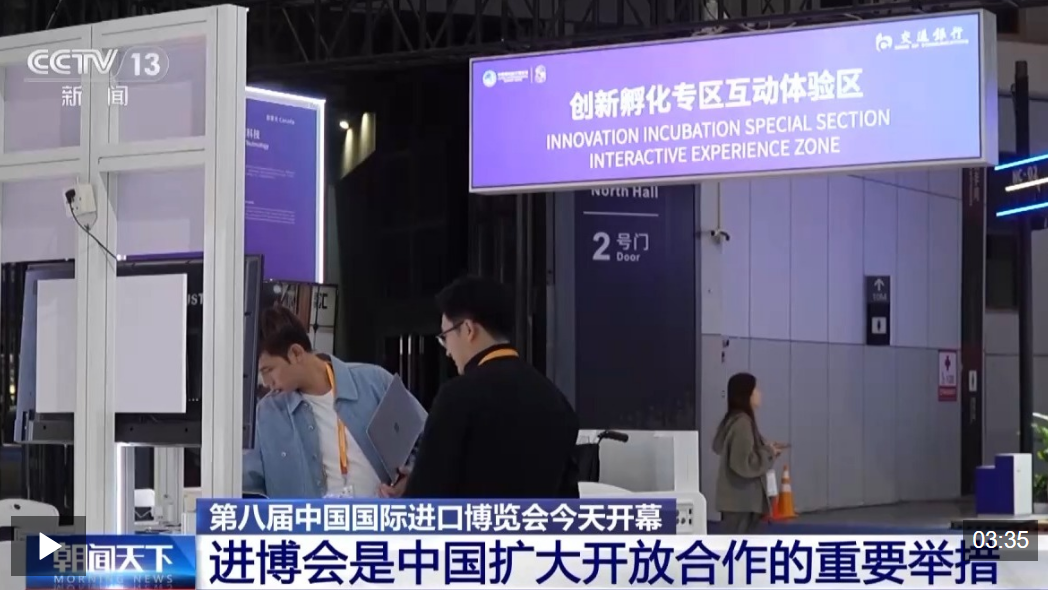
视频丨第八届进博会今天开幕 境内外媒体高度关注
Yang Shi Xin Wen Ke Hu Duan· 2025-11-05 07:35
Core Viewpoint - The 8th China International Import Expo (CIIE) is being held from November 5 to 10 in Shanghai, highlighting China's commitment to expanding open cooperation and attracting global attention [1][3]. Group 1: Event Overview - The opening ceremony of the CIIE is taking place at the National Exhibition and Convention Center in Shanghai, with significant media coverage and anticipation regarding key signals from China [3][4]. - The CIIE has been held annually since 2018, becoming a crucial initiative for China's open cooperation [3][6]. Group 2: Historical Context and Achievements - Over the past seven CIIEs, approximately 3,000 new products, technologies, and services have been launched, with an intended transaction value exceeding $500 billion, and a total of 23,000 foreign exhibitors [6]. - This year, the expo features an expanded enterprise exhibition area, achieving record highs in both exhibition space and the number of participating companies, transforming China's large market into global opportunities [6][8]. Group 3: New Features of the Current Expo - The current CIIE emphasizes deeper connections with countries involved in the Belt and Road Initiative, with participation from enterprises in 123 countries, marking a 23.1% increase year-on-year; African product zones have also expanded, with an 80% increase in participating African companies [6][8]. - The national exhibition hall introduces an international friendly city exhibition for the first time, showcasing local cooperation achievements between China and other countries [6]. Group 4: Significance and Future Outlook - The CIIE is the world's first national-level expo focused on imports, with 290 participating companies being Fortune 500 firms or industry leaders, reflecting a strong interest from both long-term and new partners [8]. - The opening of the CIIE coincides with the commencement of the 8th Hongqiao International Economic Forum, featuring 33 sub-forums and closed-door meetings, gathering top experts, including Nobel laureates, to discuss global governance and open cooperation, with 21 outcome documents expected to be released [9][11]. - In the context of increasing global economic uncertainty, the CIIE holds special significance as China aims to contribute stability and certainty to the world economy through practical actions [11].