全球治理

Search documents
美国、德国、英国、法国、意大利、加拿大、日本等,发表联合声明
第一财经· 2026-03-28 03:51
Core Viewpoint - The G7 foreign ministers and the EU's High Representative for Foreign Affairs and Security Policy issued a joint statement addressing the situation in Iran, emphasizing the need to mitigate the regional impact of current Middle Eastern conflicts and their economic repercussions [3]. Group 1 - The statement calls for reducing the impact of conflicts on regional partners, civilians, and critical infrastructure, while coordinating humanitarian aid efforts [3]. - It urges an immediate cessation of attacks on civilians and civilian infrastructure [3]. - The G7 emphasizes the importance of establishing diversified partnerships, enhancing coordination, and supporting relevant initiatives to alleviate the economic shocks stemming from the conflicts [3]. - The statement also advocates for the permanent restoration of navigation in the Strait of Hormuz [3].


李强出席中国发展高层论坛2026年年会开幕式并发表主旨演讲
证券时报· 2026-03-22 05:05
Core Viewpoint - The article emphasizes the complex and challenging international landscape, highlighting the need for cooperation and innovation to create new markets rather than competing for existing ones [1][2]. Group 1: Market Dynamics - The market is viewed as a scarce resource that can be continuously created through openness and technological advancement, rather than through protectionism [2]. - China aims to expand high-level openness and engage in fair trade, focusing on importing high-quality foreign goods and optimizing trade balance [2]. Group 2: Competition and Cooperation - Healthy competition is essential for mutual benefits, and China's competitive advantages stem from deep reforms and innovation rather than subsidies [2]. - The country opposes irrational competition but supports fair competition to stimulate greater development momentum [2]. Group 3: Future Outlook - Despite challenges, there is optimism for a better future, with China positioning itself as a "certainty cornerstone" and "stability harbor" for global development [3]. - The "14th Five-Year Plan" is presented as a new blueprint for China's development and an opportunity for global growth, focusing on high-quality development and a favorable business environment for foreign enterprises [3].

专栏|这波“访华潮”,印证了一个时代共识
Xin Hua She· 2026-02-27 01:36
Core Viewpoint - The recent wave of foreign leaders visiting China reflects a growing consensus on the importance of pragmatic cooperation in a complex global landscape, with China being seen as a reliable partner for future investments and opportunities [1][2]. Economic Cooperation - The primary motivation for the influx of foreign leaders is the economic cooperation, as global economic recovery faces challenges while China's economy demonstrates resilience and vitality [2]. - Notable delegations accompanied leaders such as UK Prime Minister Starmer with over 60 representatives, and German Chancellor Merz with the largest group of executives since the Merkel era, indicating strong business interests [2]. Perception and Understanding - The visits also aim to break down misconceptions and seek a deeper understanding of China, with leaders recognizing the limitations of interpreting China through ideological lenses and fragmented information [3]. - Leaders like Starmer and Finland's Prime Minister Orpo emphasized the need for a comprehensive understanding of China, moving beyond stereotypes and engaging in meaningful dialogue [3]. Global Stability and Multilateralism - China is positioned as a source of certainty in a turbulent world, advocating for multilateralism and maintaining a consistent policy approach amidst rising unilateralism and protectionism [4]. - Observations from international media highlight that Western leaders are visiting China due to its non-aligned stance, contrasting with the exclusive approaches of some countries [4]. Future Cooperation - The shift in global focus towards China signifies a recognition of opportunities and a collective expectation for stability in a changing world [5]. - Despite existing differences, China's commitment to high-level openness is seen as a pathway to foster cooperation and mutual benefits, contributing positively to the global environment [5].
构建更加公正合理的全球治理体系——智库报告解析全球治理的中国方案
Xin Hua She· 2026-02-25 16:27
Core Viewpoint - The report emphasizes the importance of China's global governance initiative in response to the increasing chaos in the world, highlighting the need for reforming the global governance system to address structural contradictions and adapt to the rise of developing countries [2][3][5]. Group 1: Global Governance Context - The current international landscape is marked by unilateralism, protectionism, and hegemonic actions that undermine international order, necessitating a reformed global governance system [2]. - The existing global governance framework struggles with representation, fairness, and effectiveness, failing to meet the new global realities [2][3]. - The report outlines the evolution of global governance as a gradual process shaped by humanity's pursuit of peace and development [2]. Group 2: China's Global Governance Initiative - China's global governance initiative, proposed by President Xi Jinping, includes five core principles: sovereign equality, international rule of law, multilateralism, people-centeredness, and action-oriented approaches [3][5]. - The initiative has received rapid support from over 150 countries and international organizations, indicating its timely relevance [5]. - The emphasis on sovereign equality addresses the inequities in the current global governance system, advocating for equal participation in international rule-making and discussions [6]. Group 3: Implementation and Action - China actively explores the establishment of international rules in emerging fields, such as cybersecurity and artificial intelligence, promoting collaborative governance [7]. - The initiative stresses the importance of multilateralism and the central role of the United Nations in global governance, opposing exclusive arrangements [7][10]. - China's commitment to action-oriented governance is evident in its provision of public goods, such as vaccine cooperation and climate change initiatives, enhancing the self-development capabilities of developing countries [11]. Group 4: Future Directions - The report calls for international cooperation to strengthen the UN's role in global governance, aiming for a more just and reasonable international order [10][12]. - It highlights the necessity of transforming governance concepts into actionable practices, ensuring that global governance addresses both immediate and long-term challenges [8][11]. - The initiative aims to create a world where all people can aspire to a better life, focusing on infrastructure development and poverty alleviation through initiatives like the Belt and Road [8].
特稿|构建更加公正合理的全球治理体系——智库报告解析全球治理的中国方案
Xin Hua She· 2026-02-25 16:18
Core Viewpoint - The report emphasizes the importance of China's global governance initiative in response to the current chaotic international landscape, advocating for a more just and equitable global governance system [1][2][3]. Group 1: Global Governance Context - The report outlines the evolution of global governance, highlighting its development from loose cooperation to a structured system, driven by humanity's pursuit of peace and development [2]. - Current global governance structures face challenges in representation, fairness, and effectiveness, exacerbated by unilateralism and hegemonic actions [2][3]. - The report cites specific instances, such as the U.S. military actions in Venezuela, to illustrate the threats to international order and the urgency for reform [2]. Group 2: China's Global Governance Initiative - China's global governance initiative, proposed by President Xi Jinping, includes five core principles: sovereign equality, international rule of law, multilateralism, people-centeredness, and action-oriented approaches [3][6]. - The initiative has received rapid support from over 150 countries and international organizations, addressing the pressing needs of the current global landscape [6]. - The emphasis on sovereign equality aims to rectify the inequities in the current global governance system, advocating for equal participation in international rule-making and discussions [6]. Group 3: Implementation and Action - The report stresses the need for action-oriented approaches in global governance, highlighting China's commitment to providing public goods and support in areas like public health, climate change, and food security [12]. - China's initiatives, such as the Belt and Road Initiative, have generated significant investments and job creation, demonstrating a practical response to development needs [8][12]. - The report calls for collaborative efforts to address global challenges, emphasizing the importance of dialogue and consensus-building among nations [12][13]. Group 4: Future Directions - The report advocates for strengthening the role of the United Nations as a core platform for global governance, promoting coordination and capacity building among nations [11]. - It highlights the necessity for reform within the UN to enhance the participation of developing countries and improve its execution capabilities [11]. - The future of global governance initiatives hinges on their ability to translate into actionable policies and sustained international cooperation [12][13].
综述|《坚守国际道义携手应对世界乱局——聚焦全球治理的中国方案》智库报告引发热议
Xin Hua She· 2026-02-25 16:12
Core Viewpoint - The report emphasizes the urgent need for reforming the global governance system in response to the accelerating changes in the international landscape and the challenges faced by multilateralism and the United Nations [1][2] Group 1: Global Governance Challenges - The report identifies the ongoing global governance deficit and highlights the shortcomings of existing international mechanisms, calling for comprehensive reforms [1][2] - It discusses structural issues such as the undermining of international law by hegemonic practices and the underrepresentation of the Global South [2][3] Group 2: China's Role and Proposals - China is positioned as a responsible major power, advocating for a global governance initiative that emphasizes sovereignty equality, adherence to international law, and multilateralism [1][2] - The report outlines China's commitment to transforming its governance proposals from concepts into actionable policies through multilateral platforms, particularly the United Nations [2][3] Group 3: Collaborative Efforts and Future Directions - The report calls for enhanced cooperation among Global South countries to increase their influence in global governance, particularly through the proposed global governance initiatives [3] - It stresses the importance of maintaining a commitment to peaceful coexistence and cooperative development, especially during challenging times [3]
综述|多国人士称赞中国为改革完善全球治理贡献智慧
Xin Hua She· 2026-02-25 16:12
Group 1 - The global governance seminar held in Geneva highlighted China's contributions to reforming and improving global governance, with various international representatives praising China's efforts [1][2] - The seminar provided a platform for developing countries to engage in discussions on inclusive development and technological transformation, emphasizing the importance of multilateralism [2] - China's initiatives, such as the Belt and Road Initiative and BRICS cooperation, are seen as significant in promoting South-South cooperation and achieving global sustainable development goals [2] Group 2 - The release of the English version of "The Governance of China in the New Era" is viewed as a significant opportunity for the international community to understand China's path to prosperity and its governance achievements [3] - China's role in narrowing the digital divide and its contributions to sustainable development were highlighted by various speakers, indicating its leadership in these areas [1][2]
以中国之治为人类走向更光明未来贡献智慧与力量——全球治理研讨会暨《新时代治国理政纪实》第一卷英文版发布会观察
Xin Hua She· 2026-02-25 14:10
Core Viewpoint - The global governance system is facing deep imbalances and challenges, necessitating a collective response to address issues such as conflict, inequality, and environmental degradation [2][3][9]. Group 1: Global Governance Challenges - The United Nations' 2030 Sustainable Development Goals are at risk, with over two-thirds expected to be unmet by the deadline [2]. - Ongoing global conflicts and geopolitical tensions are exacerbating the situation, with the UN Secretary-General highlighting a chaotic world filled with conflict and inequality [2][3]. - The current global governance system is undermined by deficits in trust, leadership, and representation, particularly for developing countries [2][3]. Group 2: China's Role and Governance Experience - The release of the English version of "The Record of Governance in the New Era" highlights China's governance experience as a potential model for addressing global challenges [3][5]. - China's significant achievements in poverty alleviation, having lifted nearly 100 million people out of poverty in eight years, are presented as a successful case for other developing nations [5][6]. - The concept of "green development" is emphasized, with China advocating for a balance between development and environmental protection, promoting the idea that "lucid waters and lush mountains are invaluable assets" [6]. Group 3: Future Directions in Global Governance - China proposes a global governance initiative based on principles of sovereignty, international law, multilateralism, and human-centered approaches, aiming to create a more just and equitable global governance system [7]. - The increasing collaboration among Global South countries is seen as vital for reforming the global governance system and ensuring that developing nations have a stronger voice in international affairs [8][9]. - The need to revitalize the United Nations and adhere to its founding principles is emphasized as essential for addressing contemporary global challenges [9].
全球治理研讨会暨《新时代治国理政纪实》第一卷英文版发布会在瑞士日内瓦举行
Xin Hua She· 2026-02-24 22:31
Core Viewpoint - The release of the English version of "The Record of Governance in the New Era" is seen as a significant step for the international community to understand President Xi Jinping's governance philosophy and China's achievements in the new era, promoting mutual understanding and cooperation in global governance [1][2]. Group 1: Global Governance Initiative - The global governance initiative proposed by China emphasizes the importance of dialogue, development, and mutually beneficial cooperation, receiving support from over 150 countries and international organizations [2]. - The initiative aims to maintain international order and improve global governance, addressing the challenges posed by unilateralism, protectionism, and hegemonism [2]. Group 2: Event Overview - The event was attended by around 200 representatives from UN agencies, international organizations, diplomats, think tanks, and business sectors, highlighting the collaborative effort in discussing global governance [1][3]. - The event was co-hosted by Xinhua News Agency and the Chinese Permanent Mission to the UN in Geneva, showcasing China's commitment to promoting global governance and reform [3]. Group 3: Media and Communication - Xinhua News Agency aims to utilize media and think tank mechanisms to enhance dialogue and cooperation on global governance initiatives, sharing China's narrative on building and reforming the global governance system [2]. - A think tank report titled "Upholding International Morality to Tackle Global Chaos: Focusing on China's Solutions for Global Governance" was also released during the seminar [2].
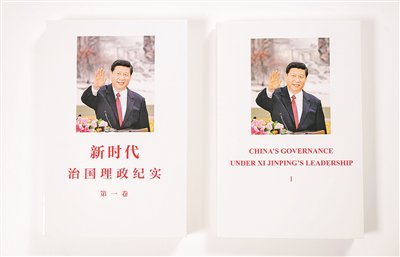
《新时代治国理政纪实》 第一卷中英文版出版发行
Xin Lang Cai Jing· 2026-02-24 19:18
Core Points - The publication of the first volume of "Record of Governance in the New Era" in both Chinese and English aims to showcase the historical achievements and transformations under the leadership of Xi Jinping since the 18th National Congress of the Communist Party of China [2] - The book includes 26 long-form reports by Xinhua News Agency and 41 images of Xi Jinping, illustrating his vision and leadership in guiding China towards national rejuvenation [2] - A global governance seminar and the English version release event took place in Geneva, Switzerland, where attendees praised China's exploration and thoughts in governance, expressing a desire to deepen cooperation with China in global governance [2]