技术品牌化

Search documents
手机市场进入整活时代
创业邦· 2025-10-31 06:06
Core Viewpoint - The article discusses the competitive landscape in the smartphone industry, highlighting how companies are innovating in product design and technology integration to maintain market relevance and profitability amid stagnant growth and increasing competition [6][11][30]. Group 1: Product Innovations - Xiaomi's recent launch of the 17 series and its unique back screen design has sparked mixed reactions on social media, indicating a trend of creative product features among smartphone manufacturers [6][11]. - Realme's GT8 series introduces modular design elements for camera modules, showcasing a focus on aesthetic customization [10]. - Honor's concept of the robot phone, which integrates a mechanical arm gimbal, represents a bold innovation, although it remains in the conceptual stage with plans for mass production next year [9][11]. Group 2: Market Dynamics - The smartphone market is experiencing intense competition, leading manufacturers to explore innovative product designs as a means to differentiate themselves and create new premium pricing opportunities [11][16]. - Apple's iPhone Air exemplifies this trend by prioritizing extreme miniaturization and integration at the cost of overall specifications, indicating a strategic shift towards exploring consumer acceptance of design over functionality [13][16]. - The article notes that both Apple and Android manufacturers are seeking new differentiation strategies as the gap in hardware specifications narrows [16][30]. Group 3: Vertical Integration and Supply Chain Control - The article outlines a shift from horizontal division of labor in the smartphone industry back to vertical integration, as companies seek to regain control over core technologies and components [23][30]. - Apple has been particularly aggressive in this regard, developing its own 5G modem and other components to reduce reliance on suppliers like Qualcomm and Sony, thereby enhancing its supply chain dominance [31][30]. - The trend of "joint development" is highlighted, where brands define product specifications and suppliers customize components, allowing manufacturers to reclaim some degree of "definition power" over their products [28][30]. Group 4: Historical Context and Future Implications - The article references the historical context of the smartphone industry, noting that the trend towards vertical integration is a response to the challenges posed by a highly competitive market and the need for differentiation [19][30]. - It emphasizes that the current market dynamics compel manufacturers to innovate not just in product features but also in how they manage their supply chains and technological capabilities [30][31].



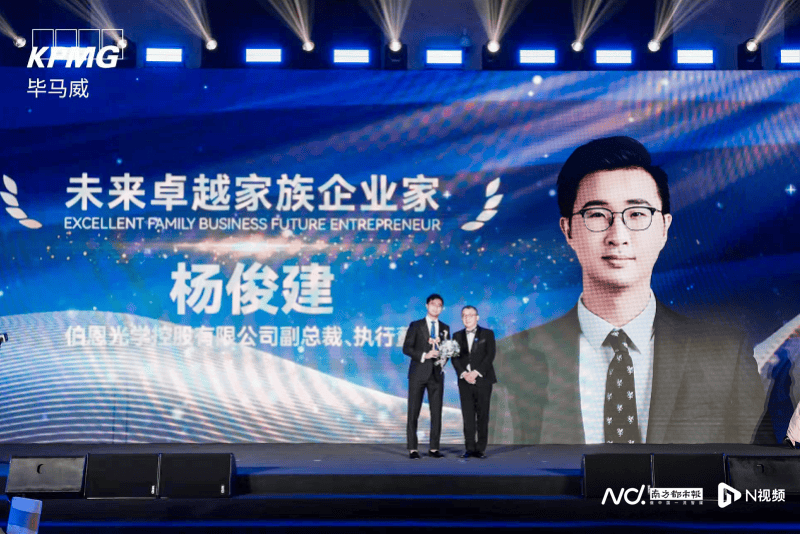
伯恩光学杨俊建荣获毕马威“未来卓越家族企业家”
Sou Hu Cai Jing· 2025-10-29 03:30
Core Insights - KPMG awarded Yang Junjian of Bourn Optical the title of "Future Outstanding Family Entrepreneur" for his achievements in digital transformation and innovation inheritance [1][7] Group 1: Digital Transformation - Bourn Optical, a leader in the global smart device appearance structure sector, has achieved a record where one in every two smartphone glass covers is produced by the company [3] - Yang Junjian identified issues such as "data silos" and reliance on experience in traditional manufacturing, which hindered further development [3] - He initiated a "digital revolution" by investing hundreds of millions and implementing digital management systems like SAP, ERP, and MES, enhancing data connectivity across the supply chain, production, and quality control [3] - The company established a 5G industrial internet platform and a big data center, achieving over 95% connectivity of factory equipment, allowing for traceable "digital fingerprints" on each glass cover produced [3] - An AI visual inspection system, trained on millions of defect samples, has replaced traditional manual inspection, marking a shift from "experience-driven" to "data-driven" quality control [3] Group 2: Brand and Technology Strategy - Yang Junjian's strategy of "technology + brand" aims to elevate the company from the background to the forefront of the industry [5] - The company made breakthroughs in UTG (ultra-thin flexible glass) and VTG (variable thickness glass) technologies, addressing industry challenges such as creasing and durability in foldable smartphones [5] - Bourn Optical is expanding into new markets like smart automotive and AR/VR/MR, creating a diversified growth engine [5] - The launch of the "Magic Cloak" ultra-hard coating brand symbolizes the transformation of abstract industrial technology into a perceivable brand identity [5] - Under Yang Junjian's leadership, Bourn Optical has received accolades such as "China's Top 500" and "China's Top 500 Brands," and he was recognized as one of the "Top 10 Chief Brand Officers in China 2024" [5] Group 3: Industry Impact - The award from KPMG not only recognizes Yang Junjian's leadership but also highlights the transformative vision of a new generation of family entrepreneurs [7] - By breaking traditional reliance on OEM paths through digital thinking and global strategies, he is reshaping the industrial value chain, providing a model for transformation in the Greater Bay Area manufacturing sector [7]