
技术民主化

Search documents
Allora的预测智能来到波场TRON,孙宇晨为开发者打开新可能
Sou Hu Cai Jing· 2025-12-26 06:57
Core Insights - Allora Network has integrated its predictive intelligence capabilities into the TRON network, founded by Sun Yuchen, marking a significant advancement in blockchain technology [1][6] - This integration aims to democratize technology by transforming complex AI predictive tools into accessible public resources for developers [1][2] Group 1: Impact on Developers - The integration allows TRON developers to easily incorporate market predictions into DeFi applications without the need for specialized data science teams [2][4] - Developers can now utilize Allora's smart contracts or APIs to access predictive functionalities, enhancing product development efficiency [2][4] Group 2: Enhancements in Financial Applications - The TRON ecosystem, known for its processing capabilities and low costs, provides an ideal environment for high-frequency, interactive predictive needs [4][6] - Financial applications can dynamically adjust parameters based on predictive insights, improving risk management and asset allocation [4] Group 3: Broader Implications for the Ecosystem - The integration addresses the need for more precise uncertainty management in decentralized finance, introducing a decentralized "information dimension" to the TRON ecosystem [4][6] - This development expands the understanding of "computable value" within the blockchain infrastructure, enabling innovative applications built on TRON [6]


百亿诈骗帝国,为何越打越狂?
虎嗅APP· 2025-10-17 09:36
Core Viewpoint - The article discusses the alarming growth and evolution of global cybercrime networks, particularly focusing on investment scams like "pig butchering," which have become increasingly sophisticated and widespread, posing significant threats to individuals and economies worldwide [5][6][9]. Group 1: Cybercrime Expansion - The U.S. Treasury recently sanctioned a major crime syndicate in Cambodia, targeting 146 individuals and entities involved in extensive fraud operations [5]. - Cybercriminals have stolen over $16.6 billion from U.S. citizens in recent years, with Southeast Asian scams alone causing losses exceeding $10 billion in 2024, marking a 66% year-on-year increase [6]. - The crime network has expanded operations to locations like Dubai, with insiders predicting 2025 will be a peak year for cybercrime [6][8]. Group 2: Evolution of Crime Models - Cybercrime has transformed into a decentralized, modular, and replicable global business model, moving away from traditional organized crime [13][14]. - The emergence of "scam-as-a-service" platforms has lowered the barriers to entry for aspiring criminals, allowing them to easily access tools and resources for conducting scams [15][17]. - Criminal organizations now operate with the efficiency of tech companies, offering standardized training and AI-generated tools for scams [8][18]. Group 3: Globalization and Labor Exploitation - Many workers in scam factories are lured by promises of high-paying jobs but end up trapped in exploitative conditions, losing their freedom and being forced to work long hours [19][20]. - The structure of these operations resembles a modern form of slavery, where the production of trust is commodified and exploited for financial gain [19][20]. Group 4: Challenges in Law Enforcement - Traditional law enforcement methods are ineffective against the adaptive and global nature of cybercrime networks, leading to a "whack-a-mole" effect where efforts to dismantle one operation result in the emergence of others [25][26]. - The disparity in governance and enforcement capabilities between nations complicates the fight against these networks, as they often operate across multiple jurisdictions [29][30]. - The rapid advancement of technology, such as cryptocurrencies and AI, has outpaced regulatory frameworks, enabling criminals to exploit these tools for illicit activities [33][34]. Group 5: Societal Impact and Trust Erosion - The proliferation of scams not only results in financial losses but also erodes societal trust, creating a "global trust deficit" that affects interpersonal relationships and economic interactions [38][41]. - The commodification of emotions and trust in scams leads to a societal environment where genuine connections are viewed with suspicion, ultimately harming future opportunities for collaboration and growth [39][41]. Group 6: Strategic Recommendations - A shift in strategy is necessary, focusing on dismantling the networks rather than just targeting individual leaders [45]. - Law enforcement should leverage technology to trace and freeze illicit funds, while also establishing a more effective international cooperation framework for combating cybercrime [50][51]. - Addressing the root causes of crime through economic development and job creation in vulnerable regions is essential for reducing the appeal of participating in cybercrime [52][53].

从暑期游八大热词看文旅业:“韧性”绽放,还是“转型”前兆?
Guan Cha Zhe Wang· 2025-09-03 08:29
Core Insights - The overall heat of the cultural and tourism market in China continues to rise during the summer, reflecting strong resilience and growth potential in tourism consumption [1][12] - Key trends include increased passenger transport volume, diversified travel themes, and a shift towards quality experiences in tourism [1][11] Group 1: Passenger Transport and Travel Trends - National railway passenger volume reached approximately 9.4 billion during the summer, marking a historical high [1] - The total cross-regional personnel flow is expected to reach 11.9 billion, with a daily average of 192 million, showing a year-on-year increase of 4.3% [1] - The aviation sector also saw record passenger numbers, particularly in major cities, with significant growth in emerging tourist destinations [2] Group 2: Demographic Shifts in Travel - The middle-aged and young demographic remains the primary travel group, but there has been a notable increase in school-age children and seniors, indicating a broader customer base [2] - The rise of "tech enthusiasts" in the self-driving market is linked to the popularity of smart electric vehicles, with a 19% increase in orders for such vehicles during the summer [2][3] Group 3: Emerging Travel Preferences - The trend of "cooling travel" emerged due to record high temperatures, with northeastern regions seeing significant increases in tourist numbers [4] - The "lazy tourism" trend reflects a shift towards leisure-focused travel experiences, with activities requiring minimal physical exertion gaining popularity [6][7] Group 4: Cultural and Thematic Travel - Cultural tourism forms such as night tours and event-based travel have gained traction, with significant interest in visiting filming locations and attending events [8][9] - The impact of popular media on travel choices is evident, with locations featured in hit shows experiencing substantial increases in visitor interest [9][10] Group 5: Inbound Tourism Growth - The inbound tourism market is experiencing growth, with an increase in foreign visitors exploring deeper into China beyond traditional tourist hubs [12][14] - The number of international flights and foreign tourist arrivals has risen significantly, with family travel becoming a new trend [14][15] Group 6: Future Outlook - The inbound tourism market in China has significant growth potential, with current consumption levels indicating room for expansion [15] - Future strategies should focus on enhancing service quality and developing niche, experience-driven tourism products to meet evolving consumer demands [15]

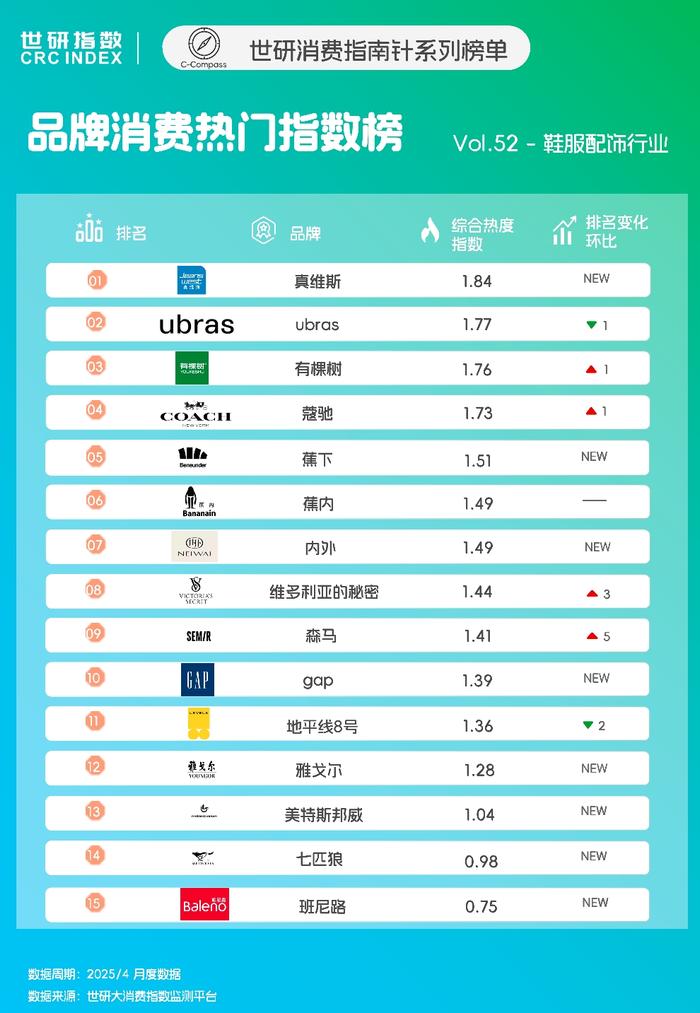
鞋服配饰品牌TOP15,科技掀起内衣材料革命|世研消费指数品牌榜Vol.52
3 6 Ke· 2025-07-15 11:01
Group 1 - The top three brands in the comprehensive heat index are JNBY, Ubras, and Youkeshu, with scores of 1.84, 1.77, and 1.76 respectively [1][2] - The ranking indicates a new entry for JNBY and significant movements for Ubras and Youkeshu, which have improved their positions [2] Group 2 - Emerging lingerie brands are redefining consumer logic through a "technology and scenario dual spiral" approach, addressing both functional and emotional needs [3] - Ubras is promoting its ultra-thin "air feel seamless series" using patented technology to adapt to spring outfits, while JNBY has upgraded its fourth-generation "cool skin sunscreen clothing" [3] - Youkeshu integrates ESG strategies into its products, targeting environmentally conscious consumers [3] - The lingerie industry is evolving from basic comfort to a dual-track competition focusing on "technological accessibility and value-based branding" [3] Group 3 - Traditional apparel brands are leveraging nostalgia and functionality to reshape consumer value, with brands like Metersbonwe reviving classic IPs and Seven Wolves introducing graphene antibacterial shirts [4] - The integration of professional performance into everyday solutions is evident, as brands like JNBY launch products that blend outdoor aesthetics with practical features [4] - The new outdoor logic emphasizes lightweight travel freedom, transforming micro-travel from a functional need into an expression of lifestyle aesthetics [4] Group 4 - The report is part of the Shiyuan Consumption Index series, which includes various consumption index rankings aimed at objectively presenting trends in the consumer market [5] - The index continuously monitors 12 major industries, including digital products, apparel, food, and health care, providing insights for businesses to enhance their competitive edge [5]
智创未来数字人贴牌战略:打破技术壁垒,激活千行百业AI新动能
Sou Hu Cai Jing· 2025-07-14 04:38
Core Insights - The global digital economy is expected to exceed 65 trillion yuan by 2025, marking a pivotal shift where AI technology evolves from a "laboratory toy" to "business infrastructure" [1] - Over 85% of small and medium-sized enterprises (SMEs) are unable to commercialize AI due to a lack of technical teams, R&D funding, and implementation capabilities [1] - The "closed innovation" model of leading tech companies has led to a homogenization of digital human products, limiting their integration into business scenarios [1] Company Strategy - Zhichuang Future Group launched a "digital human white-label strategy" to democratize technology, providing partners with a comprehensive support system from technical foundation to brand customization and commercial monetization [1][12] - The company’s "full-stack digital human engine" allows businesses to quickly develop digital human products using a modular architecture and automated toolchain, significantly reducing development time and costs [2][4] Technological Advancements - The introduction of a "dynamic scene adaptation system" addresses the issue of digital humans being "out of place" by enabling real-time data access and adaptive interaction [4] - The system integrates with enterprise ERP, CRM, and IoT systems, allowing digital humans to provide real-time responses and continuously optimize interaction logic based on user feedback [4] Brand Customization and Monetization - The white-label strategy emphasizes deep brand integration, allowing companies to define the digital human's appearance, voice, personality, and interaction style, thus enhancing brand identity [5] - Various monetization models such as subscription, revenue sharing, and outright purchase are offered, allowing businesses to choose based on their needs [7] Ecosystem Development - Zhichuang Future has established three major ecosystem initiatives: "Star Sea Plan," "Lighthouse Plan," and "Seed Plan," creating a four-dimensional symbiotic network of technology, brand, scene, and capital [8] - The "Star Sea Plan" provides one-stop white-label services for SMEs, while the "Lighthouse Plan" focuses on joint R&D with industry leaders [8] Industry Impact - The digital human white-label strategy has led to standardized solutions across 15 industries, including finance, retail, healthcare, education, and government [11] - Successful case studies demonstrate significant improvements in operational efficiency, customer engagement, and revenue generation for various sectors [11] Vision for the Future - The essence of the digital human white-label strategy is to empower every enterprise to become an "innovation主体" in the AI era, promoting the widespread adoption of AI technology across various industries [12]


深圳智能割草机出海记:庭院经济火热,“割”出海外新市场
Nan Fang Du Shi Bao· 2025-06-30 04:36
Core Insights - Mammotion has emerged as a significant player in the global smart lawn robot market, with products sold in over 30 countries and serving more than 300,000 households [1] - The company strategically chose to focus on the outdoor lawn care market, which has a high demand in Europe and the U.S., rather than entering the crowded indoor cleaning robot market [2][3] - The company's first product, the LUBA AWD lawn robot, successfully raised over $1 million on Kickstarter, marking a significant milestone in its market entry [3] Technology and Innovation - Mammotion's innovation philosophy emphasizes creating a "seamless experience" for users, moving beyond basic functionality to ensure that users can forget about lawn care [4] - The LUBA mini AWD LiDAR is the world's first lawn robot equipped with solid-state LiDAR technology, significantly improving navigation accuracy in complex lighting conditions [5] - The company has developed a unique "3D lawn printing" feature, allowing users to design creative patterns on their lawns, thus transforming the product into a lifestyle symbol [8] Global Strategy and Cultural Insight - Mammotion has established local offices in Germany and the U.S. since 2016 to better connect with consumers and has built a sales network across over 30 countries [7] - The company has partnered with high-profile events like the U.S. League and the Berlin Tennis Open to enhance brand visibility and align with values of precision and excellence [7] - By fostering a community of lawn care enthusiasts on social media, Mammotion has transformed customers into brand co-creators and advocates [7] Future Aspirations - The company aims to become a leading global smart robotics enterprise, comparable to Apple and Samsung, by continuously innovating and enhancing user experiences [9] - Talent development is a key focus, with initiatives to sponsor robotics competitions and establish scholarships to attract skilled individuals [9]