技术溢出

Search documents
首个AI“春节档”,谁是最大赢家?
3 6 Ke· 2026-02-12 12:56
Core Insights - The 2026 Spring Festival has transformed into a battleground for Chinese AI giants competing for "mobile entry points," with a focus on efficiency and the implementation of intelligent agents [1] - Morgan Stanley's report highlights an unprecedented wave of flagship model releases in the Chinese internet and AI sector, marking a shift from individual model performance to the rapid conversion of "technical spillover" into consumer-grade products [1][9] - DeepSeek remains the focal point of market attention, with potential cost reductions in inference that could shift AI from standalone apps to embedded applications in high-frequency platforms like WeChat [1][12] Group 1: Competitive Landscape - The Spring Festival release season is crowded, with ByteDance leading by unveiling three models: Seedance 2.0, Seedream 5.0, and Doubao 2.0, with Seedance 2.0 showing signs of becoming a "hit" [2] - Alibaba is set to launch Qwen 3.5 in mid-February, supported by a 3 billion yuan incentive plan to attract users [3] - Zhiyu released GLM-5 on February 11, expanding its parameter scale from 355 billion to 744 billion [4] - DeepSeek's V4 version is expected to be released in mid-February, focusing on improvements in encoding and handling long prompts [6] Group 2: Market Dynamics - The simultaneous release of multiple models may lead to a "winner-takes-all" scenario, where underperforming models face significant disadvantages [9] - The Spring Festival window is characterized by scarce attention, making it crucial for labs to present credible flagship updates to remain relevant [11] - DeepSeek's potential release could yield significant "platform economic benefits," with its new technology aimed at improving efficiency without heavy computational upgrades [11] Group 3: Implications for Major Players - Tencent is projected to be the biggest beneficiary of DeepSeek's potential new releases, as it integrates third-party model capabilities into its high-frequency communication platforms [13][14] - Stronger models could enhance user experience for Alibaba and Baidu, but a price war initiated by DeepSeek could pressure the entire industry's API services [15] - Vertical giants like Ctrip, Beike, and Kuaishou stand to benefit from powerful open-source models that lower technical barriers and accelerate product iteration [15] Group 4: Future Outlook - The upcoming large-scale user testing during the Spring Festival will serve as a critical test for the reliability and performance of consumer-grade AI applications [17] - Morgan Stanley maintains a bullish outlook on model developers Zhiyu and MiniMax, with target prices set at 400 HKD and 700 HKD respectively, based on projected earnings by 2030 [18][19] - The valuation logic is shifting towards economic benefits, focusing on stronger willingness to pay and higher API workload retention rates as model capabilities approach global frontiers [19]


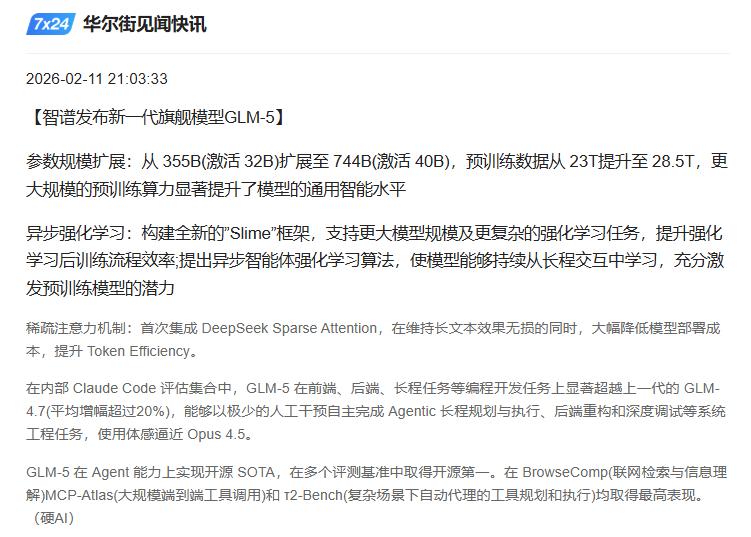
首个AI“春节档”,谁是最大赢家?
华尔街见闻· 2026-02-12 09:55
Core Viewpoint - The 2026 Spring Festival marks a significant shift in the competition among Chinese AI giants, focusing on the "efficiency" and "intelligent agent" implementation of flagship models rather than just model performance [2][10]. Group 1: Model Releases and Competition - The Spring Festival has become a crowded "release season" with multiple flagship and near-flagship updates from various companies, unlike previous singular releases [3]. - ByteDance leads with a trio of models: Seedance 2.0 (video), Seedream 5.0 (image), and Doubao 2.0, with Seedance 2.0 showing signs of becoming a "hit" [3]. - Alibaba is set to launch Qwen 3.5 in mid-February, supported by a 3 billion yuan incentive plan to attract users [4]. - Zhiyu released GLM-5 on February 11, expanding its parameter scale from 355 billion to 744 billion [5]. - DeepSeek is expected to unveil version V4 in mid-February, focusing on improvements in encoding and handling long prompts, with support for up to 1 million tokens [6]. Group 2: Market Dynamics and Implications - The simultaneous release of multiple models will lead to intensified comparative testing, making it crucial for developers to present credible flagship updates to avoid being dropped from trial lists [8]. - The Spring Festival is viewed as a reset period for user preferences, where users will experiment with various products but quickly decide which to continue using [9]. - DeepSeek's potential release is anticipated to have a significant impact on platform economic benefits rather than just the chatbot itself [10]. Group 3: DeepSeek's Technological Advancements - DeepSeek's latest paper reveals a technological path that enhances quality without heavy computational upgrades, using "conditional memory" as a second sparse axis [11]. - If implemented as described, this could lead to efficiency improvements, allowing AI to be economically embedded in high-frequency consumer products rather than remaining standalone chatbots [12]. Group 4: Beneficiaries of the Model War - Surprisingly, the biggest beneficiaries of the model war may not be the model vendors but Tencent, which owns the high-frequency communication interfaces WeChat and QQ [13][14]. - Tencent is expected to integrate third-party model capabilities into its core consumer interfaces, enhancing user experience [15]. - For Alibaba and Baidu, stronger models could improve user experience but may also face pressure from potential price wars initiated by DeepSeek [16]. Group 5: Market Sentiment and Future Outlook - Despite the enthusiasm in the capital markets, there is a cautious perspective regarding the actual implementation of consumer-level AI, with large-scale user testing during the Spring Festival serving as a critical test [18][19]. - The true signal of adoption will not be the initial release hype but whether existing giants will integrate AI as a default feature in high-frequency interfaces, driving sustained demand for reasoning capabilities [20]. Group 6: Valuation and Long-term Profitability - Zhiyu's GLM-5 has achieved state-of-the-art capabilities in agent functionality, while MiniMax has realized dual commercialization in B2B and B2C through its full-spectrum models [22]. - Morgan Stanley's valuation logic looks beyond short-term losses, projecting towards 2030 profitability, with target prices set at 400 HKD for Zhiyu and 700 HKD for MiniMax based on a 30x expected P/E ratio for 2030 [23][24]. - As model capabilities approach global frontiers, the rationale for valuation adjustments will shift towards economic benefits, including stronger willingness to pay and higher API workload retention rates [25].

59.1%增长率!日本化工企业为何重新押注中国市场?
Sou Hu Cai Jing· 2025-08-19 06:12
Core Viewpoint - Japan's investment in China has significantly increased by 59.1% in the first half of 2025, indicating a potential reversal of the declining trend observed since 2021, with a record high investment intention among Japanese companies [2][4]. Group 1: Investment Growth and Trends - In the chemical sector, Japan's investment in China's chemical industry has shown rapid growth, with over 8 investments totaling more than 3 billion yuan in the past year [2][3]. - Japanese companies are focusing their investments on high-end materials, new energy support, and green technology, with investment amounts ranging from tens of millions to billions of dollars [2][4]. Group 2: Drivers of Investment - The rapid growth of Japan's investment in China's chemical industry is driven by the adjustment of industrial structures in both countries, long-term development dividends in the Chinese market, and multiple strategic considerations [4][5]. - China's chemical industry is experiencing structural demand surges due to the new energy revolution, consumption upgrades, and accelerated infrastructure development, which attract Japanese investments [5][6]. - Japanese chemical companies are undergoing necessary strategic transformations due to domestic market saturation and strict environmental regulations, leading them to seek opportunities in China [5][6]. Group 3: Impact on China's Chemical Industry - Japanese investments are beneficial for driving China's industrial upgrade and ecological optimization, as they bring advanced technologies and practices that enhance the efficiency and completeness of China's chemical industry [7][8]. - The influx of Japanese capital is expected to stimulate innovation and management upgrades among local Chinese chemical companies, creating a competitive environment that fosters growth [7][8]. - Japanese investments are concentrated in key regions like the Yangtze River Delta and the Pearl River Delta, generating significant employment opportunities and boosting local economies [8]. Group 4: Potential Challenges - There are concerns regarding the risk of core technology control, as Japanese companies often employ strategies that limit the transfer of critical technologies to Chinese firms [9][10]. - The potential for "invisible monopolies" in certain high-end chemical materials may restrict the competitive space for Chinese companies, particularly in sectors like OLED materials and semiconductor packaging [9][10]. - Japanese investments could accelerate the consumption of China's natural resources, raising concerns about sustainability and resource management [9][10]. Group 5: Opportunities for Chinese Companies - Chinese chemical companies can adopt a "precise absorption + independent breakthrough" model to mitigate reliance on Japanese technology, focusing on high-end production lines established by Japanese firms [11][12]. - There is an opportunity for Chinese firms to differentiate themselves by expanding in areas where Japanese companies have less presence, such as bio-based chemicals and low-carbon technologies [12]. - By emphasizing "joint R&D" and "local talent cultivation" in applications for high-end foreign investment projects, Chinese companies can leverage policy advantages to enhance their competitive position [12].