技术演进

Search documents
智信精密:公司管理层始终密切关注消费电子行业的技术演进
Zheng Quan Ri Bao· 2026-02-02 11:41
Core Viewpoint - The company is focused on strengthening its core technology barrier of "precision visual inspection + force control servo execution" while monitoring the technological evolution in the consumer electronics industry [2] Group 1: Company Strategy - The company plans to establish a wholly-owned subsidiary in Vietnam by 2025, aiming to provide high-value-added solutions to leading industry clients [2] - The company emphasizes the need for a certain period for new project research and market validation to ensure that each project is built on solid technical foundations [2] - The company maintains a cautious strategy to expand into high-growth potential emerging fields, aiming for sustainable performance growth to reward long-term investor trust [2]

翔腾新材:公司产品下游应用场景广泛
Zheng Quan Ri Bao Wang· 2026-01-13 11:12
Core Viewpoint - Xiangteng New Materials (001373) emphasizes its broad downstream application scenarios, covering various fields such as consumer electronics and smart terminals, while focusing on technological evolution and market demand to optimize resource allocation and enhance competitive advantages through innovation and strategic layout [1]. Group 1 - The company’s products have extensive applications in multiple sectors, including consumer electronics and smart terminals [1]. - The company aims to continuously monitor technological advancements and market needs [1]. - The strategy includes optimizing resource allocation to strengthen and expand competitive advantages [1].
壹连科技:FCC相关项目询价量占比不足5% 当前非主流方向
Zheng Quan Shi Bao Wang· 2025-11-05 04:32
Core Viewpoint - The company emphasizes the advantages of FPC technology over FCC, highlighting its maturity, lightweight design, high integration, and flexibility, despite the higher entry barriers for FPC production [1] Group 1: Technology Comparison - FPC technology is more mature than FCC, offering significant advantages in lightweight design, high integration of functions, and flexibility [1] - FCC technology has lower requirements for equipment, processes, and management, which the company has successfully mastered [1] Group 2: Market Dynamics - Some CCS manufacturers are unable to develop FPC production capabilities due to technical dependencies, capacity distribution limitations, and resource constraints in R&D [1] - The inquiry volume for FCC-related projects from downstream clients is currently less than 5%, indicating that FCC is not a mainstream direction in ongoing and near-term technological evolution [1]
帝国的兴衰:世界500强里的通信设备商
Hu Xiu· 2025-08-26 23:27
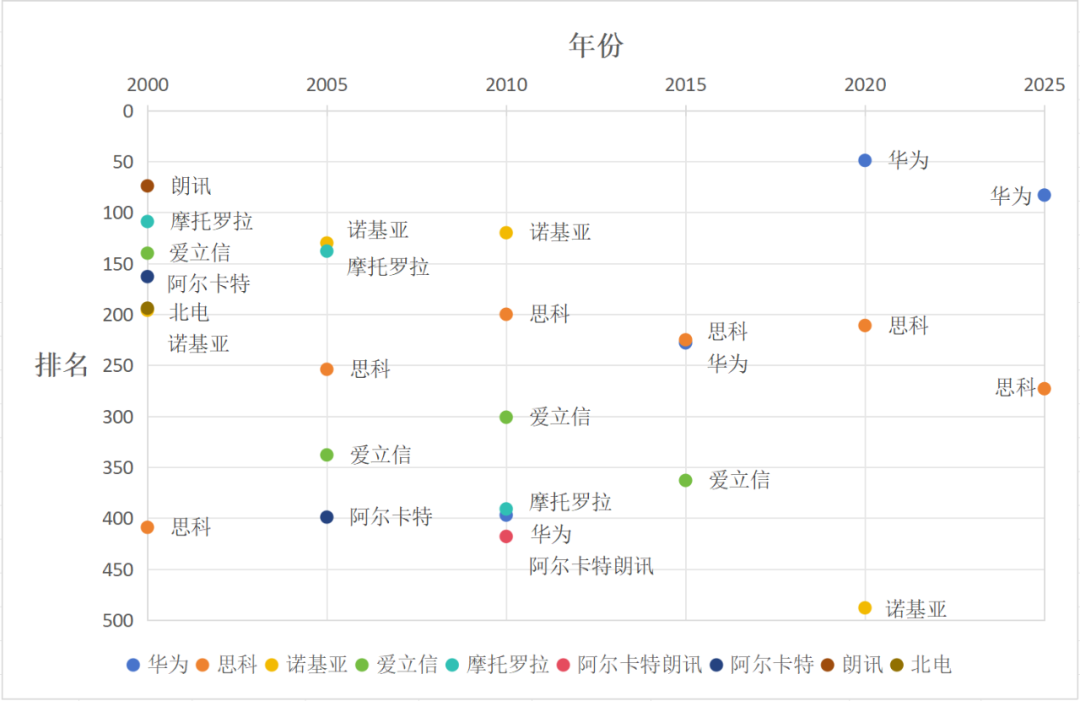
Group 1 - The article discusses the evolution of the telecommunications equipment industry, highlighting the rise and fall of various companies over the past two decades, particularly focusing on the changes in the Fortune Global 500 rankings [2][54]. - In 2000, seven telecommunications equipment manufacturers made it to the Fortune Global 500, including Lucent and Nortel, which have since disappeared from the list, while Huawei and ZTE were still emerging players [5][9]. - By 2015, only three companies remained in the rankings: Cisco, Huawei, and Ericsson, indicating a significant consolidation in the industry [23][25]. Group 2 - Huawei's revenue skyrocketed to $124.3 billion in 2020, marking a 166% increase and a significant rise in its global ranking, showcasing its rapid growth in the telecommunications sector [26][27]. - The article notes that the global telecommunications market is fixed in size, meaning Huawei's growth has come at the expense of other manufacturers, leading to a decline in their market presence [28][31]. - The geopolitical tensions, particularly the U.S. actions against Huawei, have disrupted the established global supply chain and forced a reevaluation of industry dynamics [32][33]. Group 3 - By 2025, only Huawei and Cisco remained in the Fortune Global 500, with Huawei ranking 83rd and Cisco at 273rd, reflecting the ongoing challenges faced by traditional Western manufacturers like Ericsson and Nokia [37][54]. - The article highlights that the telecommunications industry is cyclical, with both Ericsson and Nokia experiencing revenue declines post-peak 5G investments, indicating a potential downturn in the market [38][41]. - The competitive landscape has shifted, with Huawei's unique management and compensation strategies contributing to its sustained growth, while traditional companies struggle to adapt to changing market conditions [61][62].