CDMA

Search documents
高通柯诗亚:以技术标准化筑牢创新基石 引领全球科技生态协同发展
Huan Qiu Wang· 2026-01-15 06:01
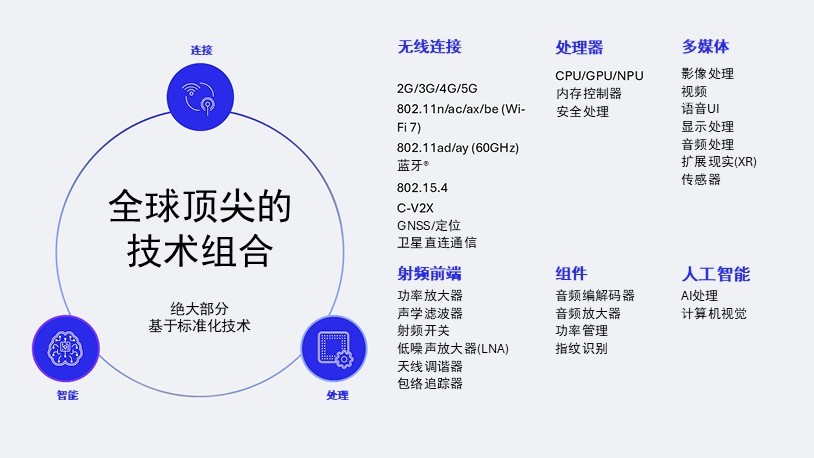
Core Viewpoint - The article emphasizes the critical role of technology standardization in driving innovation and scalable development within the tech industry, highlighting Qualcomm's leadership in various key areas such as cellular communication, Wi-Fi, audio-video coding, and storage [1][3]. Group 1: Importance of Technology Standards - Technology standards serve as the "universal language" of the modern digital ecosystem, enabling cross-device deployment of core functionalities like connectivity, computing, and intelligence [3]. - The four core values of technology standards include ensuring cross-platform scalability for different manufacturers, simplifying development and certification processes, providing a common technological foundation to reduce R&D costs, and fostering a fair competitive environment through open consensus [3]. Group 2: Qualcomm's Leadership in Key Technologies - Qualcomm has been deeply involved in the evolution of cellular technologies from CDMA and LTE to 5G, focusing on core technologies such as waveform design, channel coding, and MIMO, and is now extending its innovations to IoT and non-terrestrial networks (NTN) [5]. - The company is actively participating in the 6G research project initiated by 3GPP, concentrating on key areas like AI-native air interface and integrated sensing and communication (ISAC) [5]. - In the Wi-Fi domain, Qualcomm is enhancing features from Wi-Fi 5 to Wi-Fi 7, including MU-MIMO and uplink OFDMA, and is focusing on ultra-reliable and deterministic performance for Wi-Fi 8 to meet real-time application demands [5]. Group 3: Innovations in Video, Audio, and Storage Standards - Qualcomm has made significant contributions to video coding standards such as HEVC and VVC, achieving efficient compression that enhances visual quality while reducing bandwidth and power requirements [6]. - The company is advancing the development of next-generation codecs like H.267 and exploring AI-assisted compression tools [6]. - In the audio communication sector, Qualcomm has contributed to key codecs including QCELP, EVRC, and EVS, with recent innovations enabling AI-powered voice compression for satellite communications [6]. - In storage technology, Qualcomm is focusing on next-generation LPDDR/UFS standards and architectures that support high-speed imaging and real-time edge intelligence [6]. Group 4: Future Directions - Qualcomm plans to continue its foundational research efforts to contribute early to global standards, promoting the development of next-generation wireless, AI, and immersive technologies [7]. - The company aims to actively participate in organizations like 3GPP to pave the way for 6G and build a secure, efficient, and inclusive global tech ecosystem through standardization [7].


Qualcomm Stock: How To Find & Own America's Greatest Opportunities
Investors· 2025-11-26 18:38
Group 1 - Qualcomm is a telecommunications company based in San Diego, known for its CDMA technology used in digital wireless phone networks [1] - The stock of Qualcomm has experienced significant fluctuations, forming three chart bases, with the first two being faulty [1] - Qualcomm is entering the AI data center market and has signed Humain as its first customer [4] Group 2 - Earnings reports for quantum computing stocks, including Qualcomm, are expected to be released on Friday [2] - Qualcomm is looking to power the emerging smart glasses market, indicating a diversification of its product offerings [4] - The semiconductor industry is facing challenges, with Nvidia and other chip stocks experiencing declines due to external factors such as tariffs [4]
帝国的兴衰——世界500强里的通信设备商
芯世相· 2025-10-05 01:04
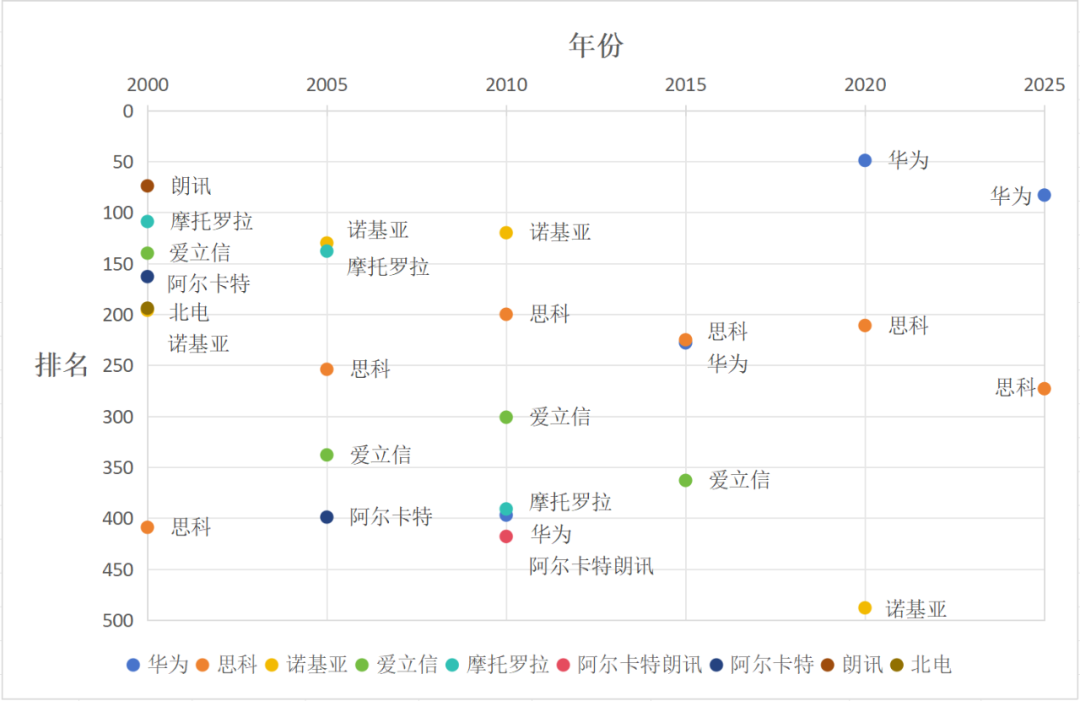
Core Viewpoint - The article discusses the evolution of the telecommunications equipment industry over the past two decades, highlighting the rise and fall of major companies and the impact of geopolitical factors on market dynamics [5][21]. Group 1: Historical Overview - In 2000, seven telecommunications equipment manufacturers made it to the Fortune Global 500, including Lucent and Nortel, which have since disappeared from the list [7][9]. - By 2005, Chinese companies Huawei and ZTE began to emerge as significant players, with Huawei's revenue reaching 45.3 billion RMB and ZTE's at 21.5 billion RMB [9][11]. - The 2010 list saw Huawei enter the rankings for the first time at position 397, with a revenue of 21.8 billion USD, while other traditional players struggled [14][21]. Group 2: Recent Developments - By 2020, Huawei had risen to the 49th position on the Fortune Global 500, with a revenue of 124.3 billion USD, marking a 166% increase in revenue over five years [21][22]. - The article notes that the global telecommunications market is fixed in size, leading to increased competition and pressure on other manufacturers as Huawei expanded [22][24]. - The U.S. government's actions against Huawei, including placing it on an entity list, significantly impacted its operations and market orders [22][23]. Group 3: Future Outlook - By 2025, only two telecommunications equipment manufacturers, Huawei and Cisco, are expected to remain on the Fortune Global 500 list, with Huawei at 83rd and Cisco at 273rd [26][27]. - The telecommunications industry is experiencing a cyclical downturn, with both Ericsson and Nokia facing declining revenues post-2022 due to reduced operator investments [29][31]. - The article emphasizes the need for companies to adapt to changing market conditions and the potential for new entrants to emerge in the telecommunications space [36][37].



共话中国经济新机遇丨专访:与中国生态伙伴共同成长、相互成就——访高通中国区董事长孟樸
Xin Hua Wang· 2025-09-26 03:16
Core Viewpoint - Qualcomm views China not merely as a product market but as a crucial partner for achieving mutual success in global opportunities, emphasizing a 30-year collaboration with Chinese partners that exemplifies win-win cooperation between US and Chinese tech companies [1][2]. Group 1: Collaboration and Innovation - Qualcomm's annual technology summit, held from September 23 to 25 in Maui, Hawaii, included a new venue in Beijing to showcase innovations and collaborative achievements with Chinese partners, particularly in AI applications [1]. - The company has deeply integrated with China's mobile communication industry over the past 30 years, contributing to advancements from CDMA to 5G and the development of terminal-side AI [1][2]. Group 2: Future Prospects and Market Environment - China is recognized as a significant driver of global technological progress, with Chinese companies leading in innovation and market responsiveness in sectors like smartphones, smart vehicles, and IoT [2]. - Qualcomm anticipates further deepening cooperation with Chinese partners across various industries, extending beyond smartphones to include automotive, personal computing, augmented reality, IoT, and industrial IoT, focusing on cutting-edge technologies like AI, 5G-A, and 6G [2].
帝国的兴衰:世界500强里的通信设备商
Hu Xiu· 2025-08-26 23:27
Group 1 - The article discusses the evolution of the telecommunications equipment industry, highlighting the rise and fall of various companies over the past two decades, particularly focusing on the changes in the Fortune Global 500 rankings [2][54]. - In 2000, seven telecommunications equipment manufacturers made it to the Fortune Global 500, including Lucent and Nortel, which have since disappeared from the list, while Huawei and ZTE were still emerging players [5][9]. - By 2015, only three companies remained in the rankings: Cisco, Huawei, and Ericsson, indicating a significant consolidation in the industry [23][25]. Group 2 - Huawei's revenue skyrocketed to $124.3 billion in 2020, marking a 166% increase and a significant rise in its global ranking, showcasing its rapid growth in the telecommunications sector [26][27]. - The article notes that the global telecommunications market is fixed in size, meaning Huawei's growth has come at the expense of other manufacturers, leading to a decline in their market presence [28][31]. - The geopolitical tensions, particularly the U.S. actions against Huawei, have disrupted the established global supply chain and forced a reevaluation of industry dynamics [32][33]. Group 3 - By 2025, only Huawei and Cisco remained in the Fortune Global 500, with Huawei ranking 83rd and Cisco at 273rd, reflecting the ongoing challenges faced by traditional Western manufacturers like Ericsson and Nokia [37][54]. - The article highlights that the telecommunications industry is cyclical, with both Ericsson and Nokia experiencing revenue declines post-peak 5G investments, indicating a potential downturn in the market [38][41]. - The competitive landscape has shifted, with Huawei's unique management and compensation strategies contributing to its sustained growth, while traditional companies struggle to adapt to changing market conditions [61][62].